Contents 10
- The day on one page
- The Duomo: the roof matters more than the interior
- The Galleria and La Scala: twenty minutes and a door into the theatre
- Sforza Castle: free courtyards and paid walls
- Sempione Park: the hour with nothing to see
- The Navigli in the evening, and how they link to the cathedral
- The metro and how to pay
- What the day costs a family of four
- In winter: sunset on the cathedral roof
- If your child is tired: what to drop
First, what this route leaves out. Leonardo’s Last Supper does not fit into a day like this without preparation: entry is by booking only, in groups for 15 minutes, and sales for each new season open once every three months. If it matters to you, buy the ticket well ahead and build the day around it.
The day on one page
Timings are for an ordinary day from Tuesday to Sunday. The route works on a Monday too, but the castle museums are closed, leaving just the courtyards.
| Time | Where | What |
|---|---|---|
| 9:00–10:30 | The Duomo | rooftop, then the cathedral inside |
| 10:45–12:00 | The Galleria, Piazza della Scala | the bull in the Galleria floor, the theatre museum |
| 12:00–13:15 | Between La Scala and the castle | lunch |
| 13:30–15:30 | Castello Sforzesco | courtyards, museums or the castle walls |
| 15:30–16:45 | Sempione Park | playground, the Arch of Peace |
| 17:00 until dinner | The Navigli and the Darsena | canals, lights, dinner |
Why this order. The cathedral roof opens at 9:00, and the first hour is the calmest: guided groups turn up later. The castle comes after lunch because its courtyards stay open until evening and the museums until 17:30. The park is for the hour when your child no longer wants to “see” anything. And the Navigli come alive just as dusk falls.
The Duomo: the roof matters more than the interior
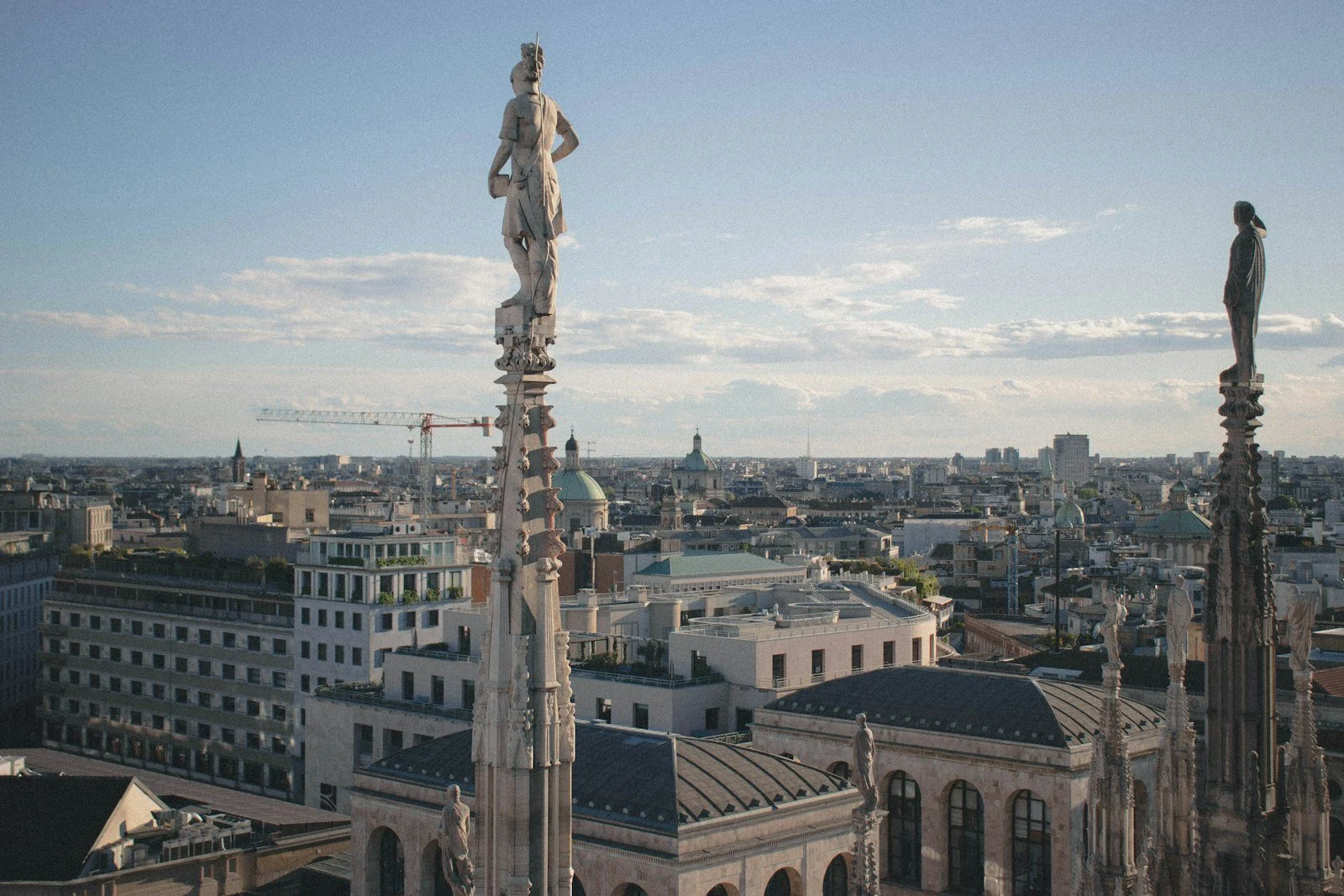
If you only have time for one paid sight, make it the rooftop of Milan Cathedral. Your child walks right among the marble spires and statues, sees gargoyles up close, and overhead is the golden Madonnina on the tallest spire. For a long time Milan kept an unwritten rule that no building should stand taller than her. When the Pirelli skyscraper went up, a copy of the statue was placed on its roof so that the Madonnina would still be the highest of all.
What to know before you buy, according to the cathedral’s official website:
- Prices. Rooftop by stairs, EUR 16; by lift, EUR 18. With the cathedral interior, EUR 22 by stairs and EUR 26 by lift. Children aged 6–18 pay exactly half: EUR 8, 9, 11 and 13.
- Up to age 5 entry is free, but the free ticket has to be collected from the ticket office; it is not issued online.
- The stairs are 251 steps. The lift only goes to the first level, at 30 metres. The second level, at about 45 metres, and the way down are by stairs only.
- No pushchairs on the roof, and no toilets up there. Use the toilets below before you go up, and bring a baby carrier for a toddler.
- Hours: rooftop and cathedral open daily 9:00–19:00, last entry 18:00. Access may be closed or changed during special services and in bad weather.
Stairs or lift is a question of tiredness, not age. An eight-year-old manages the stairs easily, and everyone walks down anyway. The lift, for EUR 2 more, makes sense with a toddler in your arms or with a full day of walking still ahead.
Buy the ticket online on the cathedral’s official website, for the first slot of the morning. When we checked prices on 12 October 2026, the ticket site first put us in a virtual queue and let us through to the tickets about a minute later. That is normal; just do not leave it until you are standing at the entrance.
The cathedral interior takes another half hour after the roof. There is a bag check at the entrance, and shoulders and knees must be covered; if you forget, a cover-up is sold at the ticket office. With a child, the stained glass is the thing — ask them to find a story they know — along with the sundial line on the floor by the entrance, once used to check the time at noon.
The Galleria and La Scala: twenty minutes and a door into the theatre
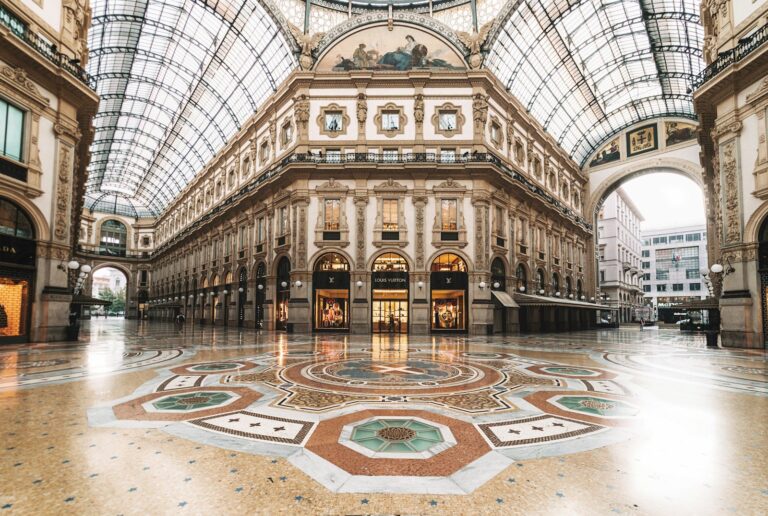
From the cathedral, cross the square and go straight into the Galleria Vittorio Emanuele II, a covered street with a glass roof that runs from the Duomo to the opera house. It is free, an ordinary city passage. Under the central dome, look at the floor: there is a mosaic bull, and by tradition people spin on their heel on it for luck. Children do it first thing, so expect a short queue of others with the same idea.
The Galleria brings you out on Piazza della Scala. The theatre looks modest from outside, and the way in is the theatre museum, entered to the left of the main façade. It is open daily from 9:30 to 17:30, last entry 17:00. For a child, the highlight is looking into the auditorium from a third-tier box: red velvet, the chandelier, the stage. But only when there is no rehearsal, performance or event in the hall; that depends on the day, and you cannot know in advance.
- Adults EUR 12, ages 6–18 EUR 8, young children free.
- The Family Junior ticket is EUR 25 for two adults and one or two children aged 6–14. For a family of four that is EUR 25 instead of EUR 40.
- Online purchases carry a booking fee; free tickets are collected at the ticket office.
- Closed on 7, 25 and 26 December, 1 January, Easter, 1 May and 15 August; open until 15:00 on 24 and 31 December.
Forty minutes is enough for the museum. If your child has no interest in the theatre, just cross the square and carry on: you will need the time at the castle.
Lunch is easier on the way to the castle, on Via Dante or the side streets nearby, than in the Galleria itself, where the cafés are expensive. How the bill works in an Italian café and what a coperto is, we cover in our piece on tipping in Italy.
Sforza Castle: free courtyards and paid walls
From Piazza della Scala the castle is about a kilometre, 15–20 minutes on foot: through Piazza Cordusio and along pedestrianised Via Dante, at the end of which the Filarete Tower rises straight ahead. If your child is flagging, it is two stops on metro M1 from Duomo to Cairoli Castello.
The beauty of Castello Sforzesco is that you do not have to pay for it to be interesting. It is a real fortress with a moat, drawbridges, towers and three big courtyards. The courtyards are open free of charge every day from 7:00 to 19:30, and children have plenty of room to run about between the walls.
If you want to go inside, there are two options, sold separately.
- The castle museums — one ticket covers them all, EUR 10. Children and teenagers up to and including 17 go free, though they still need a free ticket from the ticket office or online. On the first Sunday of the month entry is free for everyone. Open Tuesday to Sunday, 10:00–17:30, ticket office closes at 16:30; closed on Mondays and on 25 December, 1 January and 1 May. With a child, head for the Ancient Egypt Gallery: it is included in the ticket, and mummies work on children better than any painting. The Sala delle Asse, painted by Leonardo, is currently closed for restoration.
- The castle walls, the Merlate Panoramiche — a self-guided walk along a stretch of the battlements with views over the city. The adult ticket is EUR 10, and there are reduced and free rates — check which applies to your child when you buy. Entry is Tuesday to Sunday from 10:00 to 17:00 (last entry), every 20 minutes, in groups of up to 25.
One detail sets the castle walls apart from the cathedral roof: you can take a pushchair — there is a lift up, and no age limit. Two rules from the official conditions: children may not ride on your shoulders, and the parapets are high in places, so a small child will not see the view everywhere. At weekends there are also game-style routes for children up there, but the schedule changes from month to month and is posted on the castle website.
For parents keen to see a real Michelangelo: the castle holds his last sculpture, the Rondanini Pietà. It is included in the museum ticket.
Milan for Children: a sightseeing tour
This part of the day can be done with a guide as a game. The route runs from Milan Cathedral through the Galleria Vittorio Emanuele II to Sforza Castle and into quiet old courtyards. Children hunt for secret signs on the walls, hear legends of knights and Leonardo da Vinci, and find out how builders lifted statues onto the cathedral roof without cranes. Parents get the city’s story without a lecture, and the tour is in English.
EUR 260 per group of up to 5 · 3 hours · ages 6+ · entry tickets not included
Sempione Park: the hour with nothing to see
The park begins right behind the castle: leave through the last courtyard and over the bridge. It is a big city park with a pond, lawns and a playground. Straight across it you can see the Arch of Peace, a triumphal arch begun in honour of Napoleon, about a kilometre away. Walking there and back is exactly the hour when your child runs around and the adults sit on a bench.
The park is also home to the Torre Branca, a tower over a hundred metres tall with a viewing platform. It runs on a seasonal timetable with short opening windows and closes in strong wind, so we leave it out of the route: if it happens to be open when you are nearby, it is a bonus. You have already seen the city from above on the cathedral roof.
From the park to the metro: Cadorna station is at the western edge of the castle, on lines M1 and M2.
The Navigli in the evening, and how they link to the cathedral
From Cadorna it is three stops on line M2 to Porta Genova. From there it is five minutes on foot to the Naviglio Grande, the main canal with little bridges, shops and restaurants along the water, and five more to the Darsena, the city’s old port, where the canals meet.
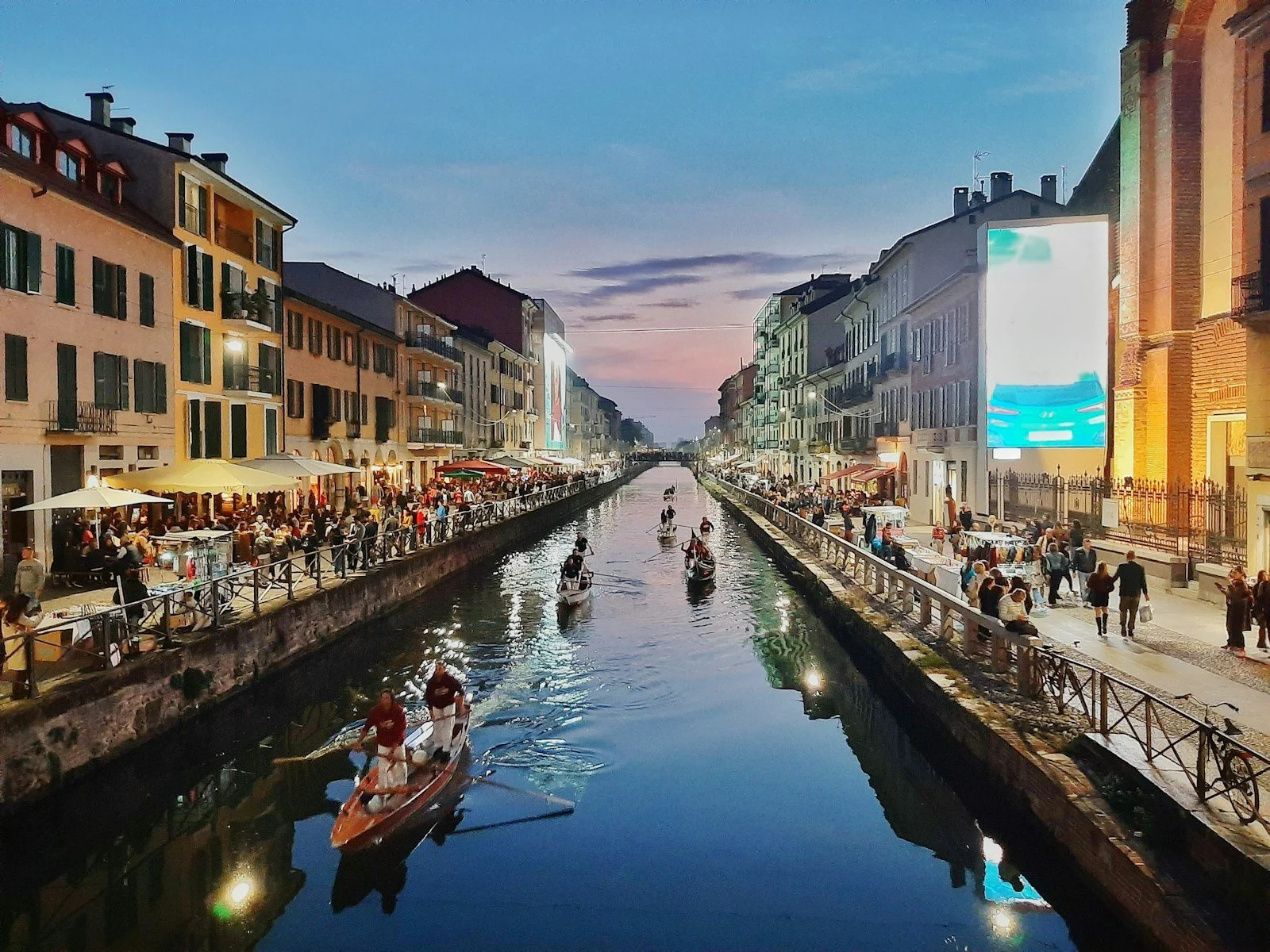
Here is the story that makes the Navigli worth putting at the end of the day. The marble your child walked on that morning was quarried at Candoglia by Lake Maggiore and brought to Milan by barge along the canals — first the Naviglio Grande, then the inner canals to a small harbour next to the building site. Around 550,000 blocks of marble passed through it. The cathedral’s boats were marked AUF — ad usum fabricae, “for the use of the works” — and paid no tolls. That marking is said to be the origin of the Italian phrase “a ufo”, meaning “for free”. The harbour was filled in in 1857, but the canals that carried the marble are still here, and you are standing on their banks.
Practical details:
- Restaurants along the canals start serving dinner around 19:00–19:30; before that it is aperitivo with snacks. For a child, a pizza or a snack by the Darsena is simpler.
- On the last Sunday of the month a large antiques market lines the Naviglio Grande, and it gets cramped with a pushchair. In December 2026 it was moved to 20 December.
- If the evening is cold or your child is worn out, the Navigli are the first thing to drop: the canals are not worth dragging a child across the city on their last legs.
The metro and how to pay
On a day like this a family will probably take the metro twice: to the Navigli and back to the hotel, sometimes also from the cathedral to the castle.
- A single ATM ticket is EUR 2.20, valid for 90 minutes from first validation on the metro, trams and buses.
- A day ticket is EUR 7.60 for 24 hours; a 3-day ticket is EUR 15.50.
- Contactless at the turnstile. Tap a contactless bank card or phone, and the system works out the cheapest fare; after four journeys in a day you are charged no more than the daily rate. Each adult needs their own card. Paper tickets are sold from machines at every station.
- Children under 14 travel free with an ID showing their age. On lines M1, M2 and M3 a child goes through the gate next to the station attendant’s booth; M4 and M5 have no booths, so you call staff on the intercom.
If you come to Milan by train for the day, Milano Centrale is linked to the centre by line M3, straight to Duomo without changing. How to book trains in advance for less is in trains in Italy: how to buy a ticket.
What the day costs a family of four
Two adults and children aged eight and eleven, on an ordinary Tuesday:
| What | Adults | Children | Total |
|---|---|---|---|
| Duomo + rooftop by stairs | 2 × EUR 22 | 2 × EUR 11 | EUR 66 |
| or rooftop only, by stairs | 2 × EUR 16 | 2 × EUR 8 | EUR 48 |
| La Scala museum, Family Junior | family ticket | included in it | EUR 25 |
| Sforza Castle museums | 2 × EUR 10 | free | EUR 20 |
| Metro, two journeys | 4 × EUR 2.20 | free | EUR 8.80 |
| Castle courtyards, Galleria, park, Navigli | — | — | EUR 0 |
That comes to about EUR 120 for everything paid, with the cathedral interior, or about EUR 100 if you stick to the roof. On the first Sunday of the month, take off EUR 20 for the castle museums. The biggest savings here are the castle museums, free for children, and the family ticket at La Scala, which few people know about.
In winter: sunset on the cathedral roof
The Duomo rooftop is open until 19:00 all year, last entry 18:00. The sun in Milan sets around 21:15 in mid-June, but around 16:55 in mid-November and around 16:40 on 21 December. So from November to January you can watch the sunset from the roof on an ordinary ticket, which is impossible in summer.
In winter it makes sense to turn the route round: the castle and park in the morning while it is light, the Galleria and La Scala after lunch, and the cathedral roof around 16:00 to catch both the city in daylight and the lights coming on. The Navigli then become dinner. November and December in Milan bring fog and rain; in bad weather the roof may be closed, so book a late slot only if the forecast is good.
Over the holidays, check closures: on 25 December the castle museums and the La Scala museum are closed, on 26 December the La Scala museum, and on 1 January both again. The cathedral stays open on holidays, but visitor access is restricted during major services.
If your child is tired: what to drop
- The Navigli. Have dinner near your hotel; the canals are the most optional part of the day.
- The La Scala museum. See the theatre from outside and head for the castle.
- The castle museums. The courtyards are free and open until evening — enough to understand what a fortress is.
What we never drop: the cathedral roof and the park. The first is why people come to Milan; the second is why your child will remember the day fondly. How we plan a day on the road around toilets and snacks in general is in our piece on toilets, food and other things guidebooks leave out. And if you are heading on from Milan to Venice, a similar route will come in handy there: what to see in Venice in one day.
All our children’s routes around the city are on the Milan tours page.
Frequently asked questions
Can you see Milan in one day with a child?
The highlights, yes. The rooftop of Milan Cathedral, the Galleria Vittorio Emanuele, Piazza della Scala, Sforza Castle with Sempione Park and the Navigli canals all fit into one day from 9 am to dinner. Everything except the Navigli lies within two kilometres and is done on foot; the canals are three metro stops away.
How much does it cost to go up to the Milan Cathedral rooftop?
According to the cathedral’s official website: EUR 16 by stairs, EUR 18 by lift. With the cathedral interior, EUR 22 and EUR 26. Children aged 6 to 18 pay half, and up to age 5 entry is free, though you still have to collect a free ticket from the ticket office.
Can you go up to the Duomo rooftop with a pushchair or a small child?
There is no age limit, but pushchairs are not allowed on the rooftop. The lift only goes to the first level, at 30 metres; the second level, at about 45 metres, and the way down are by stairs only. There are no toilets on the roof. A baby carrier is the easier option.
How much is the metro in Milan, and do children pay?
A single ATM ticket costs EUR 2.20 and is valid for 90 minutes. Children under 14 travel free on showing an ID; on lines M1, M2 and M3 they go through the gate by the station attendant’s booth. You can pay by contactless bank card right at the turnstile, and after four journeys in a day you are charged no more than EUR 7.60.
Is Sforza Castle free to enter?
The courtyards are, every day from 7:00 to 19:30. The castle museums cost EUR 10, free for children and teenagers up to and including 17, and free for everyone on the first Sunday of the month. The museums are closed on Mondays.
Can you see inside La Scala without a ticket for a performance?
You can look into the auditorium from the third-tier boxes with a ticket to the theatre museum: EUR 12, EUR 8 for ages 6 to 18, and a family ticket for two adults and one or two children aged 6 to 14 for EUR 25. But only if there is no rehearsal or performance going on at the time.
How do you get to the Navigli from central Milan?
Take metro line M2 to Porta Genova: from Cadorna by the castle it is three stops. From the station it is about five minutes on foot to the Naviglio Grande and about ten to the Darsena. Walking from the castle takes around forty minutes.