This piece is put together from dozens of such conversations.
Nothing invented. Just what guides talk about most often.
There are subjects that never come up on handsome websites.
And they are exactly the ones that decide the fate of a family day.
Kidster guides say it almost in unison:
if a toilet is not found in time, the tour is over.
Even if it has only just begun.
How it usually goes
Everyone sets off in good spirits.
The mood is good.
The city is beautiful, the children are still holding up.
And then comes the sentence after which an experienced guide mentally deletes the route:
“I need to go — now.”
Not “I’d like to”.
Not “soon”.
NOW.
At that moment the history of the city, its architecture and its cultural context
are demoted to optional subjects.
What matters is knowing where to run.
What separates an experienced guide from a new one
A new guide looks for information.
An experienced one looks for a door.
Guides say the most important points on a route
are not squares and museums
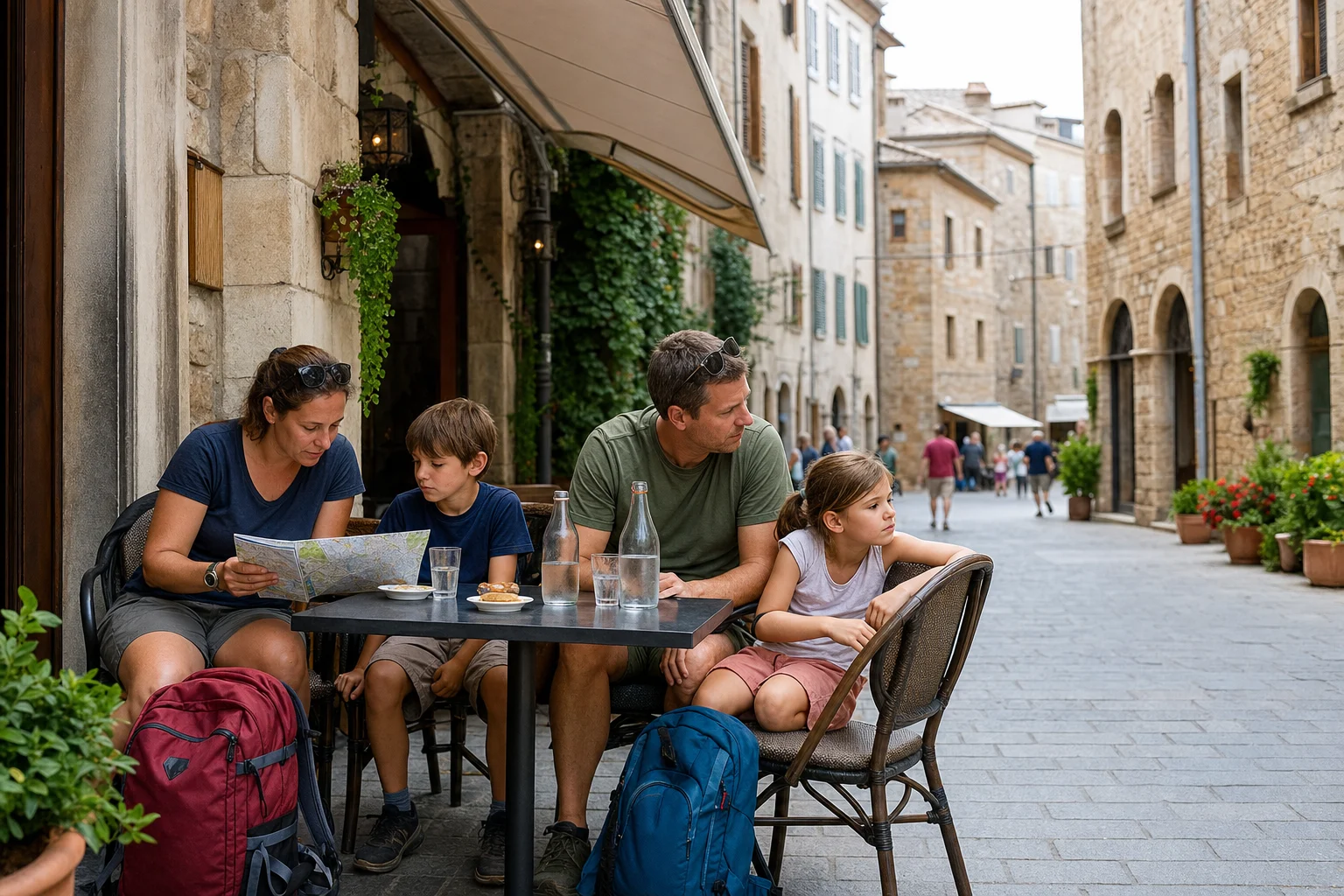
but tried-and-tested cafés where:
-
children are welcome
-
nobody looks at you sideways
-
nobody asks unnecessary questions
One guide once said:
“I can forget the date a cathedral was built,
but never where the decent toilet is.”
Food is a conversation of its own
In guidebooks food is a pleasure.
In family travel it is a condition of survival.
Guides know:
a hungry child takes in neither history, nor jokes, nor beauty.
They take in only the injustice of what is happening.
So sometimes a tour looks like this:
— two facts
— a bun
— one more fact
— something to eat, urgently
— “and now we can carry on listening”
And that is not a failure.
That is professionalism.
The story guides remember with a laugh
Once a whole group was going perfectly.
Until it turned out that the café “on the plan” was closed.
There was a pause.
The kind in which parents start counting the seconds to a meltdown.
The guide turned into a courtyard without a word.
Five minutes later the whole family was eating pizza on the steps.
Nobody knew the name of the street.
But everyone was happy.
Afterwards the father said:
“That was the best moment of the day. Thank you for not pretending it was planned.”
What we at Kidster took from this
Family journeys are not made of impressions.
They are made of small things that either work or do not.
If the child is fed, the day is possible.
If there is somewhere to go to the toilet calmly, the day is saved.
If the grown-ups do not feel ashamed of things being imperfect, joy appears.
We rarely mention this in route descriptions.
But it is what guides discuss most.
Because real journeys begin
not with monuments
but with very earthly questions.
And when someone can settle those calmly and with humour —
that is the kind of experience you want to come back to.