Contents 7
- How the Galleria came about: snow, hail and scaffolding
- The Octagon floor: four coats of arms and one queue
- Turin’s bull: how to spin, and why it is worn
- The Highline: a walk over the Galleria’s roofs
- Shops and cafés: how expensive is it?
- When to go and how long to allow
- A mini-quest for children in the Galleria
How the Galleria came about: snow, hail and scaffolding
The Galleria is not a shopping centre in the usual sense but a street roofed with glass. It is laid out as a cross: the long arm runs from Piazza del Duomo to Piazza della Scala, the short one links two side streets. According to Lombardy’s regional heritage catalogue, the arms are 14.5 m wide and 196.6 m and 105.1 m long, and where they cross stands the Octagon under a dome 47 m high from the floor to the base of the lantern. Inside are just under a hundred shops, cafés and bookshops.
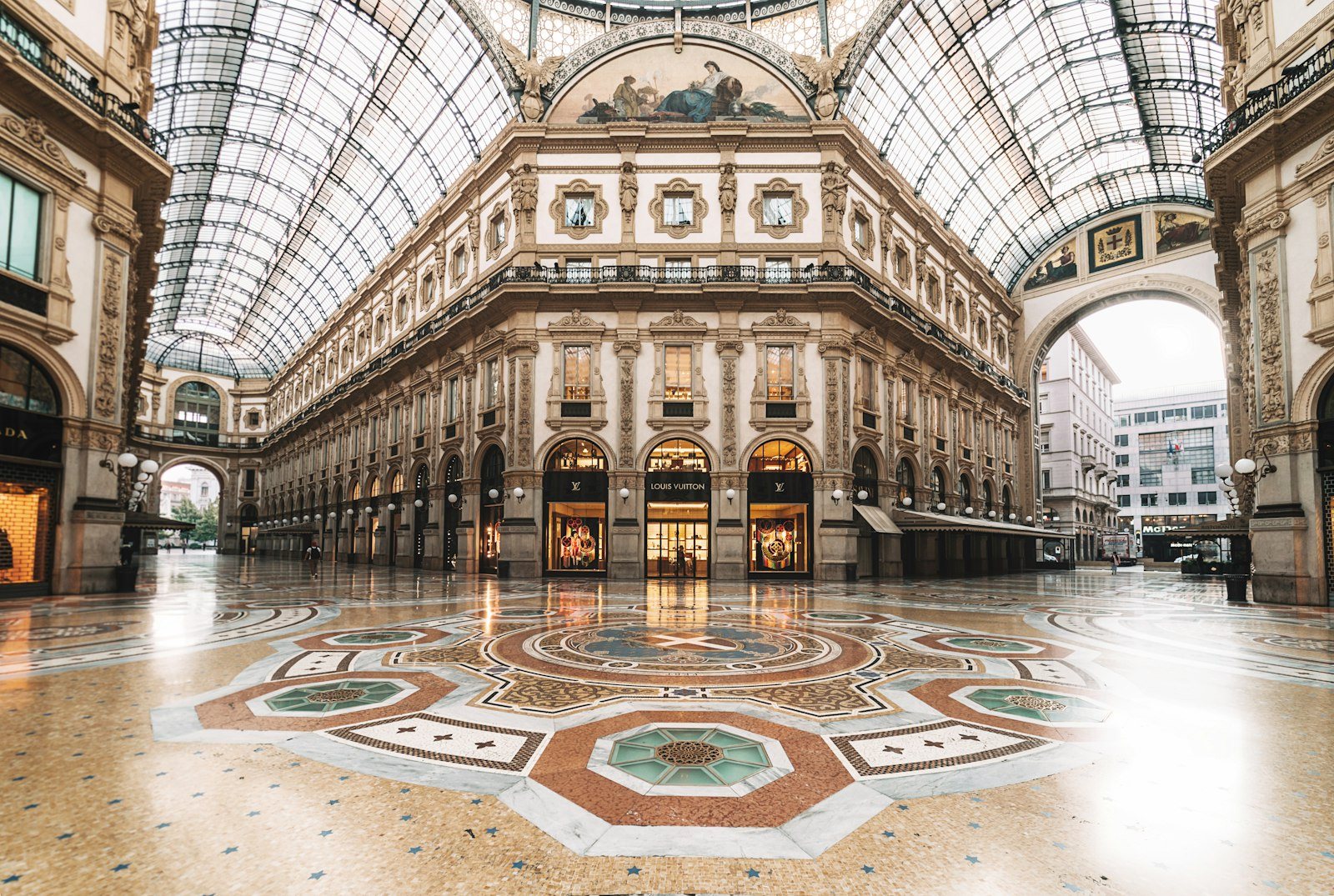
The building work produced enough stories to fill the walk from your hotel:
- 1865. The first stone is laid on the spot where the Octagon now stands, in the presence of King Victor Emmanuel II and in heavy snow — the painter Domenico Induno later painted the scene.
- 1867. The Galleria opens, though the arch onto the Duomo square is not yet there. The same year brings a scandal: the buildings along the Galleria turn out to be a storey taller than planned — secretly agreed between the mayor and the building company — and the mayor has to resign.
- Every evening. The lighting is 600 gas jets with a mechanical lighter. The heritage catalogue says this was a show in itself; the Milanese nicknamed the lighting device the “rattìn”, the little mouse. In 1880 the Galleria’s first electric light came on in one of its cafés, and a year later electricity replaced gas altogether.
- 1874. A violent hailstorm smashes every pane of the roof.
- 30 December 1877. The day before the great arch onto Piazza del Duomo is due to open, the architect Giuseppe Mengoni falls from the scaffolding and is killed. People spoke of an accident and of suicide; the truth was never established. The memorial plaque in the Galleria says he died “on the eve of his deserved triumph”. The arch opened in 1878.
- August 1943. Bombing badly damages the plasterwork, the paintings and the floor. The Galleria is restored between 1948 and 1955.
- 1966. The marble floor with the coats of arms is restored — the very floor you will be walking on.
The Galleria itself needs no ticket: it belongs to the City of Milan and works like any other street. Only the shops, cafés and the rooftop walk keep their own hours.
The Octagon floor: four coats of arms and one queue
Stand in the middle of the Octagon and look down. At the centre are the arms of the House of Savoy, the royal family under whom the Galleria was built. Around them are four mosaic city crests:
- Milan — a red cross on a white field;
- Turin — a bull on a blue field;
- Florence — a red lily;
- Rome — the she-wolf with Romulus and Remus.
Why these four? Turin, Florence and Rome were in turn capitals of united Italy: Turin from 1861 to 1865, Florence from 1865 to 1871, then Rome. Milan is the city that built the Galleria and named it after Italy’s first king. That is why the floor crests are often called “the four capitals”.
The floor is made of several kinds of marble and coloured glass. If your child likes puzzles, ask them to find all four crests before you say which one is the bull. It is not hard: one of them always has a queue.
Turin’s bull: how to spin, and why it is worn
The ritual goes like this: put your heel on the spot under the bull’s belly — its most “manly” part — and turn round on it three full times. The right heel is the usual advice; accounts differ on which way to turn, and there is no strict rule. It is said to bring luck and to make sure you come back to Milan. The city’s own press release on the restoration says exactly that: visitors can once again do the traditional three turns.
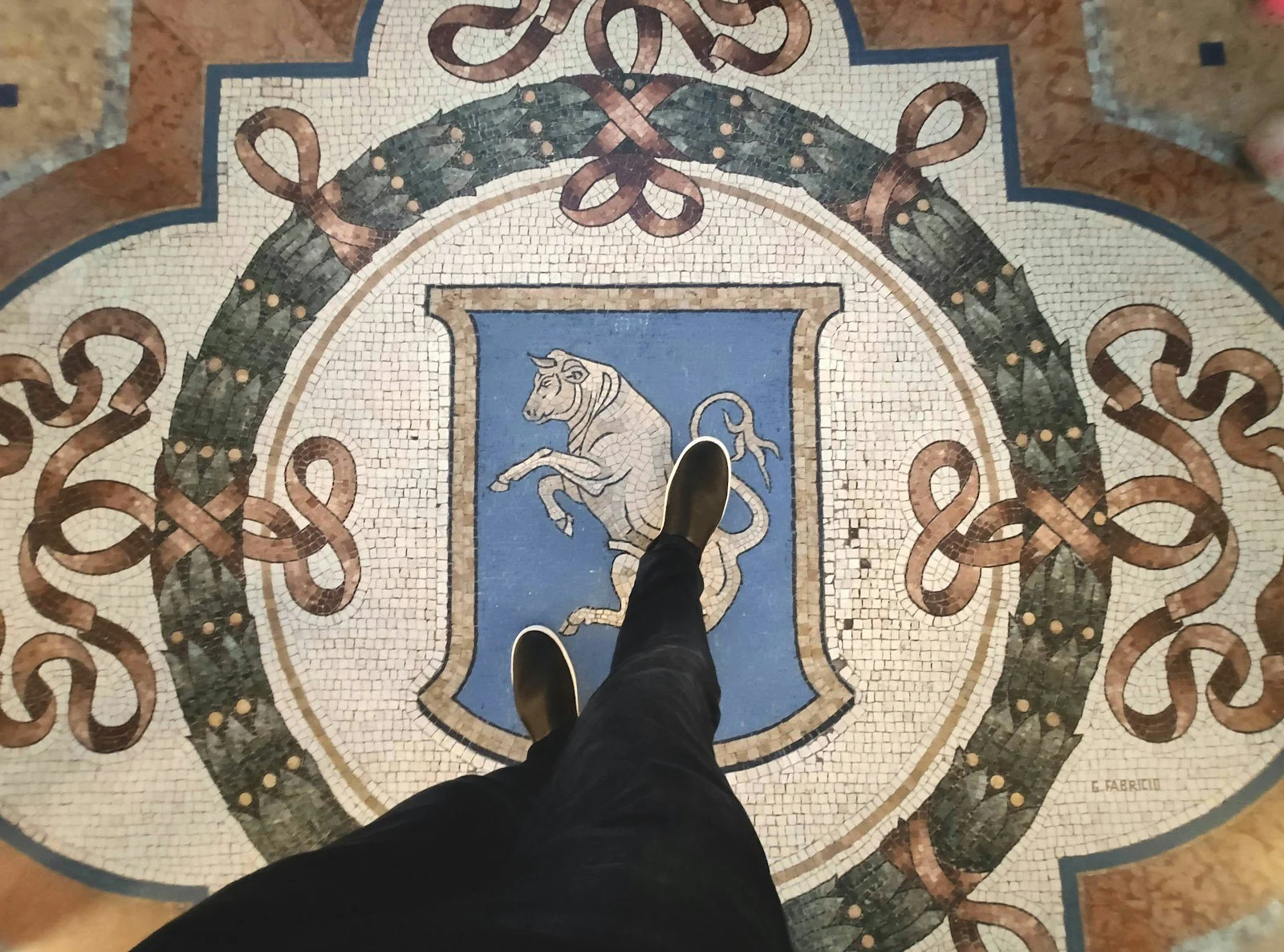
Nobody knows for certain where the tradition comes from. The Italian press says the Milanese were already doing it in the 19th century; later it spread through guidebooks and became one of the city’s best-loved tourist rituals. There are two popular explanations: luck — and a little dig at Turin, the former capital and Milan’s long-standing rival. These are legends, not records.
What the ritual does to the floor is well documented: according to the city authorities, thousands of people a day spin on the bull, and the pink mosaic stones under their heels wear down into a proper hollow. The city patches it from time to time:
- September 2017 — the previous restoration of the bull.
- 27 May to 5 June 2026 — the latest. The work was done by the restorer Gianluca Galli. The worn sections were removed, according to press reports to a depth of at least 2.5 cm; the base was consolidated, and new pieces of the same kind of marble as in the 19th century were laid, filled and polished. The city stresses that the design was not changed.
It did not go without a row. When a city councillor posted the “after” photos, more than four hundred comments piled up on social media: many felt the bull had lost its most important feature and was “now an ox, not a bull”. The town hall replied that the materials need to settle and the mosaic will look more even over time. So if you have seen photos of the bull from before 2026, it may look paler and newer in person — that is normal.
How to do it with a child and no tears:
- Come early in the morning or late in the evening. The Galleria never closes, and before the shops open there is nobody at the bull. During the day the queue can be several dozen people long.
- Hold a small child by both hands. The floor is polished marble, the new patch is polished too, and three turns on one heel make adults dizzy as well.
- Do not linger. Three turns, a photo, then make way. The bull lies in the middle of the walkway, with people passing all the time.
- Tell your child it is a game. Nobody guarantees the luck, but a reason to come back to Milan is a good one.
The Highline: a walk over the Galleria’s roofs
Above the Galleria’s glass roof runs the Highline route: a metal walkway along the vaults, a panoramic lift, an exhibition room and a terrace on the very top of the arch facing Piazza del Duomo — from there you see the cathedral almost at eye level. The route existed before, and in 2026 it reopened after a revamp: a glass lift was added, visitors were let into the “Clock Room” for the first time — the room from which all of Milan’s public clocks were controlled in 1932 — and a children’s trail with games and riddles was introduced. Ask for the children’s leaflet at the entrance.
| Ticket | Price |
|---|---|
| Full price | EUR 15 |
| Ages 19–25, over-65s | EUR 12 |
| Ages 13–18 | EUR 10 |
| Children aged 7–12 | EUR 7 |
| Ages 0–6 | free |
| Open date (no time slot) | EUR 20 |
| Guided tour | EUR 25 |
A family of two adults and children aged seven and ten pays EUR 44 at standard rates (15 + 15 + 7 + 7). What to know before you buy:
- Hours. Tuesday to Sunday, 10:00–18:00, last entry 17:30, closed on Mondays. Some days are closed for private events.
- Timed tickets. No more than 150 people are admitted per hour, so it is best to book online in advance, especially at weekends. The ticket desk on site sells same-day tickets only, but without a booking fee. You can be up to 60 minutes late.
- Entrance — inside the Galleria at number 11/12, in the lobby on the Piazza della Scala side. You go up to the sixth floor by lift or stairs, and there are more stairs along the route.
- No pushchairs. They are not allowed for safety reasons and to keep escape routes clear, and there is no cloakroom. Bulky items are not allowed either, and bags may be checked.
- For children. No running, jumping or leaning over the railings; the route is watched, including by plain-clothes security staff. The walkway is a metal grating you can see the drop through — some small children find that frightening, so be ready to pick yours up.
- Food. You cannot bring your own food or drink; there are cafés and toilets on the route.
- Weather. In light rain the Highline stays open and there are no refunds; in severe weather it closes, and tickets are then refunded.
- Time. Allow about an hour. The free audio guide runs on your phone; bring your own headphones.
Is it worth it if you are going up on the cathedral roof anyway? The views are different: from the Duomo you look at the spires and the city, from the Highline at the cathedral itself and the glass spine of the Galleria. If you can only pick one, the Duomo roof with its statues will impress a child more — tickets and the climb are covered in our article Milan Duomo: tickets and the rooftop. The Highline makes a good second choice once your child is over six and comfortable with heights.
Shops and cafés: how expensive is it?
Expensive — and there is a reason. The premises in the Galleria belong to the city and are let by auction. In May 2024 the jeweller Tiffany won the auction for a 174.5 m² shop by the Octagon: EUR 3.6 million a year, or about EUR 20,630 per square metre. The newspaper Il Giorno compared that with rents on Fifth Avenue in New York. The city’s rental income from the Galleria rose from EUR 30 million in 2018 to EUR 70 million. Prada, Louis Vuitton, Gucci and other fashion houses have windows onto the Octagon.
Alongside them are historic names: the Biffi café and pâtisserie has been here since the opening in 1867, the Savini restaurant also dates from the 19th century, and the Camparino bar was opened in 1915 by Davide Campari — son of Gaspare, who invented the famous bitter and lived right here in the Galleria. There is also the Borsalino hat shop, opened in 1883.
Practical points for families:
- A coffee or juice at the counter is cheaper than at a table almost everywhere in Italy. If you just want to try “that famous café”, have a drink at the bar and do not sit down.
- A table in the Galleria is a charge for the seat and the view. Read the menu before you sit, and check the coperto line (the cover charge) — what it is and how to deal with it is in our article tipping in Italy.
- A snack with children is cheaper in the streets leading away from Piazza del Duomo; you can always come back to stroll through the Galleria — it is not going anywhere.
We do not quote current café prices here: there are no official price lists online, and figures from reviews go out of date quickly.
When to go and how long to allow
Without the Highline, 20–30 minutes is enough for the Galleria: walk from the Duomo to La Scala (about 200 m), spin on the bull, find the crests and look up at the dome. With the Highline, add an hour. It fits most neatly with the cathedral: leave Piazza del Duomo through the great arch, walk the length of the Galleria and come out by La Scala, and from there carry on to Sforza Castle if you like. A ready-made day route with a child is in our article what to see in Milan in one day.
- Morning before 10:00 — empty, no queue at the bull, and you can see the floor properly.
- Daytime — the busiest, especially at weekends.
- Evening — the chandeliers and shop windows are lit and the Galleria is at its most beautiful. If your child is not worn out, it is the best time for photos.
The Galleria lies inside the Area C charging zone, so it is better not to drive into the centre. The nearest metro station is Duomo (lines M1 and M3).
A mini-quest for children in the Galleria
Twenty minutes in the Galleria easily turns into a game. Give your child these tasks:
- Find the four cities on the Octagon floor and guess which crest is which: cross, bull, lily, she-wolf.
- Find the four continents under the dome. The half-moon panels at the base of the dome show Europe, Asia, Africa and America. Let your child work out which is which from the people and animals in the pictures.
- Find the architect’s plaque. Mengoni’s memorial plaque with the date 30 December 1877 is a good cue for the story of the last man to check the building before the big day.
- Count the glass “ribs” of the dome — or simply look straight up: a glass roof of this size was something new in the 19th century.
- And only at the end — the bull. As a reward for finding the crests.
The Galleria also has its own page on our site: Galleria Vittorio Emanuele II, and next door is Milan Cathedral.
“Milan for Kids” sightseeing tour
A walking game through the historic centre: children hunt for secret signs on the walls of old buildings, hear legends of knights and artists and solve observation challenges, while adults pick up little-known details about the city. The route takes in Milan Cathedral, the Galleria Vittorio Emanuele II with its mosaics, Sforza Castle and quiet courtyards. The Highline is not part of the tour.
EUR 260 per group of up to 5 · 3 hours · ages 6+
Our other tours in the city are on the page tours in Milan.
Frequently asked questions
Where is the bull in Milan that people spin on?
In the Galleria Vittorio Emanuele II, right in the middle — in the eight-sided space under the glass dome known as the Octagon. The floor there has four mosaic coats of arms around the arms of the House of Savoy. The bull is Turin’s emblem: a golden bull on a blue field. You will spot it by the queue and the worn patch under its belly.
How do you spin on the bull in the Galleria?
Put your heel on the worn patch under the bull’s belly and turn round three times on the spot — that is how the City of Milan itself describes the ritual. The right heel is the usual advice; accounts differ on which way to turn, and there is no strict rule. It is said to bring luck and to promise that you will come back to Milan.
Is the Galleria Vittorio Emanuele II open 24 hours? Do you have to pay?
The Galleria is a public covered passage between Piazza del Duomo and Piazza della Scala. It is free and never closes. Only the shops, cafés and the Highline rooftop walk keep their own opening hours.
How much does the Highline Galleria cost?
As of October 2026, according to the official website: EUR 15 full price, EUR 12 for ages 19–25 and over-65s, EUR 10 for ages 13–18, EUR 7 for children aged 7–12, free under 6. An open-date ticket is EUR 20, and a guided tour EUR 25. It is open Tuesday to Sunday, 10:00 to 18:00, and closed on Mondays.
Can you do the Highline with a small child or a pushchair?
Children of any age are allowed, and under-6s go free. Pushchairs are not: Highline’s rules do not allow them on the route, and there is no cloakroom. The route has stairs and a raised metal-grating walkway, and running and jumping are forbidden. You will need to carry a toddler or use a sling or carrier.
Who built the Galleria, and what happened to the architect?
The Galleria was designed by Giuseppe Mengoni. The first stone was laid in 1865 and it opened in 1867, but without the arch onto the Duomo square. On 30 December 1877, the day before the arch was due to open, Mengoni fell from the scaffolding and was killed. A memorial plaque in the Galleria records it. The arch was opened in 1878.
Why is there a hole in the bull, and what has been done about it?
Thousands of people a day spin on exactly the same spot, and the little mosaic stones wear down into a dip. The city repairs it from time to time: in 2017, and again from 27 May to 5 June 2026, when the worn sections were taken out and replaced with marble of the same kind. Spinning is allowed again since then.