Contents 9
- The route hour by hour
- Morning: the Strada Nova, a EUR 2 gondola and Rialto
- St Mark’s Square: what to show your child outside
- Where to eat and sit down without getting fleeced
- The Accademia Bridge and back along the Grand Canal
- If your child is tired: what to drop
- Toilets
- The access fee: where things stand
- A day trip from Florence or Milan
The route hour by hour
Timings assume you arrive at ten in the morning. If you arrive earlier, everything shifts, and that is only a good thing: before eleven, Rialto is noticeably quieter.
- 10:00 — Santa Lucia station or Piazzale Roma. From Piazzale Roma it is five minutes to the station over the Constitution Bridge. Walk along the Strada Nova, a wide street laid out in the 19th century by filling in canals.
- 10:30 — the traghetto at Santa Sofia. A gondola crossing straight to the Rialto fish market.
- 10:45 — the market and the Rialto Bridge. About forty minutes: market, bridge, view of the canal.
- 11:30 — on to St Mark’s through the Mercerie shopping lanes, fifteen minutes following the signs.
- 11:45–13:00 — St Mark’s Square from the outside. The clock with the Moors, the lions, the horses on the basilica, the waterfront looking out over the lagoon. If you have booked, the basilica inside.
- 13:00 — lunch well away from the square.
- 14:00 — through Campo Santo Stefano to the Accademia Bridge, about twenty minutes.
- 14:30 — Dorsoduro. Sit down, have an ice cream, let your child run around a campo.
- 15:30 — vaporetto line 1 from the Accademia stop back to the station, about half an hour along the Grand Canal.
Why this direction and not the other way round. In the morning a child has the energy for the walking part, and at four in the afternoon, when their legs have given up, the best thing that can happen is to sit in a boat and watch palaces for half an hour. The ride back along the canal also delivers you right to your train. In December this matters even more: the sun sets at around half past four, and by dusk you are already at the station.
With a pushchair the route is much harder: there are dozens of stepped bridges on it and hardly any ramps. For a child under three, a carrier is easier.
Morning: the Strada Nova, a EUR 2 gondola and Rialto
From the station, follow the yellow “Per Rialto” signs painted on the walls: in Venice they are more reliable than your phone, because maps often lose the satellites in the narrow calli. The Strada Nova is the straightest and widest street in the city, it is hard to get lost on, and there are plenty of places to buy water and a snack.
Before you reach Rialto, turn down towards the canal by the church of Santa Sofia. This is a traghetto pier — a large gondola that ferries people from one bank to the other. The whole Grand Canal, nearly four kilometres long, has only four bridges, which is why these crossings have survived from the days when there were many more of them. It costs EUR 2 per person, paid in cash to the gondolier as you board. Venetians ride standing up; tourists with children can sit on the gunwale. The crossing takes a couple of minutes, but for a child it is a real gondola and a real oar, and a gondola ride costs dozens of times more. On the far bank you land right by the fish market.
The traghetto does not run every day or at every point — especially in winter, in fog and when the water is rough. Santa Sofia is the most reliable of the crossings. If the pier is empty, simply carry on along the Strada Nova to the Rialto Bridge and cross on foot.
The fish market under the colonnade of the Pescheria is open Tuesday to Saturday, mornings only. For a child it beats any aquarium: cuttlefish, crabs, swordfish on ice. On Sundays and Mondays the stalls are empty, so head straight for the bridge.
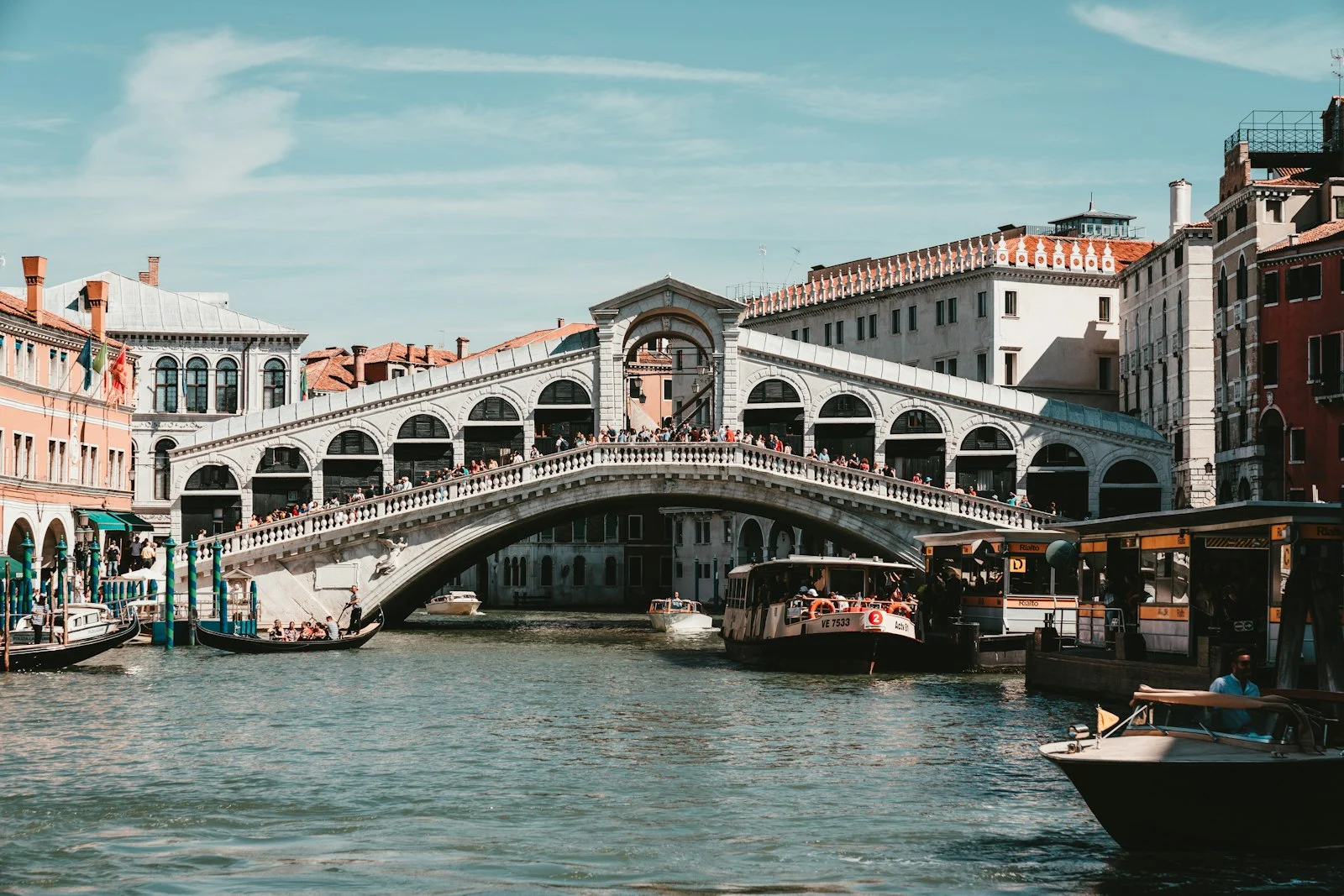
The Rialto Bridge was finished in 1591; before it there were wooden bridges here, and one of them collapsed under a crowd of onlookers. Climb the central steps between the shops, and take in the view from the side terraces along the edges. The best shot of the Grand Canal is from the middle, looking towards the station.
St Mark’s Square: what to show your child outside
From Rialto, the “Per S. Marco” signs lead to St Mark’s Square, fifteen minutes through the Mercerie lanes. You come out into the square under the clock tower, and that is the best way in: your child sees everything at once.
- The clock tower. On top, two bronze figures known as the Moors strike the bell with hammers every hour. Time it for the hour.
- The horses on the basilica. The four bronze horses above the entrance are copies; the originals, around two thousand years old, are inside in the basilica museum. A good puzzle: “how can you tell they are not the real ones?”
- The lion on the column. The winged lion is the symbol of St Mark and of Venice. Ask your child to count lions on the way to the Accademia: there are dozens of them on houses, well-heads and flags.
- The waterfront. Walk down to the water between the two columns: the lagoon, gondolas at the moorings, the island of San Giorgio opposite.
Inside the basilica is not worth attempting without a booking. Tickets are named and timed, sold on the basilica’s official website; without one, the queue along the façade can easily eat an hour this kind of day does not have. If you do want to go in, book a slot around midday in advance; the visit takes about half an hour. The Doge’s Palace next door is a separate visit of a couple of hours, and we leave it out of a one-day route with a child.
From November to January there can be acqua alta, high water. The MOSE barriers are raised when the tide forecast is 110 cm or more, but St Mark’s Square is the lowest point in the city and starts to flood at around 80 cm. The forecast is published by the city’s tide centre on the municipal website. If high water is expected in the morning, swap the order: Rialto and Dorsoduro first, St Mark’s after lunch when the water has gone down. Rubber boots are sold right in the square.
A children’s tour of Venice: a journey through the city’s riddles
If you would rather not find your own way through the calli while keeping a child’s attention, this part of the route can be done with a guide as a game: puzzles, tasks and mini-competitions on the way from St Mark’s to Rialto and along the Grand Canal, with a detour into quiet courtyards. Children find out why Venice does not sink and what it takes to become a gondolier.
EUR 250 per group of up to 5 · 2.5 hours · ages 6+ · basilica and transport tickets not included
Where to eat and sit down without getting fleeced
The main rule: the closer to St Mark’s and Rialto, the pricier and worse it gets. We do not recommend specific addresses — they change faster than articles do — but a few simple signs work.
- Walk two blocks away. Lunch is easier on the way to the Accademia or in Dorsoduro than on the square itself. A menu with photos in six languages and a tout at the door are reasons to walk on.
- Bacari and cicchetti. Venetian wine bars sell cicchetti — small sandwiches and snacks taken from the counter one by one. Children like choosing for themselves, and it is quicker and cheaper than a sit-down lunch. Standing at the bar is usually cheaper than a table.
- Check the bill in advance. In Italy a table carries a coperto — a charge for bread and place setting — and sometimes a service charge too. Both should be shown on the menu. At the cafés on St Mark’s Square with a live orchestra, a music supplement is added to the bill as well.
- Picnics on benches only. Sitting and eating on steps, bridges, quaysides and on the ground is banned in Venice by city regulations, and people are fined for it. There are benches in the Giardini Reali behind the square, by the water, and on the big campi of Dorsoduro.
- Supermarkets are at Piazzale Roma and on the Strada Nova: water, fruit and yoghurts for your child at normal prices.
The best place simply to sit after lunch is one of the big squares in Dorsoduro, ten minutes from the Accademia Bridge. There are no cars, few tour groups, and local children kick a ball about. While your child runs around, the adults have a coffee at a table on the edge of the square.
The Accademia Bridge and back along the Grand Canal
From St Mark’s, walk to the Accademia Bridge through Campo Santo Stefano, about twenty minutes. The bridge is wooden: it was meant as a temporary structure in 1933 but was never replaced with a stone one. From the middle you get the best-known view of the canal and the dome of the Salute church; for photos it beats Rialto, and it is less crowded. On the far side, in Dorsoduro, is the Accademia gallery — we skip it with a child on a day like this, as it is a separate museum of a couple of hours.
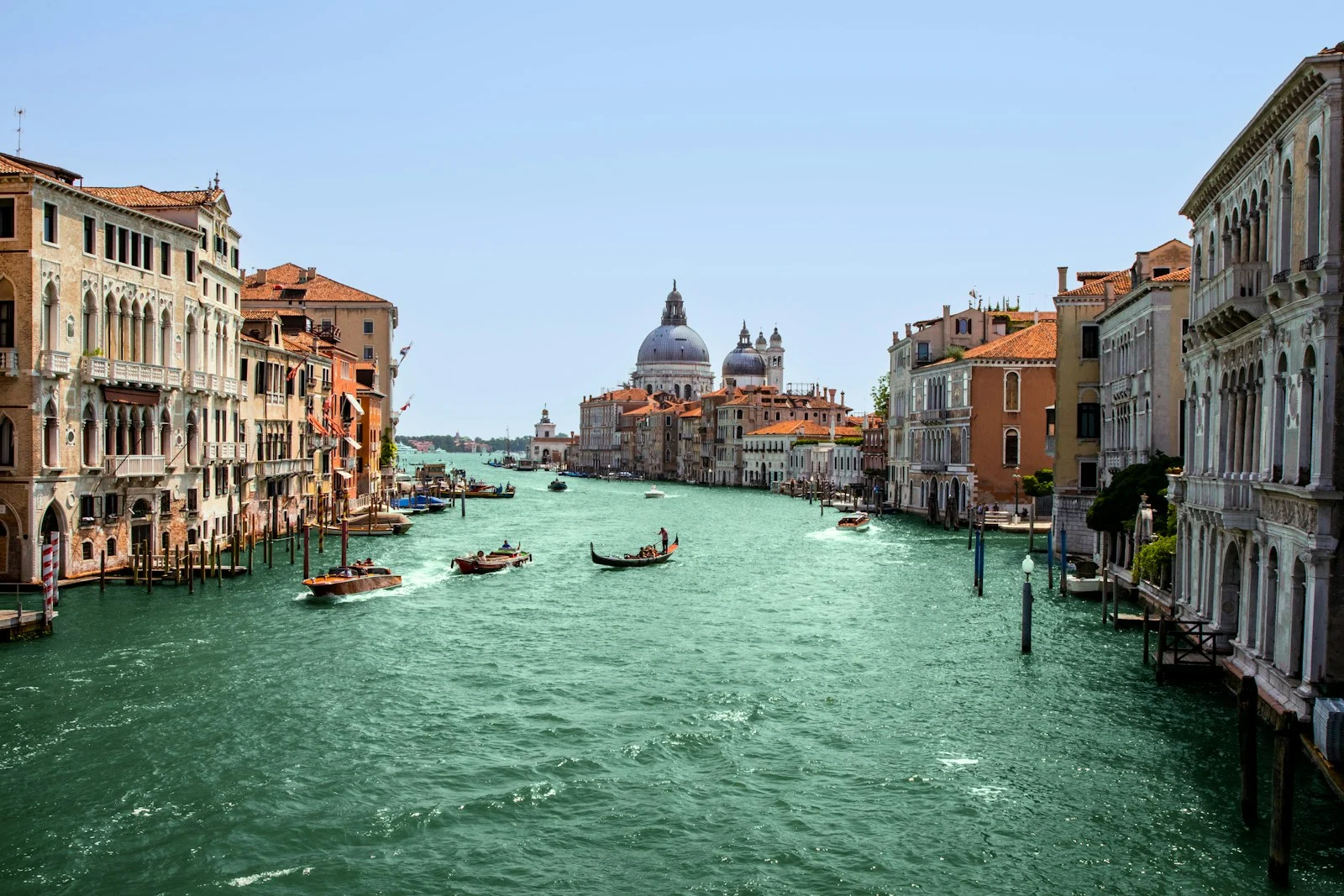
Back on vaporetto line 1 from the Accademia stop. It is the slow line, stopping at every other palace along the whole Grand Canal: about half an hour to the station (the Ferrovia stop), a little longer to Piazzale Roma. Boats run roughly every 12 minutes. Take the open seats at the bow or stern if there are any: you see much less from the cabin. If you walk back from Dorsoduro instead of taking line 1, the station is about forty minutes away.
| What | Price | When it pays off |
|---|---|---|
| Vaporetto, 75-minute ticket | EUR 9.50 | one or two journeys a day |
| Vaporetto, 24 hours | EUR 25 | three journeys or more |
| Vaporetto, 48 / 72 hours | EUR 35 / 45 | if you stay overnight |
| Children under 6 | free | from six, full fare |
| Traghetto across the Grand Canal | EUR 2 | cash to the gondolier |
Do the sums in advance: for a family of two adults and children aged eight and four, one journey costs EUR 28.50, with the four-year-old travelling free. You must tap the ticket on the reader at the pier before boarding, or it is not valid. You can buy it at the Venezia Unica ticket offices and machines by the station and at Piazzale Roma, or in the operator’s official app.
If your child is tired: what to drop
It is better to cut the route from the end than from the middle. In order:
- Dorsoduro and the Accademia Bridge. Board line 1 right at St Mark’s (the San Marco Vallaresso or San Zaccaria stop): about 40 minutes to the station, and you still pass under the Accademia Bridge on the canal.
- The walk from the station. In the morning, take line 1 straight to Rialto, about 20 minutes, and start at the market. You miss the traghetto but save half an hour of walking.
- The basilica inside. If your child is not in the mood, it is better to lose a half-hour booking than to drag them through the queue and the crowds.
What we never drop: Rialto, St Mark’s Square and the ride along the Grand Canal. Those three things are why people come to Venice for one day.
Toilets
Public toilets in Venice are paid and run by the Veritas company: about EUR 1.50 per person, a little less at Santa Lucia station. There is a turnstile at the entrance that takes coins and bank cards. Along the route there are toilets by the station, at Piazzale Roma, near Rialto, at St Mark’s — behind the square, on the Giardini Reali side — and under the Accademia Bridge on the Dorsoduro side. The large toilets near St Mark’s, Rialto and Piazzale Roma have baby-changing tables.
The free option is the toilet in a café where you have ordered something; without an order you are usually turned away. How we plan a day with children around toilets and snacks in general is in our piece on toilets, food and other things guidebooks leave out.
The access fee: where things stand
In 2026 Venice charged day visitors a fee to enter the historic centre for the third year running. The 2026 rules:
- 60 days between 3 April and 26 July — mostly weekends and holidays;
- only from 8:30 to 16:00; arrive later and there is nothing to pay;
- EUR 5 if paid at least four days before the visit, EUR 10 if later;
- children under 14 are exempt and do not register, but carry a document showing their date of birth in case of checks;
- guests staying overnight in accommodation within the Municipality of Venice do not pay, but must get a free exemption QR code;
- failing to pay carries a fine of EUR 50 to 300.
The 2026 season closed on 26 July, and there is nothing to pay to enter at the moment. The city has promised to announce dates for 2027 later and has said there may be more than 60 days. If you are travelling in spring or summer 2027, check the calendar on the official portal cda.ve.it before buying train tickets.
A day trip from Florence or Milan
Venice makes a good day trip with a child: the high-speed train takes about two hours from Florence and about two and a half from Milan, and arrives right at Santa Lucia station, where our route begins. Catch a train before nine in the morning and come back after five in the evening — that leaves six or seven hours in the city, exactly enough for this route. Do not get the terminus wrong: you want Venezia S. Lucia, not Venezia Mestre on the mainland. How to buy tickets in advance and for less is in trains in Italy: how to buy a ticket. If you are based in Florence and only have one day for the city itself too, we have the same kind of guide: what to see in Florence in one day.
All our children’s routes around the city are on the Venice tours page.
Frequently asked questions
Can you see Venice in one day with a child?
The highlights, yes: Rialto, St Mark’s Square, the Grand Canal and the Accademia Bridge fit into six or seven hours if you walk one way and come back by vaporetto. Museums barely fit into a day like that: one at most, and St Mark’s Basilica with a booking is the best choice.
How much is the vaporetto in Venice in 2026?
A 75-minute ticket costs EUR 9.50, 24 hours EUR 25, 48 hours EUR 35 and 72 hours EUR 45. Children under 6 travel free with an adult; from six they pay the full fare. For one day with two journeys, single tickets work out cheaper.
Do you have to pay the Venice access fee with a child?
Children under 14 are always exempt. In 2026 adults paid EUR 5 or 10 only on 60 set days between 3 April and 26 July, from 8:30 to 16:00. The fee is not in force now, and the city has not yet announced dates for 2027.
How much is the traghetto across the Grand Canal?
EUR 2 per person per crossing, paid in cash to the gondolier as you board. The crossing takes a couple of minutes. Not every point is running: the most reliable are Santa Sofia by the Rialto market and San Tomà.
How much are toilets in Venice?
The city’s Veritas toilets cost about EUR 1.50 per person, a little less at Santa Lucia station. There is a turnstile at the entrance that takes coins and cards. The large toilets near St Mark’s, Rialto and Piazzale Roma have baby-changing tables.
How long is the walk from the station to St Mark's Square?
About 2.5 km following the yellow “Per S. Marco” signs via Rialto. An adult covers it in 40–45 minutes; with a child and stops, allow an hour to an hour and a half. On vaporetto line 1 it takes about 40 minutes.
Can you do Venice as a day trip from Florence or Milan?
Yes: the high-speed train takes about two hours from Florence and about two and a half from Milan, straight to Santa Lucia station. Catch a train before nine in the morning and come back after five in the evening, and you have six or seven hours in the city.