Contents 7
Bridges and pushchairs: what the city itself says
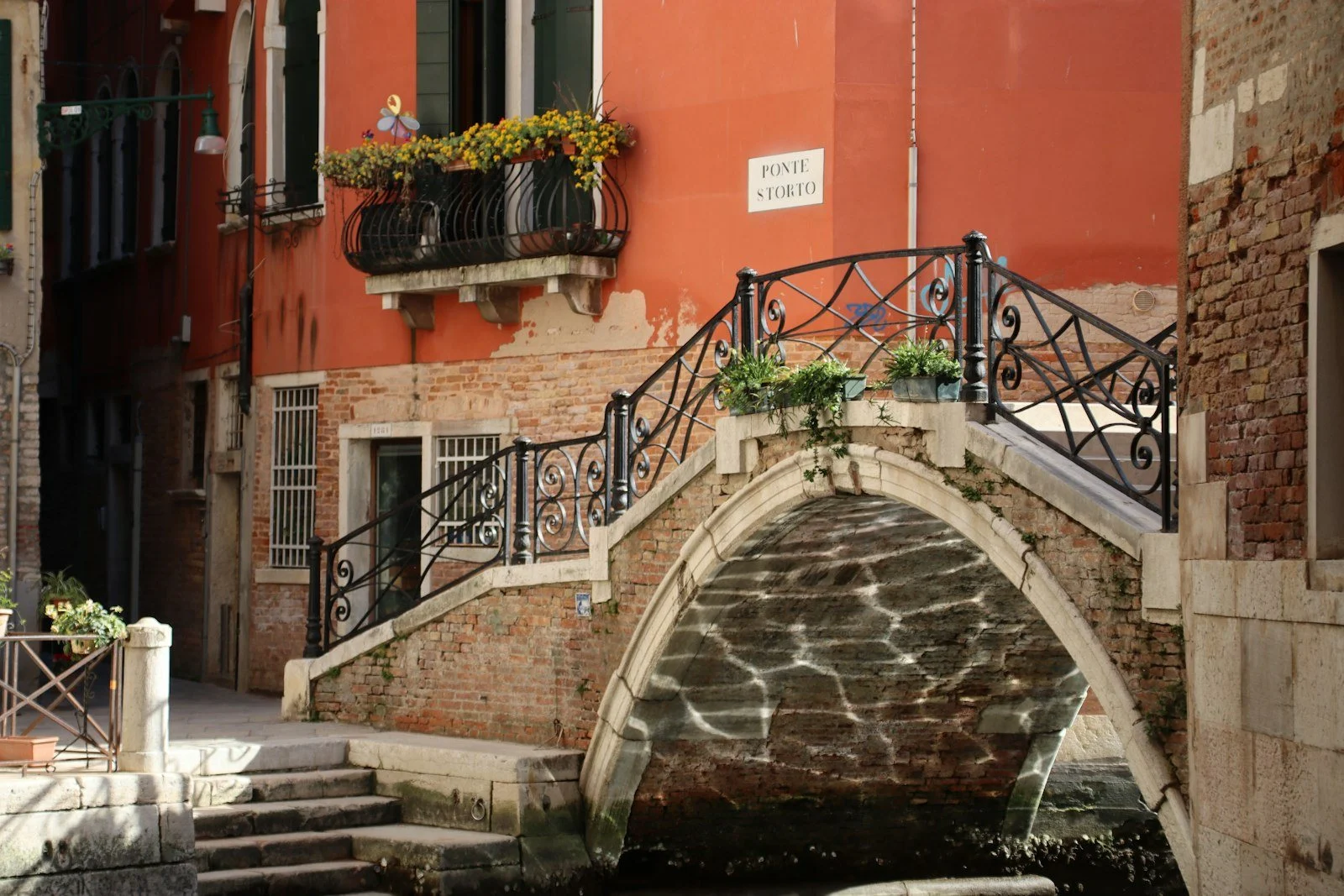
The City of Venice says plainly on its page for people with reduced mobility that the historic centre has more than 400 bridges linking about a hundred islands. An older guide from the city’s accessibility office gives a figure that explains everything: a wheelchair user who moves only on land can visit about 2% of the historic city, and only around the station and Piazzale Roma. Add public water transport, and almost 70% of the area becomes accessible. The city still quotes that “almost 70%” today.
For a parent with a pushchair the conclusion is the same: the vaporetto is not a sightseeing trip but a way round the bridges. The landing stages float, you step onto them level from the quay, and they rise and fall with the water. Under the operator’s rules a pushchair travels folded, but if the boat is not crowded you may board with it open. Children under six travel free; how to pay and which lines you need are in our guide to the vaporetto in Venice.
There are ramps on some bridges, but not many, and the city frankly calls many of its solutions experimental:
- The “easy step” (gradino agevolato): low, long, sloping steps that let you roll a pushchair rather than carry it. You will find them on the Guglie Bridge on the way from the station into Cannaregio, and on the San Felice Bridge nearby.
- A removable ramp on the Ponte della Paglia by the Doge’s Palace, where people stop to look at the Bridge of Sighs.
- Seasonal ramps on the Pietà and del Vin bridges along the Riva degli Schiavoni. The city’s step-free route description says they are put up from February to November, so in December they may not be there.
- New ones. In October 2026 the city was finishing a ramp on the Ponte della Salute in Dorsoduro and promised more: on the Ponte dei Frati near San Marco and on the San Cosmo bridge on the Giudecca. Work on the Guglie ramp is also being completed.
The most useful step-free stretch for families is described in the city’s route around San Marco. Take line 1 or 2 to the San Marco Vallaresso stop, walk along Calle Vallaresso, turn into Calle Larga Ascension, pass the Bacino Orseolo gondola station and follow Calle Salvadego out into St Mark’s Square without meeting a single bridge. With a pushchair you enter the basilica through the Porta dei Fiori on the left, which has a permanent ramp; the Doge’s Palace has a lift. The Mercerie from the Clock Tower to the church of San Zulian is level too. Beyond that, towards the Rialto, the steps begin.
Our conclusion: for a child under three, use a baby carrier, and have the second adult carry a light folding pushchair. It is there for daytime naps and the vaporetto, not for pushing round the city. A big pram in Venice means lifting it at every bridge, and narrow calli where you cannot pass people coming the other way.
Where to stay: the historic centre, Mestre or the Lido
If you can, spend at least one night in Venice itself. Day-trippers arrive around ten and leave around five, and early in the morning and in the evening the city belongs to the locals: children kick a ball around the campi, and you can walk past the Rialto without holding your child by the hood. Above all, you can go back to your room for a nap in the day rather than hunting for a bench.
| Where | Good for families | Less convenient |
|---|---|---|
| Historic centre | an empty city morning and evening, naps in your room, no commuting | more expensive; suitcases and pushchair over bridges from the stop; old buildings do not always have lifts |
| Mestre (mainland) | cheaper, roomier, easy with a car, ordinary supermarkets | a daily commute there and back, in the evening with a tired child |
| Lido | beach in summer, quiet streets, cars and bikes on the island | empty beaches in winter, and a vaporetto every time you go into town |
When choosing a hotel in the centre, ask the owners one thing: how many bridges are there between the nearest vaporetto stop and the door. A hotel five minutes from the stop but three bridges away will feel further, with a suitcase and a pushchair, than one ten minutes away along a level quay.
On money: the Venice tourist tax is charged per person per night, for up to five consecutive nights, and the rate depends on the zone: the historic centre with the Giudecca, the lagoon islands or the mainland. Children under 10 are exempt, and the city’s rules give a 50% reduction to teenagers aged 10–16. This is separate from the access fee for day-trippers, which people staying in accommodation within the municipality do not pay — and Mestre and the Lido are part of it. Who pays the fee and how to get the exemption is covered in our article on the Venice access fee.
Toilets: EUR 1.50, and free under six
Venice’s public toilets are run by Veritas, and the city sets the price. Under the city tariff entry costs EUR 1.50, or EUR 1 at Tronchetto and the Giardini gardens, and children go free until their sixth birthday. The tariff dates from 2019, and guides in 2026 still quote the same EUR 1.50. There is a turnstile at the entrance, so keep some coins. Santa Lucia station has its own toilets by platform 1, about EUR 1.20, where cards are accepted.
| Toilet | Where | Hours | Baby changing |
|---|---|---|---|
| Piazzale Roma | by the bus terminal | 8:00–20:00 | yes, two |
| San Leonardo | Cannaregio, on the way from the station | 11:00–16:30 | yes |
| Rialto Novo | by the Rialto market | 9:30–19:00 | yes |
| San Bortolomio | by the Rialto Bridge, San Marco side | 9:30–19:30 | yes |
| Diurno San Marco | behind St Mark’s Square | 9:30–19:00 | yes |
| Giardini Reali | waterfront garden by the square | 10:00–18:00 | yes |
| Santi Filippo e Giacomo | behind St Mark’s Basilica | 9:30–19:30, Fri–Sat to 21:00, Sun to 20:30 | yes |
| Accademia | under the Accademia Bridge | 9:30–18:30 | no |
| Giardini Napoleonici | park in Castello, EUR 1 | 11:00–19:00 | yes |
| Tronchetto | car-park island, EUR 1 | 8:00–20:00 | yes |
Mind the hours. The San Leonardo toilet on the main street from the station opens only from 11:00 to 16:30, and most of the others close by seven in the evening. After dinner you are left with a café where you have ordered something, or your hotel room. One more option not in the table: the Correr Museum and the Doge’s Palace on St Mark’s Square have their own toilets for visitors, and the Doge’s Palace also has a baby-changing room.
Acqua alta: wellies, sirens and reshuffling the day
Acqua alta, high water, is not a day-long flood but a tide lasting a couple of hours. The city publishes precise levels, and they make planning a day with a child easy:
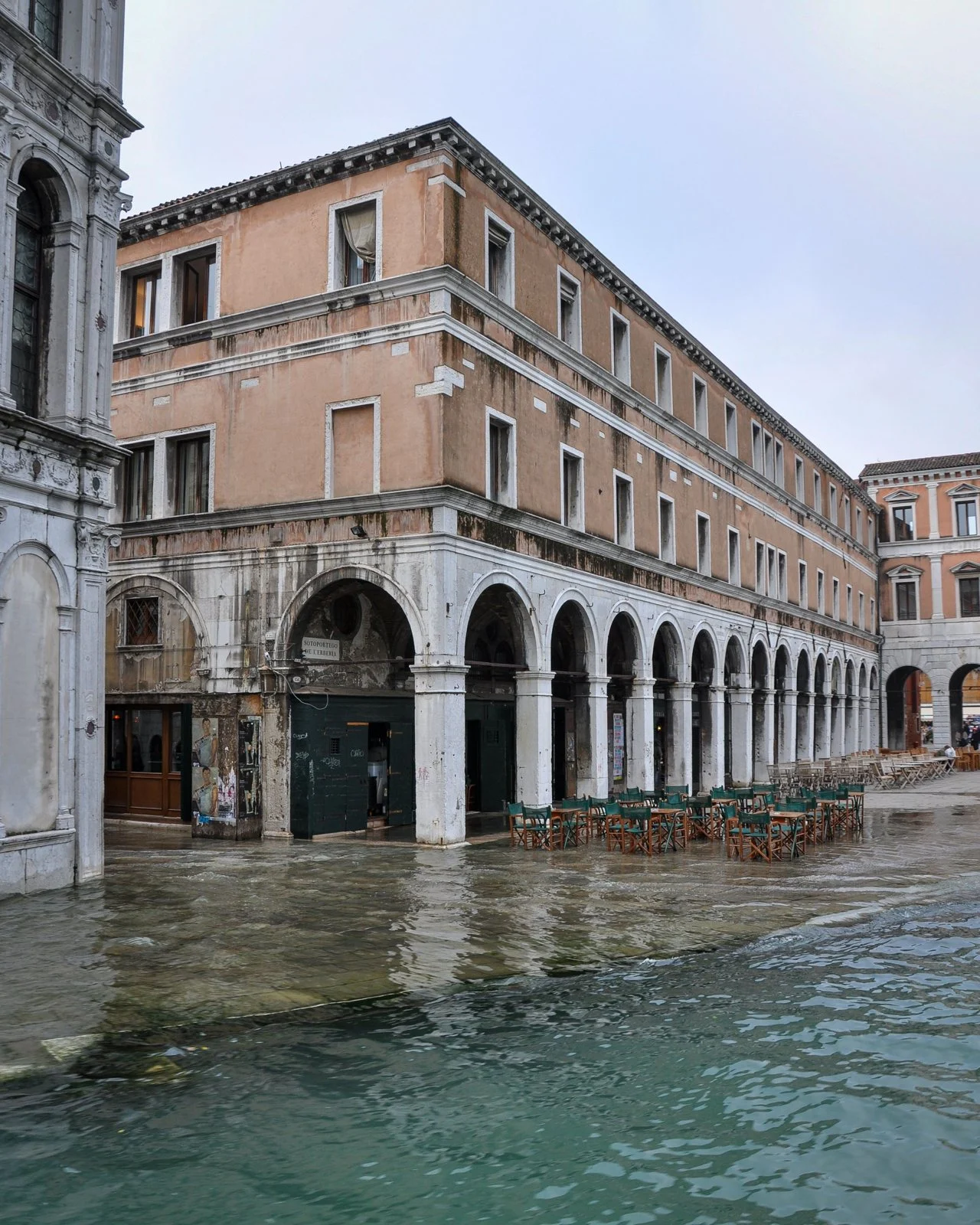
- 82 cm: water appears on St Mark’s Square, the lowest point in the city;
- 95 cm: some vaporetto routes change, but services run to schedule;
- 105 cm: the area around the Rialto Bridge starts to flood;
- 120 cm: a tide like this lasts on average less than an hour and a half; up to this level you get around on raised walkways, the passerelle;
- 135 cm: water reaches the square in front of the station.
The MOSE flood barriers are raised when the forecast reaches about 100–110 cm, so St Mark’s Square can be under water even when MOSE is working. In early 2026 the barriers went up 24 times in the first fifty days of the year. The plan is simple: check the tide centre’s forecast on the city website in the morning, spend the peak somewhere higher, such as near the station or deeper into Cannaregio, and leave San Marco until afterwards. The walkways are narrow and awkward with a pushchair, which is one more argument for a carrier.
When a tide of 110 cm or more is expected, the city sounds sirens, and that makes a game for a child. First comes a general alert, then a series of notes: one long note means 110 cm, two rising notes 120, three 130, four 140 and above. A child only has to count the sounds to know how high the water will rise. And why the city stands in water at all without sinking is explained for children in our article why Venice stands on water.
Children’s wellies are safer packed from home: boots and overshoes are sold on the spot, but hunting for the right child’s size on a high-tide morning is no fun. And spare socks in the backpack, even if the forecast looks calm.
Drinking fountains and snacks
Venice tap water is drinkable, supplied by the same Veritas, and the street fountains carry it too. According to the map the city issued with Veritas in 2022, there are 126 fountains in the historic centre and another 60 on the islands. A bottle for each child saves both money and café queues in summer. The parks have fountains as well: the city’s family portal lists two in Parco Savorgnan, two in the Sant’Elena gardens and one in the Giardini.
Eating on bridge steps or sitting on the ground to eat is banned in Venice, so for a snack look for a bench in a square or park. How to find food away from the tourist traps is in our one-day route, linked at the top of this article.
Keeping children busy beyond the squares
The Natural History Museum in the Fondaco dei Turchi on the Grand Canal (Santa Croce 1730) is the best place in Venice for a rainy day with children aged five and up. The star exhibit is an almost complete skeleton of the dinosaur Ouranosaurus, more than seven metres long. It was found in 1973 by Giancarlo Ligabue’s expedition in the Niger desert and has been on show in Venice since 1975. Next to it is the giant prehistoric crocodile Sarcosuchus.
- Hours: October to May 9:00–17:00, last entry 16:00; June to September 10:00–18:00. Closed on Mondays.
- Tickets: EUR 15, reduced EUR 7.50 for children aged 6–14, free for under-5s.
- A family trick: under the “Seniors + Junior” offer, a group of two adults and at least one child under 16 pays the reduced price for everyone. A family with children of eight and eleven pays EUR 30 instead of EUR 45. It is not an online fare; ask at the ticket office.
Parks with playgrounds. There are few, so it pays to know where they are. The Giardino Papadopoli, between Piazzale Roma and the station, is fenced and has a playground: the perfect place to wait for a train or bus. Parco Savorgnan in Cannaregio, a few hundred metres from the station along the Lista di Spagna, is shady, with a playground and two fountains. The Giardini in Castello (Giardini vaporetto stop) are the largest green space in the centre, with playgrounds and a EUR 1 toilet nearby. Further on, at Sant’Elena, there is a pine park by the water with play areas.
Small things children love. The traghetto across the Grand Canal for EUR 2 is a real gondola for two minutes; more in our guide gondola in Venice: what it costs and is it worth it. The Clock Tower on St Mark’s Square, with its bronze figures striking the bell, can be visited inside only on a booked guided tour and only by children aged 6 and over, at EUR 15, reduced EUR 11. And in Dorsoduro, on the San Trovaso canal, there is a squero, an old boatyard where gondolas are repaired; from the quay opposite you can see the boats lying upside down on the bank.
What disappoints
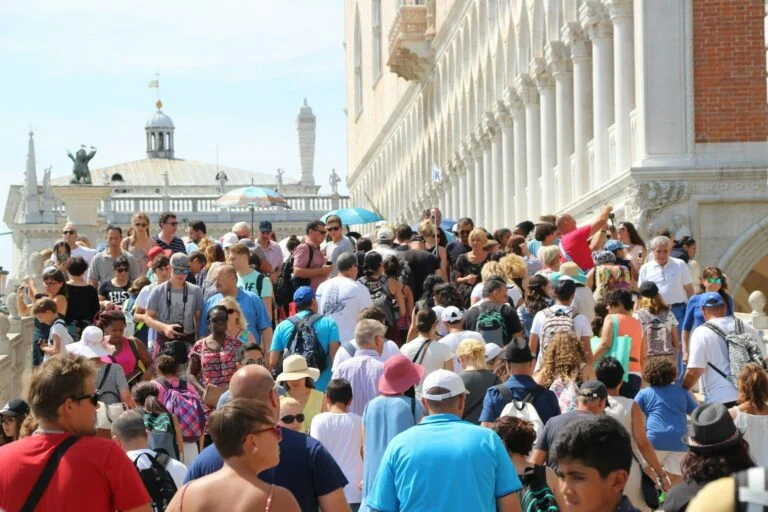
- St Mark’s Square at midday. The crowd is so thick you cannot let your child go a step, and the pigeons many people come for may not be fed on the square. Come before ten in the morning or after five in the afternoon.
- A gondola with a toddler. Thirty minutes sitting still in a narrow boat is hard for a three-year-old. The traghetto gives the same feeling in two minutes.
- Carnival with small children. The costumes are wonderful, but the main spots are packed. In February 2026 the carnival crowds even led to the raised walkways being suspended in some tourist areas during high water.
- The “we’ll walk everywhere” plan. In Venice you count bridges, not kilometres. Children tire of steps faster than of distance, so every hour or so build in a bench, a campo or a vaporetto.
- The Lido in winter. In summer it is a beach; in December it is a quiet island with closed beaches. As a base it only works in the warm season.
A children’s tour of Venice: a journey through the city’s riddles
If you want the city explained to your child rather than simply shown, this is a walking game with a guide: puzzles, challenges and mini-competitions on the way from St Mark’s Square to the Rialto Bridge, along the Grand Canal and through quiet courtyards. Children find out why Venice does not sink and what it takes to become a gondolier. It is a walking tour with bridges, so little ones are easier in a carrier.
EUR 250 per group of up to 5 · 2.5 hours · ages 6+
All our children’s routes in the city are on the page tours in Venice.
Frequently asked questions
Can you get around Venice with a pushchair?
Yes, but not as you would in an ordinary city. The historic centre has more than 400 bridges, nearly all with steps, so the pushchair has to be carried. The city reckons that with water transport almost 70% of Venice is reachable without barriers: the vaporetto stands in for the bridges, and the landing stages float and have no steps. For a child under three, a baby carrier plus a light folding pushchair works best.
Are there ramps on the bridges in Venice?
On some. There are gentle “easy steps” on the Guglie and San Felice bridges in Cannaregio, a removable ramp on the Ponte della Paglia by the Doge’s Palace, and seasonal ramps on two bridges along the Riva degli Schiavoni. In autumn 2026 the city was finishing a ramp on the Ponte della Salute and preparing more. Most bridges still have steps.
Where is the best place to stay in Venice with children?
For at least one night, in the historic centre: the city is empty in the early morning and evening, and you can go back to your room for a nap in the day. Mestre is cheaper and easier with a car, but you will commute every day. The Lido is good in summer, for the beach. Children under 10 do not pay the Venice tourist tax.
How much are public toilets in Venice, and do children pay?
The city’s Veritas toilets cost EUR 1.50, or EUR 1 at Tronchetto and the Giardini gardens. Under the city tariff, children go free until their sixth birthday. Nearly all the big toilets have baby-changing facilities, except the one under the Accademia Bridge.
What should you do with children in Venice during acqua alta?
Check the tide centre’s forecast and move St Mark’s Square to after the peak: water appears on the square from a tide of 82 cm, and a 120 cm tide lasts on average less than an hour and a half. Pack children’s wellies and spare socks from home. The vaporetti keep running during high water; only some routes change.
Is the water from Venice's drinking fountains safe?
Yes. The fountains carry the same Veritas mains water as the taps. The city’s 2022 map shows 126 of them in the historic centre and another 60 on the islands. Bring a bottle: in summer it saves both money and time.
Where can you take children in Venice besides St Mark's?
To the Natural History Museum on the Grand Canal, with a skeleton of the dinosaur Ouranosaurus more than seven metres long: under-6s go free, ages 6–14 pay EUR 7.50. For running about, the parks with playgrounds: the Giardini in Castello, Savorgnan and Papadopoli near the station. And cross the Grand Canal by traghetto for EUR 2.