Contents 9
- The official fare and what it covers
- Day or evening: the winter sunset trick
- Songs, accordions and “serenades”
- Sharing a gondola: how the price is split
- The traghetto: a two-minute gondola for EUR 2
- What age it suits, and how safe it is
- Where to board and which route to ask for
- How not to overpay: five questions before you board
- The sums for a family of four
The official fare and what it covers
Gondola prices are set neither by the gondolier nor by an “association” but by the city council: the current tariff was approved by Executive Resolution No. 89 of 20 April 2023. That raised it by EUR 10, the first increase in many years, and it has not changed since.
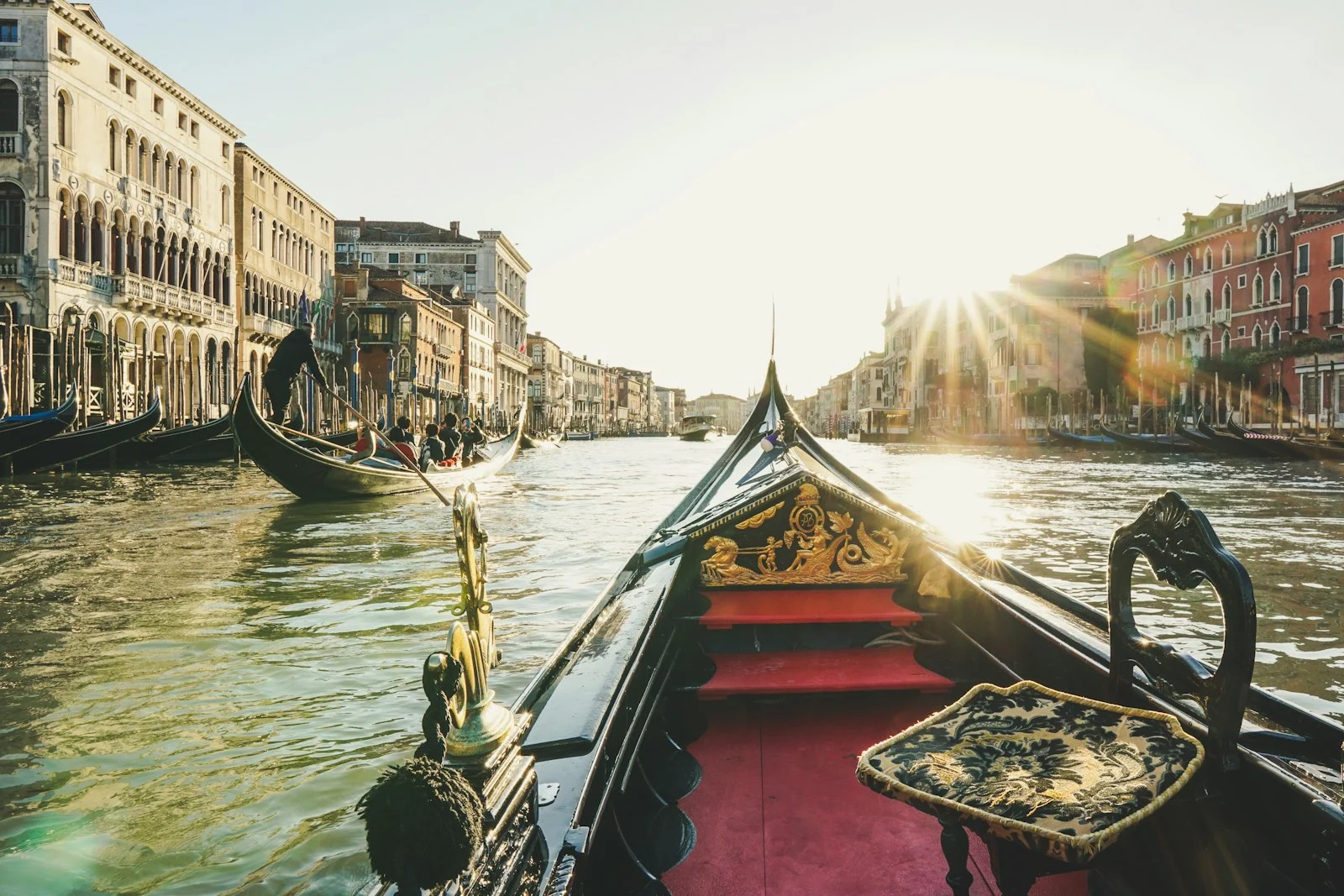
- Daytime, 9:00 to 19:00 — EUR 90 for 30 minutes.
- Evening and night, 19:00 to 4:00 — EUR 110 for 35 minutes.
- Any other length — pro rata. So 45 minutes by day is EUR 135, and an hour is EUR 180.
- Passengers — no more than five. That is written into the regulations with no exception for children: a child on your lap is still a passenger, and a family of six will not fit in one gondola.
Plenty of websites still say “up to six people” and “EUR 40 for every extra 20 minutes”. Those are leftovers from the old tariff, when a gondola cost EUR 80 for 40 minutes. Today an extra 20 minutes by day works out at EUR 60 pro rata, which is worth knowing before a gondolier offers to “carry on a bit”.
The city states plainly that the length of a ride may shift by a few minutes because of water traffic, tides and weather. And under the regulations the fare table must be displayed at every gondola station, on the landing stage and in every gondola. If you cannot see one, be wary before you even step aboard.
Day or evening: the winter sunset trick
The line between the daytime and evening fare is 19:00 all year round. But the sun sets in Venice at very different times: around 21:00 in mid-June and around 16:30 in early December. The arithmetic follows.
- From mid-October to mid-March the sun goes down before 19:00. A ride at dusk, as windows and lamps along the canals light up, costs the daytime EUR 90. In December that is roughly 16:30 to 18:30, before a child is worn out and ready for dinner.
- In summer the evening fare after 19:00 mostly buys daylight: it does not get dark until about nine. For the lights you would have to wait until late, which with children rarely works.
- Morning is the calmest time on the water: fewer boats, shorter queues at the stations, and gondoliers more willing to head into the side canals.
In November and December Venice gets acqua alta. With a high tide a gondola may not fit under the low bridges, and the route will change. That is not a scam, just physics — confirm the route on the spot. And dress your child more warmly than for walking: on the water in winter it is noticeably colder.
Songs, accordions and “serenades”
A song is not part of the fare. The official EUR 90 or EUR 110 covers the boat and the oarsman, and the gondolier is not obliged to sing — most do not. Music works differently in Venice: a singer and an accordionist are hired separately, most often for a “serenade”, where several gondolas travel in convoy along the Grand Canal with the musicians in one of them.
These rides are sold by agencies and booking sites per seat rather than per boat, and the price there is set by the market, not the city. If you want music, agree it and the amount before boarding, as a separate item. If the gondolier bursts into song mid-ride and then asks for extra that you never agreed, you are not obliged to pay.
Sharing a gondola: how the price is split
Since the fare is per boat, it can be shared. There are two ways.
- Team up yourselves at the station. Couples and small groups often look for others to share with. The gondola price does not change; you simply split it: EUR 90 among five is EUR 18 each. For a family of four, a fifth passenger saves EUR 18 in total — not much, and with a stranger aboard you cannot shape the route around your child.
- Buy a seat in a shared gondola through an agency. That is a packaged product with a meeting point and a fixed route, usually along the Grand Canal. In autumn 2026 booking sites were selling these seats from about EUR 30 per person upwards, with child prices varying between operators. For a family of four this almost always costs more than a whole gondola at the official fare.
The upshot for families: with two or more children a whole gondola is nearly always better value than sharing, and you choose the route.
The traghetto: a two-minute gondola for EUR 2
There are only four bridges over the Grand Canal, so traghetti — gondola ferries with two oarsmen — cross between them. A couple of minutes across the canal, and your child can say, quite truthfully, that they have ridden in a gondola. It is city public transport, and the fares are published by the council.
- Price: EUR 2 per person; EUR 0.70 for residents and IMOB card holders. The official price list has no child fare.
- Capacity: up to 12 passengers.
- You pay the gondolier, so keep some coins handy.
| Crossing | Weekdays | Weekends and holidays |
|---|---|---|
| Dogana | 9:00–18:00 | 9:00–18:00 |
| Santa Maria del Giglio | 9:00–18:00 | 9:00–18:00 |
| San Tomà | 8:30–19:00 | 9:00–18:30 |
| Santa Sofia | 8:30–19:00 | 9:00–18:00 |
| Carbon | 9:00–12:00 | closed |
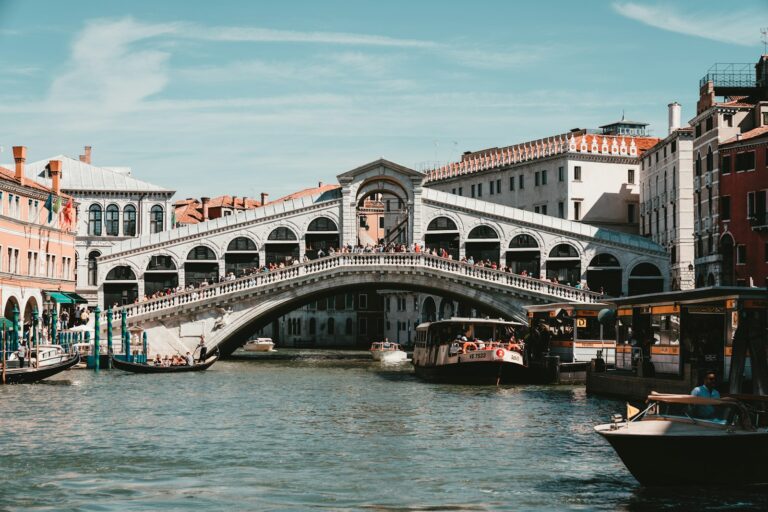
The handiest for families are Santa Sofia, which crosses to the market by the Rialto Bridge, and Santa Maria del Giglio, which crosses towards the Salute church. At San Tomà tourist queues have built up since 2024–2025: locals complain the crossing has turned into a “two-euro gondola”, and at the landing you will be queuing alongside people who simply need to get to the other side. Venetians traditionally cross standing up, but with a child sit down on the bench straight away: passing motorboats make the boat rock.
If you are in Venice over Christmas, check the table: the traghetti do not run on 25 and 26 December.
What age it suits, and how safe it is
The rules set no age limit. Parents’ experience suggests children from about five sit through half an hour happily: they love watching the gondolier push off a house wall with his foot on a bend and call out “oé!” before a blind corner. For a three-year-old thirty minutes can feel long, and the traghetto is an honest substitute. Teenagers tend to like gondolas less than their parents expect; they are more likely to be won over if they get to choose the route.
What the city’s regulations say about safety:
- The gondolier must hold a certificate as an “experienced swimmer” — no licence is issued without it.
- Life jackets for passengers are not mentioned in the regulations, and there is no requirement to wear one. If it matters to you, ask the gondolier before boarding or bring your child’s own.
- Boarding. Many stations have an attendant with a boathook who holds the gondola against the landing; it is a licensed job in its own right. Hand your child across from arms to arms, step into the middle of the boat and sit down at once. Standing up while moving is not allowed.
- A pushchair will have to be folded: a gondola is narrow and there is no room for one.
With small children there is one rule above all: quiet canals rather than the Grand Canal. The Grand Canal carries vaporetti, water taxis and delivery boats, all throwing up a wash, and a gondola rocks noticeably. In the narrow canals the water is almost still.
Where to board and which route to ask for
There are ten official gondola stations, or stazi: Danieli, Molo, Dogana, Trinità, Santa Maria del Giglio, San Tomà, San Beneto, Carbon, Santa Sofia and San Marcuola. The fare is the same at all of them; what differs is the queue and where you can get to in half an hour.
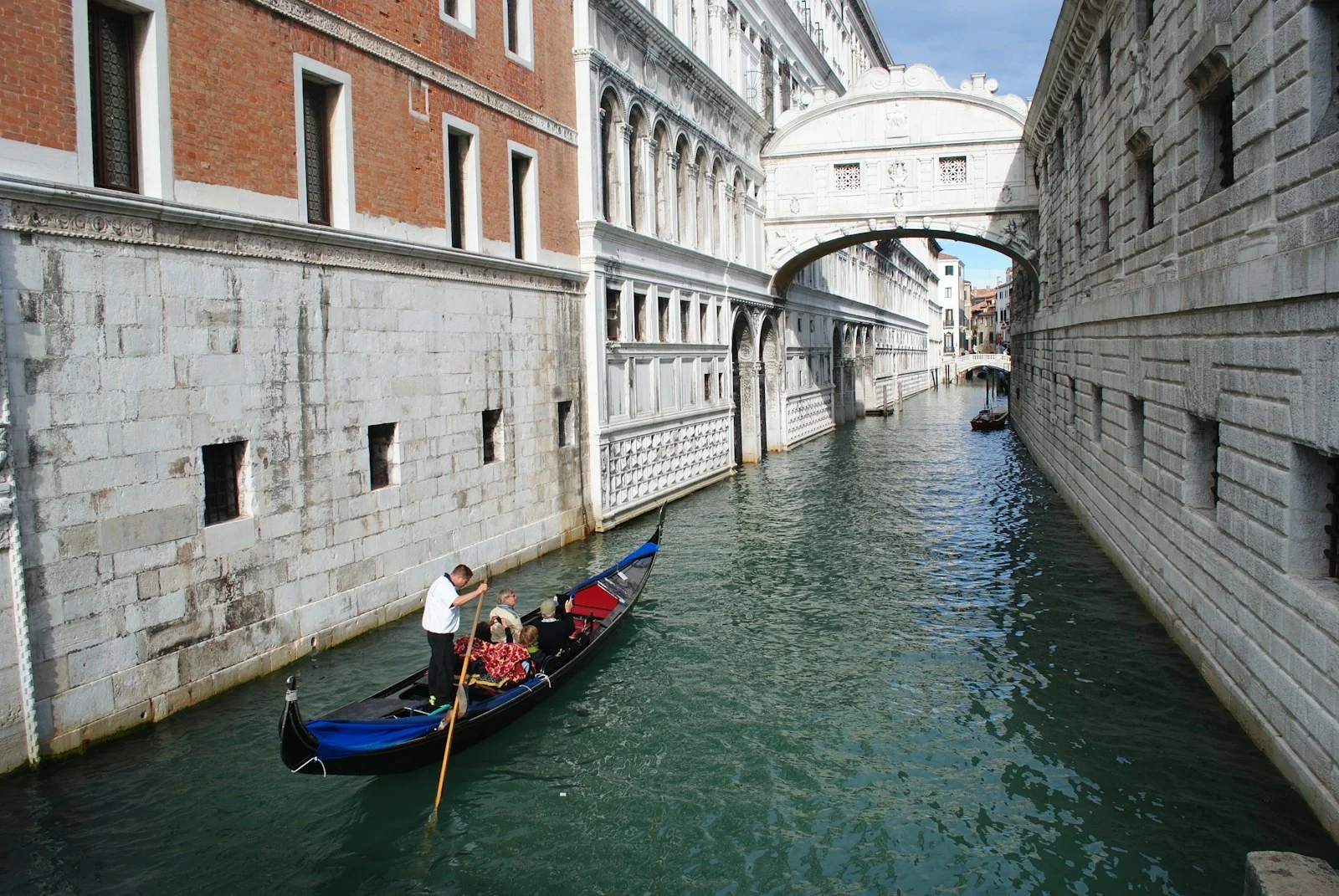
- Around San Marco (Danieli, Molo, Dogana, Trinità, Santa Maria del Giglio and San Beneto at the Bacino Orseolo) — the most gondolas and the most people. It is easy to slip into the narrow canals behind the square from here, but the water off San Marco is also the choppiest.
- By the Rialto (Carbon) and in San Polo (San Tomà) — the middle of the Grand Canal: good if you want to see the palaces from the water.
- In Cannaregio (Santa Sofia by the Ca’ d’Oro, San Marcuola nearer the station) — quieter, shorter queues, with calm residential canals close by.
Thirty minutes is not enough for both the Grand Canal and the quiet backwaters: it is either a stretch of the Grand Canal with a turn into a side canal, or a loop entirely through the little rii. Say what you want before boarding: “only the small canals” or “a bit of the Grand Canal”. Gondoliers usually know a couple of routes from their station that fit comfortably into half an hour. As for the whole Grand Canal, it is cheaper and longer by vaporetto — more on that below.
How not to overpay: five questions before you board
The fare is fixed, but misunderstandings happen, almost always because something was not agreed in advance. Before boarding, ask:
- Is the price per boat or per person? The right answer is per boat: EUR 90 by day, EUR 110 in the evening.
- How many minutes? 30 by day, 35 in the evening. Note the departure time on your phone.
- Which route? Say what you want to see and check that it fits into the time you are paying for.
- Anything on top of the fare? A song, photos, “a bit longer” — only if you agreed beforehand and know the amount.
- How do I pay? Cash is common — check in advance, so you are not hunting for a cash machine at the landing.
Two things help you check: the fare table, which the rules say must be displayed in every gondola, and the licence number fixed to the outside of a crosswise board in the boat. If you are overcharged anyway, the council takes complaints through its DIME digital service or on 041 041 — and the licence number will come in handy.
The sums for a family of four
Take two adults and children aged seven and ten, on a weekday in December.
| Option | On the water | Whole family | What you see |
|---|---|---|---|
| Gondola, 9:00–19:00 | 30 minutes | EUR 90 | narrow canals and/or a stretch of the Grand Canal |
| Gondola, after 19:00 | 35 minutes | EUR 110 | the same, in the dark |
| Gondola by day, 45 minutes | 45 minutes | EUR 135 | both the Grand Canal and quiet canals |
| Vaporetto, line 1 | the whole Grand Canal | EUR 38 (4 × 9.50) | every palace from the water, but with a crowd |
| Traghetto | a couple of minutes | EUR 8 (4 × 2) | one crossing of the canal |
If the goal is to see the Grand Canal, the vaporetto wins: EUR 38 for four, and you travel its whole length from the station to San Marco. If the goal is a gondola ride as such, the EUR 8 traghetto gives a child that very feeling. And EUR 90 for a gondola buys what neither offers: the quiet of the narrow canals, where you can hear the water lapping at the walls, with the boat to yourselves.
Our answer for a family of four: take a gondola once, by day, into the narrow canals — and if you are visiting between October and March, at dusk before 19:00. Use the vaporetto for the Grand Canal, and the traghetto as a bonus when you need the other bank anyway. How to fit all this into a single day is in our route what to see in Venice in one day.
One more detail for day-trippers: in 2026 the access fee for the historic centre was charged on about 60 days between April and July, at weekends and on holidays, with children under 14 exempt. There is none in December.
A children’s tour of Venice: a journey through the city’s riddles
A walking game around Venice: children solve puzzles, compete in mini-challenges and, with the guide, work out how the city stands on water without sinking — and what it takes to become a gondolier. The route runs through St Mark’s Square, to the Rialto Bridge, along the Grand Canal and through quiet courtyards. A gondola ride is not included, but afterwards your child will look at a gondolier with quite different eyes.
EUR 250 per group of up to 5 · 2.5 hours · ages 6+ · gondola not included
Our other routes in the city are on the page tours in Venice.
Frequently asked questions
How much is a gondola ride in Venice?
Under the city tariff, EUR 90 for 30 minutes between 9:00 and 19:00, and EUR 110 for 35 minutes between 19:00 and 4:00. That is the price for the whole gondola, not per person. Other lengths are charged pro rata: 45 minutes by day is EUR 135.
How many people fit in a gondola?
No more than five passengers, as set out in the city regulations. There is no exception for children: a baby on your lap counts too, so a family of six needs two gondolas.
Is the gondola price per person or per boat?
Per boat. With four of you, the daytime fare works out at EUR 22.50 each. You can team up with strangers at the gondola station and split EUR 90 five ways; the fare itself stays the same.
Does the gondolier sing as part of the price?
No. The official fare covers the boat and the oarsman only. A singer or musician is a separate service at a separate price, agreed before you board.
What is a traghetto and how much does it cost?
A gondola ferry across the Grand Canal: a couple of minutes on the water for EUR 2 per person (EUR 0.70 for residents). Five crossings are running at the moment, each with its own hours. The official price list has no child fare.
From what age can a child ride a gondola?
The rules set no age limit. Children from about five usually sit through thirty minutes happily; with a toddler, choose the quiet canals rather than the Grand Canal, where motorboats kick up a wash.
Do gondolas provide life jackets for children?
The city’s gondola regulations do not require passengers to wear life jackets, while the gondolier must hold a certificate as an experienced swimmer. If a life jacket matters to you, ask the gondolier in advance or bring your own.