Contents 11
- What it costs
- Children: free under six, then the adult fare
- How to pay: three ways
- Validation and the fine
- Suitcases and pushchairs
- The lines a visitor needs
- How not to go the wrong way
- Queues: the station, Piazzale Roma, San Marco
- From the airport: Alilaguna or the bus
- At night
- Pass, singles or on foot: the sums for a family
What it costs
The vaporetto, like the Mestre buses, the tram and the People Mover, is run by the municipal company ACTV (part of the AVM group). They share one set of tickets, and for visitors the prices are:
| Ticket | Price | Worth knowing |
|---|---|---|
| Single, 75 minutes | EUR 9.50 | validate at every pontoon, including when changing boats |
| 24 hours | EUR 25 | the hours run from first validation |
| 48 hours | EUR 35 | |
| 72 hours | EUR 45 | |
| 7 days | EUR 65 | |
| 72 hours with Rolling Venice, ages 6–29 | EUR 27 + EUR 6 for the card | the card is valid for a year |
| Airport supplement on a pass | EUR 7 one way, EUR 13 return | ACTV bus to Marco Polo Airport |
Note the last row: neither a single ticket nor a pass covers the airport on its own; airport routes have a separate fare. Also, the vaporetto does not exempt you from the city access fee. In 2026 it was charged to day-trippers on 60 separate days between April and July, at EUR 5 or EUR 10; it does not apply in December.
Children: free under six, then the adult fare
Under ACTV rules a child travels free until their sixth birthday. They need no ticket and nothing to validate. From six a child pays the full fare: ACTV has no child or family tickets.
The only discount is the Rolling Venice card for young people aged 6 to 29. It costs EUR 6, lasts a year and entitles you to a 72-hour pass for EUR 27 instead of EUR 45. That is EUR 12 saved per person on a single pass, so if you are in Venice for three days, get a card for every child aged six or over and for any parent still under 30. The card is sold at Venezia Unica ticket offices, or bought online at veneziaunica.it and collected from a machine; bring a document that shows the holder’s age.
How to pay: three ways
- A bank card straight on the validator. Contactless Visa, Mastercard, Maestro and American Express all work, as do phones and watches holding a card. Tap it on the validator at the pontoon entrance: a beep and a green light mean you are through. On the water there is no need to tap again when you get off. The charge appears the following day as one sum.
- The AVM Venezia app. It sells both single tickets and passes; the ticket lives only on the phone and cannot be moved to a plastic card. Before boarding you activate it, and a QR code for the validator appears on the screen. One important detail: it always takes 3 minutes from activation for the code to appear. Activate the ticket while you walk to the stop, not as the boat is pulling in.
- Machines and ticket offices. Machines stand at the main stops, and Venezia Unica offices are at Piazzale Roma, the station and the airport. If you bought a ticket in advance on veneziaunica.it, you receive a booking code (PNR) by email: enter it at a machine and it prints the ticket.
Paying by card has a feature few people know about: it turns itself into a pass. As soon as the rides on one card add up to more than EUR 25 within 24 hours of the first tap, the system issues a 24-hour pass. The same applies at EUR 35 for 48 hours, EUR 45 for 72 hours and EUR 65 for a week. So you do not have to decide in advance whether to buy a pass: pay per ride and you will never pay more than the pass would have cost.
One card can pay for up to five people: everyone’s tap is made on the same validator within 60 seconds, and you then travel together. ACTV does not explain how the EUR 25 cap works in that case. If the family plans to ride a lot, it is safer for each adult to pay with their own card or phone and to buy passes for children over six. At an inspection you show the same card or phone you paid with.
Validation and the fine
A ticket must always be validated, and before you step onto the pontoon: the validators are at the entrance, not on board. That applies to passes and to changes too: every boarding is a fresh tap. You cannot buy a ticket on board with cash: since 1 July 2024 only cashless payment is accepted on the water.
Without a ticket, or with an unvalidated one, the amount depends on how quickly you pay:
- within five days, EUR 64.50: a EUR 50 fine, EUR 9.50 for the ride itself and EUR 5 in costs;
- from day 6 to day 60, EUR 124.50;
- from day 61, up to EUR 324.50 by court order.
The same amounts apply to luggage that breaks the rules, covered below.
Suitcases and pushchairs
With a valid ticket you can carry up to three pieces of luggage free, each no more than 150 cm in length, width and height combined. For a fourth suitcase and beyond you buy another ticket for every three pieces. A suitcase over 150 cm is not allowed on board at all.
A practical point: 150 cm is roughly a medium suitcase. A large checked case of 75 × 50 × 30 cm already comes to 155 cm and is formally over the limit. If you are coming for a week with an enormous suitcase, measure it before you travel.
ACTV rules let a pushchair travel free when folded. On the water there is an exception: if the boat is not crowded and it is safe, you may board with it unfolded. In practice, at rush hour a crew member will ask you to fold it, so it is easier to hold a toddler in your arms as you board. The large boats on line 1, with their open deck, have noticeably more room than the narrow launches on other lines.
The lines a visitor needs
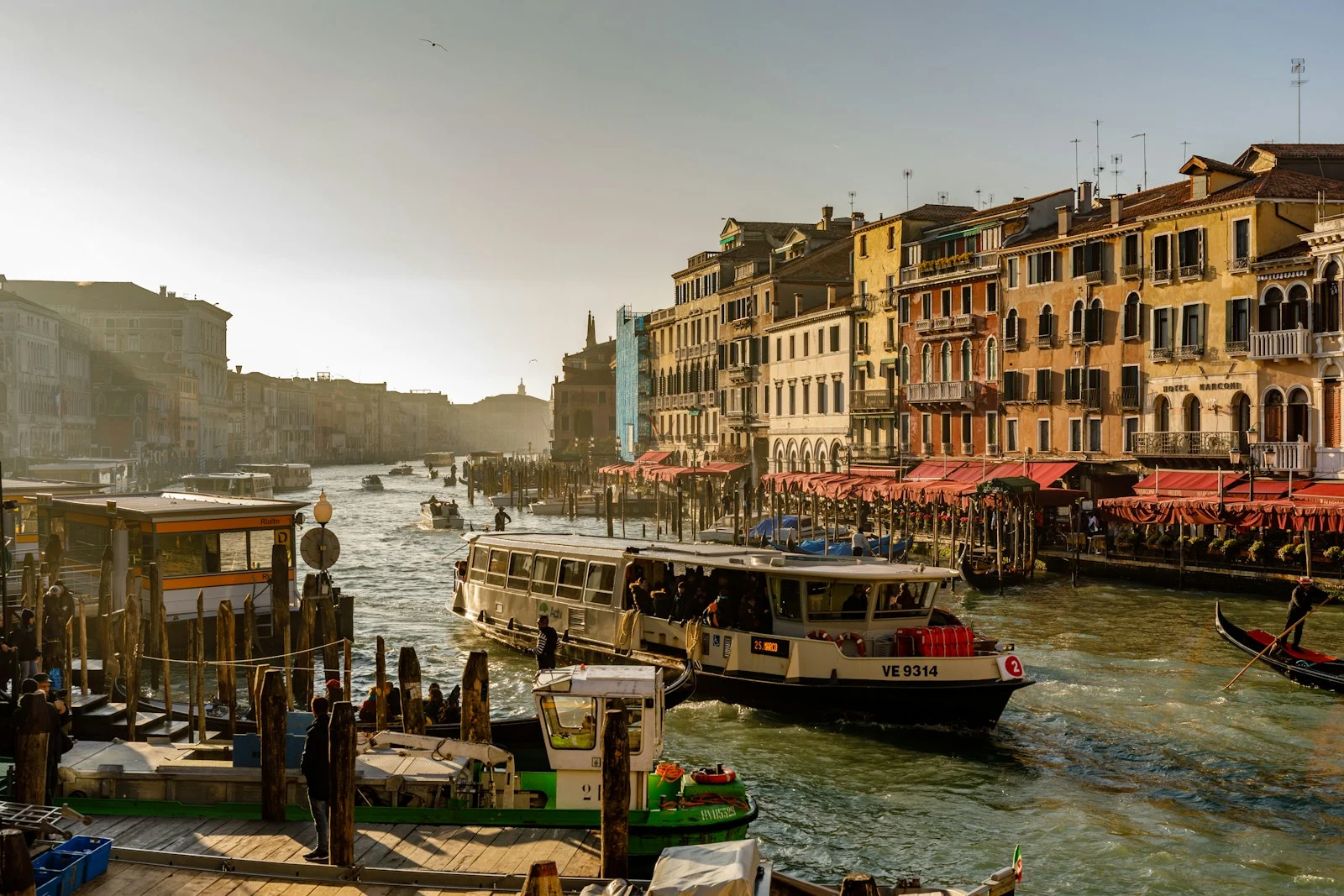
- Line 1 is a slow ride along the whole Grand Canal: Piazzale Roma, Ferrovia, Rialto, San Marco and on to the Lido. It calls at almost every stop and takes about 45 minutes from Piazzale Roma to San Marco. It is the best sightseeing trip you can get for the price of one ticket.
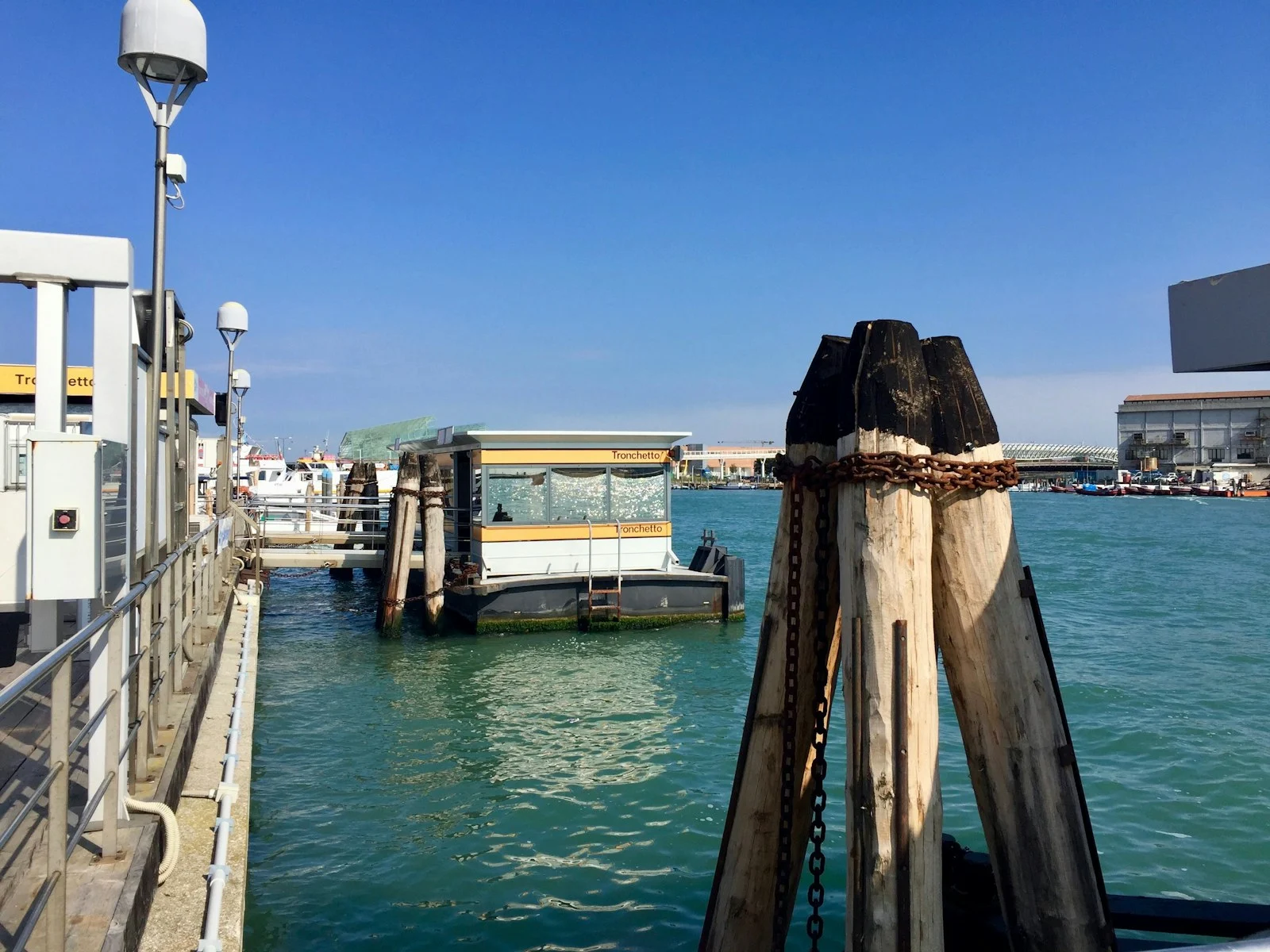
- Line 2 also runs along the Grand Canal but with fewer stops, so it is faster. On the other side it loops round the city along the Giudecca Canal via the Zattere and Tronchetto. Use it if you simply need to get quickly from the station to Rialto or San Marco.
- 4.1 and 4.2 circle the city in opposite directions: Murano, Fondamente Nove, Ferrovia, Piazzale Roma, Giudecca, San Zaccaria. The main line to Murano.
- 5.1 and 5.2 are another loop in both directions: Lido, Fondamente Nove, Ferrovia, Piazzale Roma, San Marco/San Zaccaria. Handy if you are going from the station to the Lido and do not want to crawl down the Grand Canal.
- The Lido is served by line 1 and by 5.1/5.2; from San Zaccaria it is a short hop.
- Line 12 runs from Fondamente Nove to Murano (the Faro stop), Mazzorbo, Burano, Torcello and Punta Sabbioni. Burano is about 40–45 minutes away, with a boat roughly every half hour in season.
Timetables change with the seasons and on public holidays, so check the exact times in the AVM Venezia app on the day.
How not to go the wrong way
The number one beginner’s mistake is boarding the right line in the wrong direction. At the bigger stops each line and direction has its own pontoon, marked with letters: A, B, C, D. A sign at the pontoon entrance shows the line number and the next stops, and a display on board shows the destination. Before boarding, check that your stop is on the list; if in doubt, ask the crew member who opens the gate: “San Marco?” You will have a “sì” or “no” within a second.
The circular lines need particular care. 4.1 and 4.2 run the same loop in opposite directions, as do 5.1 and 5.2. Both will get you there, but one in ten minutes and the other via half the city. Check the map at the pontoon to see which way is shorter.
Queues: the station, Piazzale Roma, San Marco
Most people arrive by train at Santa Lucia station or by bus at Piazzale Roma, and on a summer morning everyone heads for lines 1 and 2 at once. At the Ferrovia pontoon a boat sometimes leaves full and you wait for the next. If you came by bus, board right at Piazzale Roma: it is the first stop on line 1, the boat arrives empty and you can take seats at the front. From the train it means crossing the Constitution Bridge with its steps, so with a pushchair and suitcases it is simpler to wait for the next boat at the station.
In the evening it is the other way round: queues build up at the San Marco stops as everyone heads back to the station at the same time. If your day ends at St Mark’s Basilica and your child can still walk, go on foot to Rialto in 15–20 minutes and board there: it is easier to get on and a calmer walk.
If you are coming to Venice by train, how to buy a ticket without overpaying is in our article on trains in Italy.
From the airport: Alilaguna or the bus
Boats from Marco Polo Airport to the centre are run by a private company, Alilaguna, not ACTV, so ordinary tickets and passes are not valid on them. A single is EUR 18 and a return EUR 32. The fare includes one large suitcase and one piece of hand luggage, and each extra piece is EUR 4. Children under six travel free with an adult. The Orange line runs straight down the Grand Canal via Rialto to the Giglio stop near San Marco, taking a little over an hour.
Cheaper and faster is the ACTV Aerobus to Piazzale Roma for EUR 10, then the vaporetto. If you are buying a pass anyway, the airport supplement is EUR 7 one way.
At night
At night the daytime lines are replaced by line N. It runs a big loop: from San Zaccaria along the Giudecca Canal to Tronchetto and Piazzale Roma, then down the Grand Canal past Rialto and the Accademia to San Marco and on to the Lido. Tickets and passes are valid on it. It runs less often than the daytime lines, so if you are getting back to your hotel late, check the last daytime boat and the next night one in the app beforehand.
Pass, singles or on foot: the sums for a family
Take a family of two adults and children aged 5 and 9. The five-year-old travels free, so three people pay. The break-even point is simple: the 24-hour pass pays off from the third ride of the day (3 × EUR 9.50 = EUR 28.50 against EUR 25), 48 hours from the fourth, 72 hours from the fifth and the week from the seventh.
| Scenario | Singles | Passes | Best choice |
|---|---|---|---|
| One day: station to San Marco on line 1, walk back | 3 × EUR 9.50 = EUR 28.50 | 3 × EUR 25 = EUR 75 | singles |
| One day with Murano and Burano: 4 rides | 12 × EUR 9.50 = EUR 114 | 3 × EUR 25 = EUR 75 | 24-hour pass |
| Three days, 2–3 rides a day | from EUR 171 | 2 × EUR 45 + Rolling Venice for the 9-year-old EUR 33 = EUR 123 | 72 hours |
And the main point: Venice is small, and on foot it is often quicker. From the station to St Mark’s Square is 40–50 minutes at an adult pace, following the yellow “Per S. Marco” signs — almost as long as line 1 takes. So for a day visit this pattern works: there by vaporetto down the Grand Canal for the view, back on foot via Rialto. How we put a day in Venice together is in what to see in Venice in one day. If you just need to cross the Grand Canal where there is no bridge nearby, look for a traghetto, a gondola ferry that takes a couple of minutes from bank to bank. Whether a proper gondola ride is worth it with a child, and what it costs, we cover separately.
We do not run a vaporetto tour, but we do have children’s quests around the city itself — all our routes in Venice.
Frequently asked questions
How much does the vaporetto in Venice cost in 2026?
A 75-minute single ticket is EUR 9.50. Passes: 24 hours EUR 25, 48 hours EUR 35, 72 hours EUR 45, 7 days EUR 65. The time runs from first validation, not by calendar day.
At what age do children pay for the vaporetto?
From six. Until their sixth birthday children travel free with no ticket. From six they pay the full fare; there are no child tickets. Young people aged 6–29 get a discount with the Rolling Venice card: 72 hours for EUR 27, plus EUR 6 for the card itself.
Can I pay for the vaporetto with a bank card?
Yes. A contactless Visa, Mastercard, Maestro or American Express card, or a phone or watch holding one, is tapped on the validator at the pontoon entrance. You are charged the single fare, but one card is never charged more than EUR 25 in 24 hours: the system turns your rides into a pass automatically.
Is a vaporetto pass worth it?
The 24-hour pass pays off from three rides a day, 48 hours from four rides, 72 hours from five and the week from seven. If you are in town for a day and walk back to the station, single tickets are cheaper.
What is the fine for riding the vaporetto without a ticket?
For travelling without a ticket or with an unvalidated one: EUR 64.50 if paid within five days (EUR 50 fine, EUR 9.50 fare and EUR 5 costs), EUR 124.50 from day 6 to day 60, and up to EUR 324.50 after that.
Can I take a suitcase and a pushchair on the vaporetto?
With a ticket you can carry up to three pieces of luggage free, each no more than 150 cm in total dimensions; anything larger is not allowed at all. Fold the pushchair if you can; an unfolded one is allowed when the boat is not crowded.
Which vaporetto goes to Murano and Burano?
For Murano, the circular lines 4.1 and 4.2 from Fondamente Nove. For Burano, line 12 from Fondamente Nove via Murano, which takes around 40–45 minutes. All of them are covered by the ordinary ticket and passes.