Contents 8
- How to explain it in one minute
- Why build a city in a lagoon at all?
- An upside-down forest: what the houses stand on
- Why the piles haven’t rotted in all these centuries
- A stone sock: why there is a white band at the bottom
- High water: when the sea drops in
- MOSE: 78 gates on the seabed
- Where to see it all for yourselves
How to explain it in one minute
If your child asks right there on a bridge, here is the one-minute version. Feel free to put it in your own words:
“Imagine pushing into wet sand not one stick but a hundred, packed tight, one against the next. One stick sinks if you press on it, but a hundred will hold up a book. The Venetians did the same, only the sticks were tree trunks and the sand was the mud at the bottom of the lagoon. Under one church there are more than a million of them. On top they laid planks, then a stone that keeps the water out, and only then built the houses. The trunks don’t rot because there’s no air in the mud, and without air the fungi that spoil wood can’t live. So Venice stands on a forest — only it’s upside down and hidden underground.”
What follows is the detail for the grown-up, in case the next question is “but why…”.
Why build a city in a lagoon at all?
A lagoon is neither sea nor land. This one is a vast, shallow “bath” between the mainland and the Adriatic, cut off from the sea by long, narrow islands. Water flows in and out through three inlets twice a day with the tides. Across most of the lagoon the water is only about a metre deep, and you need to know where the navigable channels run between the shallows.
That is exactly why people fled here. In 452, while Attila’s Huns were laying waste to towns on the mainland, their inhabitants hid on the lagoon islands. And in 568–569, when the Lombards invaded Italy, people from the mainland began to move here for good. An enemy army in heavy ships ran aground in the lagoon, while the locals knew where the channel lay. The channels are still marked today by “bricole” — clusters of oak posts sticking out of the water. You can see them from any boat to Murano or the Lido.
Venice even has a “birthday”: 25 March 421. But that is a legend — medieval chroniclers made the date up, and in reality the city grew gradually out of settlements on different islands. Children love the idea that a city has a birthday, like a person. Just be honest that it is a fairy-tale one.
An upside-down forest: what the houses stand on
The ground under Venice is soft mud and sand, rather like porridge. Put a stone house on it and it will slowly sink and tilt. The builders solved this in four layers:
- Piles. Hundreds or thousands of sharpened trunks were driven into the mud, packed tightly together. They compacted the ground around them and held by friction, and the longest reached the caranto. That is the Venetian name for a layer of dense ancient clay: geologists explain that it is a soil that formed when this was still dry land, before the sea covered it. The caranto is much firmer than the mud and carries foundations well, some of them dating back to Gothic times.
- Platform. The tops of the piles were cut level, and planks and beams of oak and larch were laid across them — a wooden “raft”.
- Stone. On the raft went Istrian stone, more on which below.
- Brick. Only above that did the ordinary brick walls begin.
Which trees were used? Scientists from Italy’s National Research Council (CNR) took samples from foundations in five of Venice’s six districts and found just five or six species: alder, larch, oak, pine, elm and spruce. Spruce seems to have come into use later than the rest. The Rialto Bridge, according to a study by the same group, stands mostly on alder. Timber for the piles came from the mainland, including the foothills of the Alps.
The most famous example is the church of Santa Maria della Salute at the entrance to the Grand Canal. Building began in 1631 in thanks for the end of a plague, and according to a description of the city from 1663, 1,106,657 piles of oak, alder and larch were driven in beneath it, each about four metres long. The piling took more than two years. Nobody can recount them today — you can hardly dig up the church — so tell your child it is the number “from an old record”. But even if the clerk was out by tens of thousands, that is still more than a million trunks under a single building.
An experiment at home before the trip. Fill a bowl or basin with sand or potting soil and soak it with water. Push in one pencil and press down on it with your palm — it sinks. Now push in twenty pencils tight together, lay a piece of card on top and stand a mug on it. It usually holds. That is a Venetian foundation in miniature. If your child already knows why the tower in Pisa leans, draw the parallel: soft ground is the whole story there too, as we explain in why the Leaning Tower of Pisa doesn’t fall.
Why the piles haven’t rotted in all these centuries
Wood does not rot on its own: it is eaten by fungi, and fungi, like us, need oxygen. Under the houses the piles sit in dense, waterlogged mud that air barely reaches. Fungi cannot live there, so the timber survives for centuries.
But the piles are not eternal. Some bacteria work without oxygen, only very slowly. In that same CNR study most of the foundation samples showed decay, and in the worst of them the wood had kept only about a third of its original density. How well it survived depended on the thickness of the timber, how deep it was buried, whether it lay flat or stood upright, and the species. In the Rialto Bridge piles, severe bacterial attack turned up in just one alder sample, and the rest of the foundation was in good condition. So the honest answer to “why don’t they rot?” is: they do, but so slowly that the houses stand for hundreds of years.
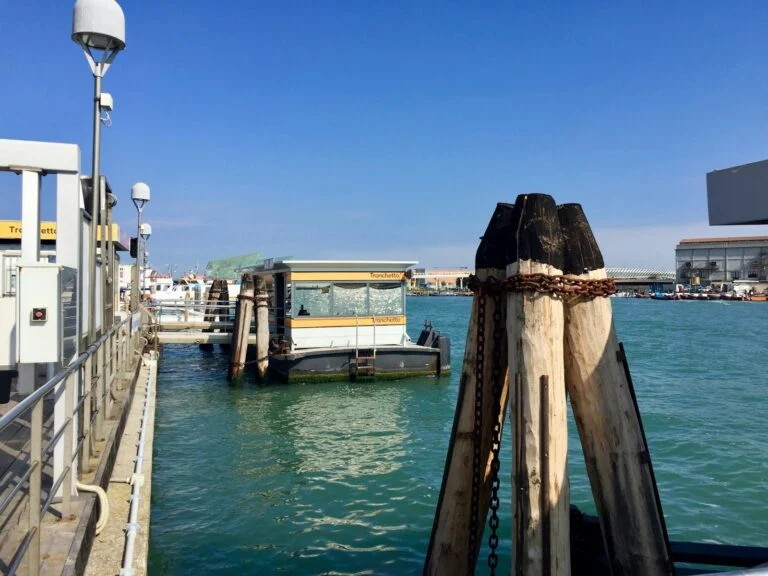
And here is the most vivid comparison, one you can show from any waterfront. Look at the wooden posts in the water by the landing stages, where boats are tied up. They are oak too. But these posts stand in open water, where there is oxygen and where shipworms live — wood-boring molluscs that drill into the timber from inside. According to a 2025 study, these oak posts in Venice often have to be replaced every 18–24 months. The lagoon has warmed by about 2 °C in twenty years, and since 2013 warm-water shipworms, even greedier ones, have turned up here. So the same wood lasts centuries in the mud under a house, and a couple of years in the water at a jetty.
Since 2015 people have been trying to protect the posts: some are clad with metal staples, others are made of polyurethane. Turn it into a hunt: who will be first to spot a stapled post or a “plastic” one among the wooden ones?
A stone sock: why there is a white band at the bottom
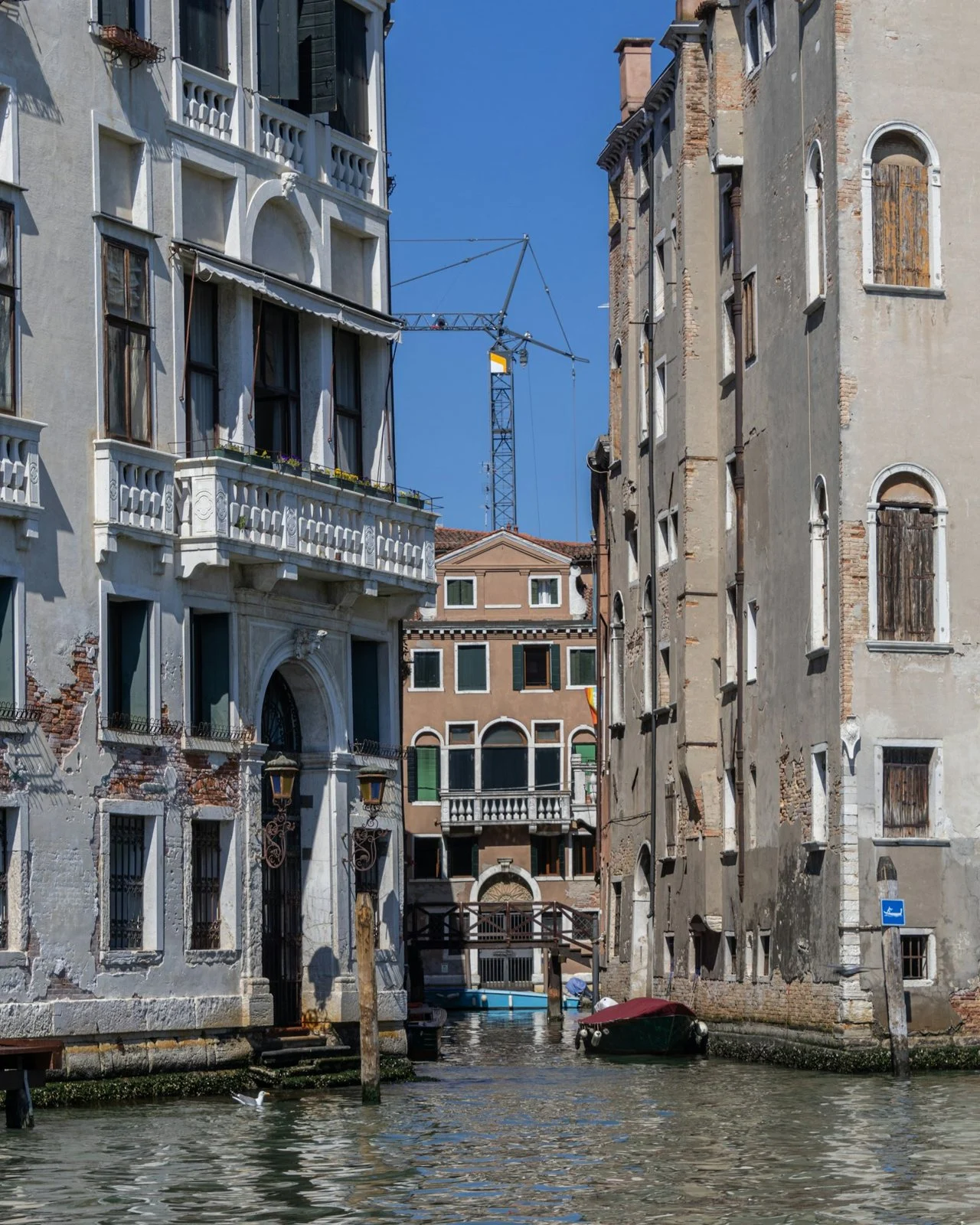
Look at any palace from the water, for instance from a vaporetto on the Grand Canal. The walls are brick, red or rendered, but the lower part going down into the water is smooth white or pale grey stone. This is Istrian stone, a dense limestone from the Istrian peninsula on the far side of the Adriatic, now in Croatia. It came by sea, and Venice valued it above all because it absorbs almost no water. From roughly the 14th century it was used as a matter of course at the base of buildings.
You can explain it over a cup of tea. Dip the corner of a sugar cube into the cup and the tea runs up through the whole cube. Brick behaves similarly, only more slowly. Salty lagoon water creeps up into it, dries and leaves salt behind, and the salt crystals slowly break the brick apart from inside. A glass marble in place of the sugar would not soak up any tea. Istrian stone is a “glass” sock with a brick house pulled on over it.
Along the canals you can easily spot three bands on the walls. At the bottom, a dark green band slippery with algae: how high the water reaches almost every day. Above it, the white stone. And where the water rises above the stone, the brick shows crumbling plaster and white salt deposits. Those are the marks of the sea slowly catching up with the city.
High water: when the sea drops in
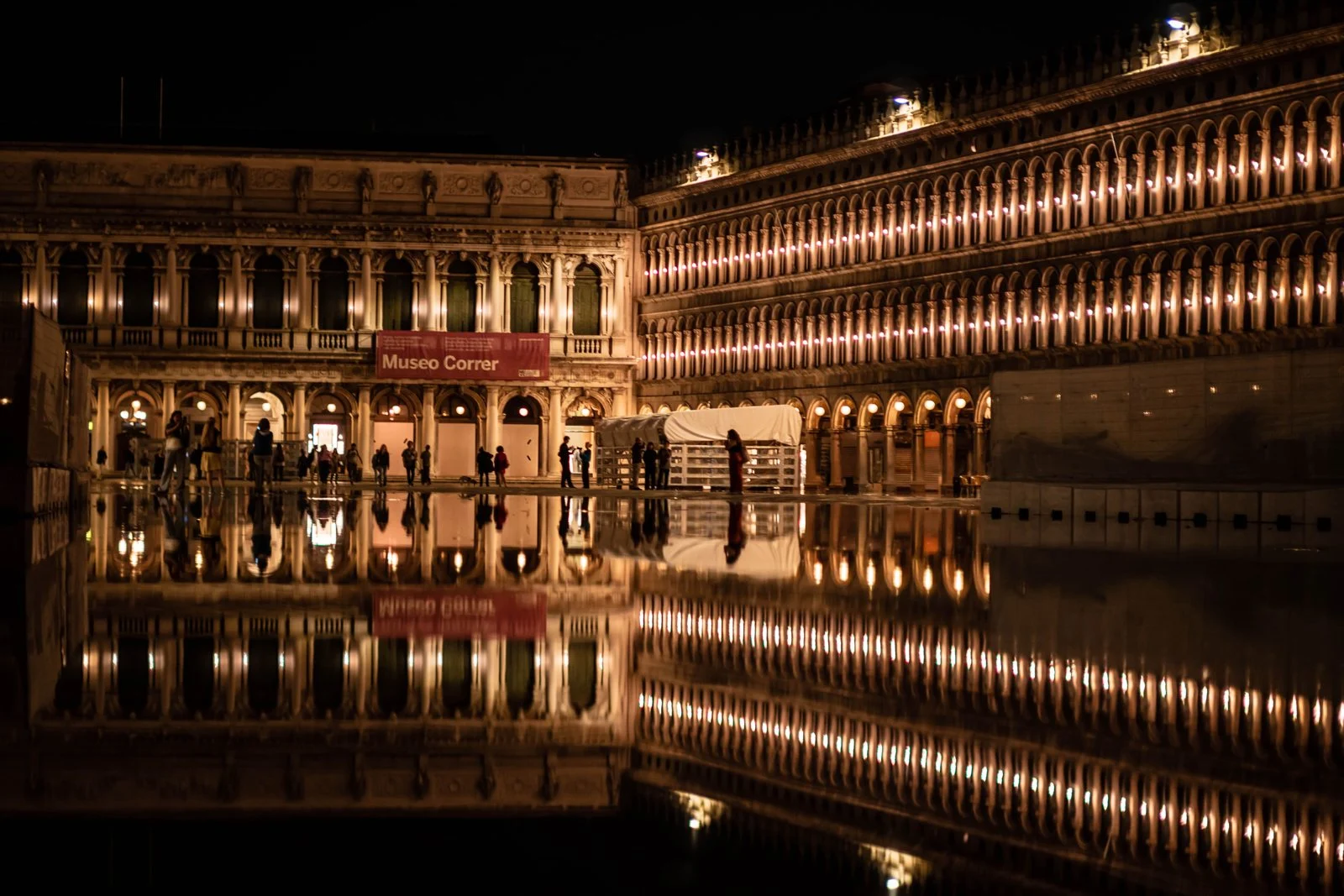
Twice a day the water in the lagoon rises and falls. Usually the difference is small, and the city hardly notices. But sometimes several things coincide: a strong tide driven by the Moon, the warm southerly sirocco wind pushing water up the Adriatic towards Venice, and low air pressure that lets the sea “swell” slightly. Then the water spills out of the canals into the streets and squares. That is acqua alta — high water.
In Venice tide heights are measured from a conventional zero on the tide gauge at Punta della Salute, the point by that very church on a million piles. Here is what the numbers in a forecast mean:
| Tide | Share of the historic centre under water | Siren signal |
|---|---|---|
| 90 cm | 2% | — |
| 100 cm | 5% | — |
| 110 cm | 12% | one long tone |
| 120 cm | 28% | two rising tones |
| 130 cm | 46% | three rising tones |
| 140 cm | 59% | four rising tones |
| 160 cm | 77% | four tones |
| 194 cm, the record of 4 November 1966 | almost 90% | — |
The lowest point in the city is St Mark’s Square. The threshold of the basilica sits at about 65 cm and the middle of the square at about 85 cm, so the square floods long before the rest of Venice. Curiously, the water first appears not over the waterfront but from below: it rises through the drain gratings in the paving, along old channels beneath the square. If you are in St Mark’s at high tide, show your child the water coming up out of the gratings while the edge of the quay is still dry.
The sirens are an adventure in themselves. Before a strong tide, loudspeakers on bell towers across the city sound a signal like the old siren, followed by a few notes. Just count the notes: one long one means 110 cm is expected, two rising ones 120 cm, three 130 cm, and four 140 cm or more. The signal is repeated several times. A child who has “read” the forecast from a siren needs no tour guide.
When it happens: according to the city’s tide centre, of the 296 tides of 110 cm or more recorded from 1872 to 2018, 95% fell between October and March, and November is the most likely month. The record is 194 cm on 4 November 1966; second place is 187 cm on 12 November 2019. And high water has become more frequent: in the early 20th century a tide of 110 cm came on average once a year, and in recent years five or six times a year. There are two reasons: the sea is rising, and the city itself is slowly settling.
In practice, for a family: high water lasts on average about two and a half hours around the peak of the tide and then drains away. The council publishes the forecast for the next few days at comune.venezia.it, and rubber boots are sold right in the city. How to rearrange your day if water is expected in the morning is in our route what to see in Venice in one day, and what happens at the basilica on such days is in our guide to St Mark’s Basilica tickets.
MOSE: 78 gates on the seabed
The most surprising thing about MOSE is that you cannot see it. On the seabed of the three inlets through which the sea enters the lagoon — at the Lido, Malamocco and Chioggia — lie 78 huge steel box-gates. Each is 20 metres wide, between 18.5 and 29.5 metres long and weighs 168 to 330 tonnes — roughly one or two blue whales. On ordinary days the gates are full of water and lie in concrete housings on the bottom, while ships and fishing boats pass over them.
When a strong tide is expected, compressed air is pumped into the gates. The air pushes the water out, the box becomes light, floats up and swings on two hinges like a lid, coming to rest at an angle across the inlet. A row of these gates cuts the lagoon off from the sea, and the tide stays outside. When the danger has passed, the air is let out, the gates fill with water again and settle back on the bottom.
A bath-time experiment. Take a plastic cup, fill it with water and lay it upside down on the bottom of the bath. Slip a straw under it and blow: the air pushes out the water and the cup floats up. That is exactly how the MOSE gates rise — except each one weighs hundreds of tonnes.
The name is an acronym of the Italian for “experimental electromechanical module”, but Italians hear Moses in it — Mosè in Italian — who, in the Bible story, parted the sea. A few more things worth knowing:
- It protects against tides of up to 3 metres and is designed for a sea-level rise of up to 60 cm over the next hundred years, according to the consortium that built it.
- Construction began in 2003, and the gates were first raised for real on 3 October 2020. On 12 March 2025 they went up for the hundredth time, and the Italian Ministry of Infrastructure estimates that over those five years the city was spared more than EUR 2.6 billion in damage. In the winter of 2025–2026 the gates were raised dozens of times in a single season.
- Not every high tide raises them. The gates are closed for forecasts of around 110 cm. A tide of 80–100 cm still reaches St Mark’s Square, so in November or December you may well see walkways and water in the square even though MOSE is working.
- Ships don’t get stuck. A lock about 370 metres long was built at Malamocco so that large vessels can pass even with the gates up.
- It is expensive. The system cost EUR 5.493 billion at 2005 prices, and each raising costs hundreds of thousands of euros. And if the gates go up more and more often, the lagoon exchanges less water with the sea — scientists are still debating what that will mean for it.
Where to see it all for yourselves
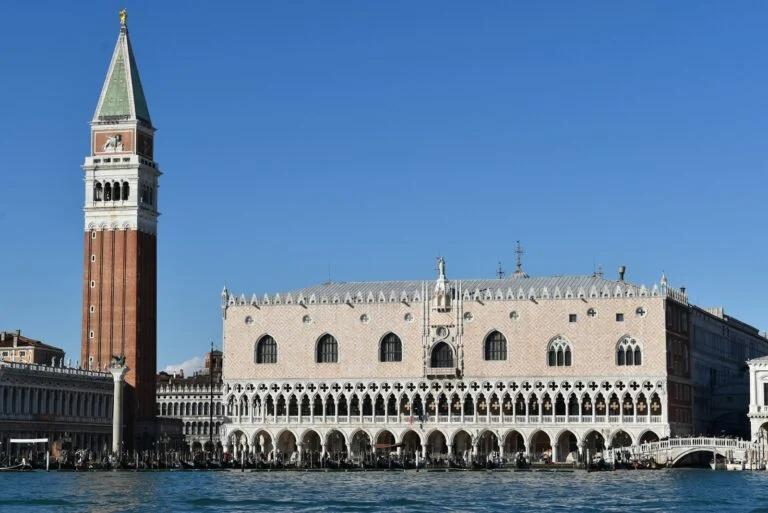
- Santa Maria della Salute — the church “on a million piles”. The best view of it is from the middle of the wooden Accademia Bridge. Then you can walk round to the Punta della Dogana behind the church and watch the Grand Canal meet the lagoon.
- Palaces on the Grand Canal — look for the white stone “sock” and the green band of algae. It is easiest from the slow vaporetto line 1; which ticket to buy is in our guide to the vaporetto in Venice.
- Mooring posts by the palaces and gondola stations — the same oak that lasts a couple of years in the water. Look for posts clad in metal staples.
- The Rialto Bridge — a late 16th-century stone bridge on alder piles. Ask your child to guess how many people are on the bridge right now, and remind them that all of them are held up by wood under the water.
- St Mark’s Square — the lowest point in the city: the drain gratings the water comes up through, and the glass wall put round the basilica’s narthex in 2022.
- Bricole — clusters of posts marking the channels in the lagoon. You can see them from the boat to Murano, Burano or the Lido.
- Sirens — between October and March there is a chance of hearing them. Count the notes.
A children’s tour of Venice: a journey through the city’s riddles
A walking game around Venice in which children work out with the guide how the Venetians managed to build a city on water and why it doesn’t sink. Along the way there are puzzles, mini-challenges and a task about what it takes to become a gondolier. The route runs through St Mark’s Square to the Rialto Bridge, along the Grand Canal and through quiet courtyards. The tour is in English.
EUR 250 per group of up to 5 · 2.5 hours · ages 6+
Our other routes in the city are on the page tours in Venice.
Frequently asked questions
Why doesn't Venice sink?
The city stands on wooden piles driven tightly into the lagoon mud. The piles compact the soft ground and hold by friction, and the longest reach a hard layer of ancient clay called the caranto. On top of the piles lies a timber platform, on that a dense Istrian stone, and only above it the brick walls.
What is Venice built on, and what wood are the piles?
Alder, larch, oak, pine, elm and spruce have been found in its foundations, according to a study by Italy’s National Research Council using samples from five districts of the city. The Rialto Bridge stands mostly on alder, and a description from 1663 puts 1,106,657 piles of oak, alder and larch under the Salute church.
Why don't the wooden piles in Venice rot?
Wood is eaten by fungi, and fungi need oxygen. In dense, waterlogged mud there is almost none, so the piles survive for centuries. Not for ever, though: bacteria work slowly without oxygen, and most of the samples scientists took showed decay, even though the houses still stand on them.
Why was Venice built on water?
To hide. People from the mainland fled to the lagoon islands from Attila’s Huns in 452 and moved there for good after the Lombards arrived in 568–569. In the shallow lagoon enemy ships ran aground, while locals knew the channels. The founding date of 25 March 421 is a legend.
What is acqua alta and when does it happen?
A tide high enough for water to spill out of the canals into the streets. According to the city’s tide centre, 95% of tides of 110 cm or more fall between October and March, most often in November. The water usually stays for two or three hours and then drains away. St Mark’s Square, the lowest point in the city, floods first.
How does the MOSE barrier in Venice work?
78 steel gates filled with water lie on the seabed in the three inlets between the sea and the lagoon. When a tide of around 110 cm or more is expected, compressed air is pumped in, the gates float up, swing on their hinges and cut the lagoon off from the sea. They were first raised on 3 October 2020 and for the hundredth time on 12 March 2025.
Will Venice end up under water?
Not soon, but the sea is catching up: the city is slowly settling while the sea rises. In the early 20th century a tide of 110 cm came about once a year; now it is five or six times a year. MOSE is designed for tides of up to 3 metres and a sea-level rise of up to 60 cm over a hundred years.