Contents 8
- What it costs and what is included
- How to buy, and why you do not need a reseller’s “skip the line”
- Opening hours: weekdays, Sundays and feast days
- The rules that get people turned away
- What to show a child in 20 minutes
- The bell tower: separate ticket, separate entrance
- Acqua alta in November and December
- What else your basilica ticket gets you
What it costs and what is included
The basilica, the Pala d’Oro (the golden altarpiece behind the high altar) and the St Mark’s Museum with the Loggia of the Horses are three paid areas sold singly and in combinations. The bell tower is a separate ticket and is not part of any bundle.
| Ticket | Adult | Ages 11–18 | Under 10 |
|---|---|---|---|
| Basilica | EUR 10 | EUR 5 | free |
| Basilica + Pala d’Oro | EUR 20 | EUR 10 | free |
| Basilica + Museum and Loggia of the Horses | EUR 20 | EUR 10 | free |
| Full: basilica, Pala d’Oro, Museum and Loggia | EUR 30 | EUR 15 | free |
| Museum and Loggia only (Sunday morning) | EUR 14 | EUR 7 | free |
| Bell tower | EUR 15 | EUR 7.50 | free |
What matters for a family:
- A free child ticket still has to be booked. In the shop it is a separate line, “Bambini 0–10 anni”, at EUR 0. One order can hold no more than five tickets, and no more than two of them free child tickets. A family with three little ones will need a second order.
- The age cut-off wobbles between documents. The shop treats “0–10 years” as free, while the official tariff document says “under 10”, with the discount running from 10 to 18. Tickets are named and staff may ask for ID at the door, so bring your child’s passport either way.
- There is no separate Treasury ticket in the 2026 tariff. Older guidebooks mention the Tesoro for a few euros, but there is no such ticket in the official price list or the shop, so do not count on it.
- The Museum with the horses is not sold without the basilica, except on Sunday morning, when the basilica is closed for services. At other times the Museum and the Pala d’Oro are add-ons to basilica entry, EUR 10 each.
How to buy, and why you do not need a reseller’s “skip the line”
There used to be two queues at the basilica: a long free one and a short one for people who had booked for a few euros. Since 1 July 2025 only one option remains: a named ticket for a half-hour slot. The booking itself is your skip-the-line, and there is no need to pay extra for it.
- Open the ticket shop from the official website, basilicasanmarco.it, and register with an email address you actually check — tickets are sent there and kept in your account.
- Choose the ticket, the date and the slot. Sales open about three months ahead: on 6 October tickets were on sale up to 3 January 2027.
- Enter the names — the ticket is personal and cannot be passed to someone else.
- Arrive for your slot: the basilica admits you no more than 15 minutes before or after its start. The bell tower is stricter, at 5 minutes.
The 10:00–10:30 basilica slot is not on sale in 2026: a service is held then. You can also buy on the spot, though not at the basilica itself but from machines at the churches that belong to the shared scheme (more on that below). In December there is a fair chance of a free slot for the same day; in high season it is a gamble.
And the key warning. Under the rules of the Procuratoria di San Marco, which runs the basilica, tickets bought through non-accredited intermediaries are invalid and cancelled without a refund. If you want a guided visit inside, choose a guide accredited by the Procuratoria, not a reseller site with a “skip the line” banner.
Opening hours: weekdays, Sundays and feast days
- Monday to Saturday: basilica, Pala d’Oro and Museum from 9:30 to 17:15, last entry 16:45.
- Sundays and major church feasts: the basilica is open to visitors from 14:00 to 17:15, last entry 16:45. Mornings are for services, and from 9:30 only the Museum and the Loggia of the Horses are open.
- Bell tower: daily from 9:30. In winter, November to March, the last slot in the shop is 18:00–18:30; in summer it stays open until 21:15.
In December the feast-day timetable also falls on weekdays: 8 December (the Immaculate Conception), 25 December, 1 and 6 January are days when services led by the Patriarch can shift the hours. Before your trip, check which slots the shop shows for your date.
Sunday can work in your favour: in the morning, the Museum and the Loggia with the horses for EUR 14 while the basilica is closed, then after 14:00 the basilica itself for EUR 10. That comes to EUR 24 per adult against EUR 20 for the combined weekday ticket, but the day splits into two short visits, which is easier on children than an hour in one go.
The rules that get people turned away
An official visitor regulation applies inside. The parts that matter most for a family:
- 20 minutes. That is the time allowed in the basilica itself, plus 10 minutes at the Pala d’Oro, following the roped-off route without stops that hold up the flow. No need to run, but save the detailed story of each mosaic for the square.
- No sitting. Not at all, anywhere inside. If your child tires quickly, take a break in the square before you go in, not after.
- Shoulders and knees covered — for everyone, children included. Very short skirts and shorts will not get in, bare feet are not allowed, and men and boys take their hats off. In summer the easiest fix is a light scarf or cardigan in your bag.
- Backpacks no bigger than 40 × 30 × 20 cm, wheeled suitcases never. There is a metal detector at the entrance and bags may be checked. The free left-luggage room at the Ateneo San Basso by the Piazzetta dei Leoncini, mentioned in older guidebooks, closed in 2023 “for technical reasons”. It no longer appears on the official website, so a large backpack has to go to a paid luggage store nearby or stay at your hotel.
- No food, no drinks, no chewing gum, phones on silent, voices low.
- Terraces. On the Loggia of the Horses children under 12 must be held by the hand, and pushchairs are allowed only folded.
What to show a child in 20 minutes
Twenty minutes is enough if you know where to look. Agree with your child beforehand what they are hunting for, and the walk-through becomes a game.
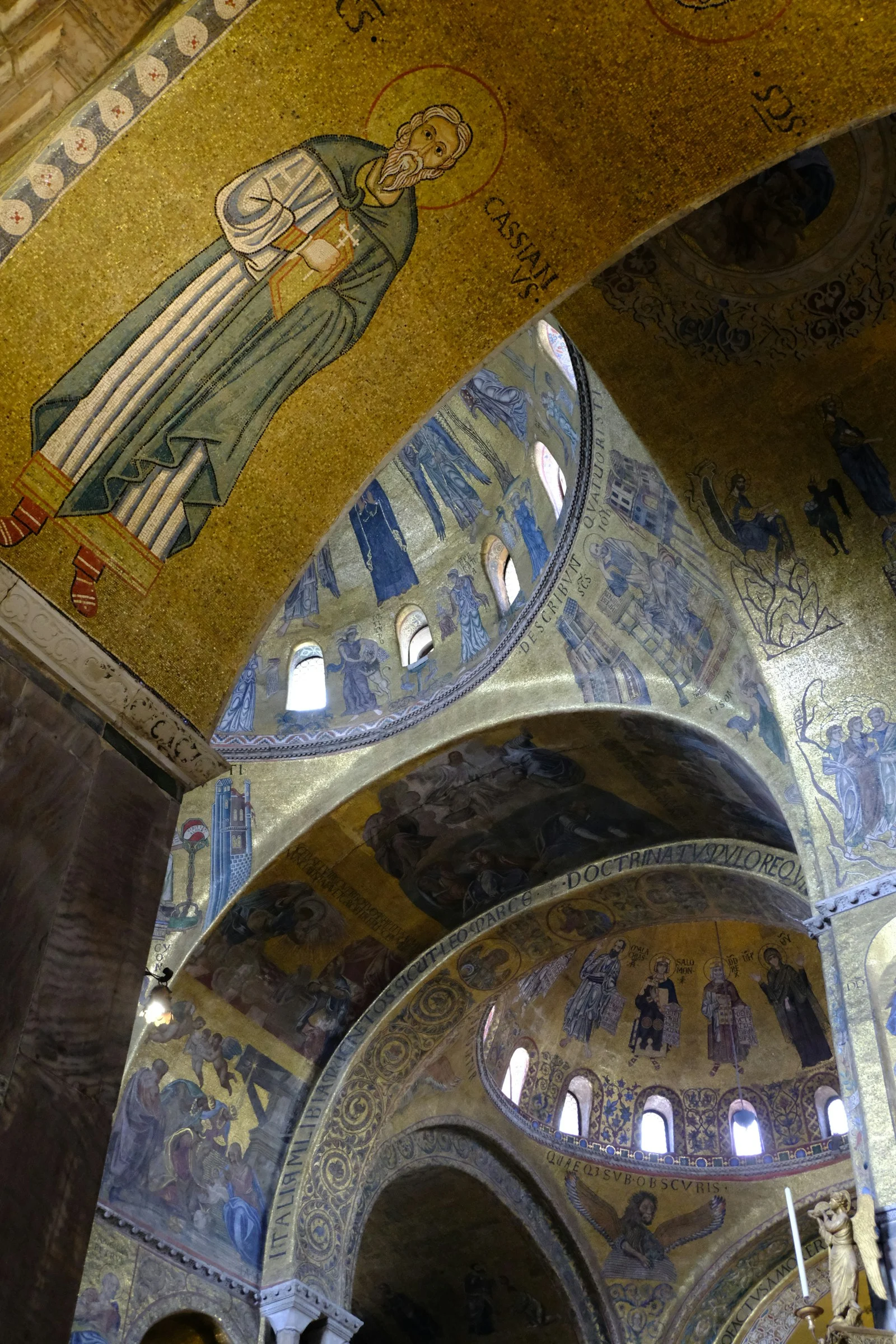
- The golden ceiling. Around 8,000 square metres are covered in mosaic — domes, vaults, arches. The entrance through the San Pietro door leads under the dome telling the story of Creation: ask them to find the animals and Adam. Inside the task is simpler — look up and count the domes.
- The wavy floor. The 12th-century marble floor is set from thousands of pieces, and it visibly rises and dips. The basilica stands on piles, and over nine centuries the ground beneath it has settled unevenly. Your child will feel it underfoot before you explain.
- St Mark under the altar. The apostle’s relics were brought from Alexandria in 829, and the legend says the merchants hid them under pork carcasses so the guards would not search the cargo. The story is told in mosaic on the façade — find it in the square on the way out.
- The Pala d’Oro. A golden altarpiece behind the altar, studded with precious stones. The Procuratoria calls it the only large piece of Gothic goldsmith’s work in the world to survive intact. It costs EUR 10 on top, and you get the same 10 minutes to look.
- The horses: real ones and copies. The four bronze horses on the façade are copies. The originals were brought from Constantinople in 1204, taken to Paris by Napoleon in 1797, returned in 1815, and moved into the Museum in the 1980s to protect them from polluted air. Upstairs you first see the originals in the gallery, then step out onto the Loggia and stand next to the copies above the square. Let your child spot the difference.
If a family with children aged 6 to 12 can choose only one add-on, we would take the Museum and Loggia rather than the Pala d’Oro: the horses and the view over the square stay in the memory longer than one more golden altarpiece.
The bell tower: separate ticket, separate entrance
The 98.6-metre Campanile di San Marco stands apart from the basilica and has its own entrance, its own time slot and its own security queue. The only way up is by lift, about 40 to 45 seconds to the bell chamber at 60 metres. There are no stairs for visitors and the cabin is small — worth knowing if your child dislikes tight spaces. The recommended time at the top is 30 to 40 minutes. On a clear day you see the lagoon, the islands, the sea and the Dolomites, and above you on the spire stands the golden Archangel Gabriel.
You can tell your child that the tower is younger than it looks. The old campanile simply folded up and collapsed onto the square in 1902, and the new one was built on the same spot, exactly as before — “where it was and as it was” — by 1912.
It costs EUR 15, EUR 7.50 for children aged 11 to 18, free under 10. If you can only afford one of the two tickets, with younger school-age children the bell tower often wins: a lift, height and a view, with no 20-minute rule.
Acqua alta in November and December
St Mark’s Square is one of the lowest points in Venice: water reaches it at a tide of just 75–80 cm. The MOSE barrier system protects the city, but it is raised only for forecasts of around 110 cm (in practice from about 100 cm, to allow for forecasting error). Between those figures the square floods, and this happens most often from October to January. The water usually stays for a few hours around the peak of the tide and then drains away.
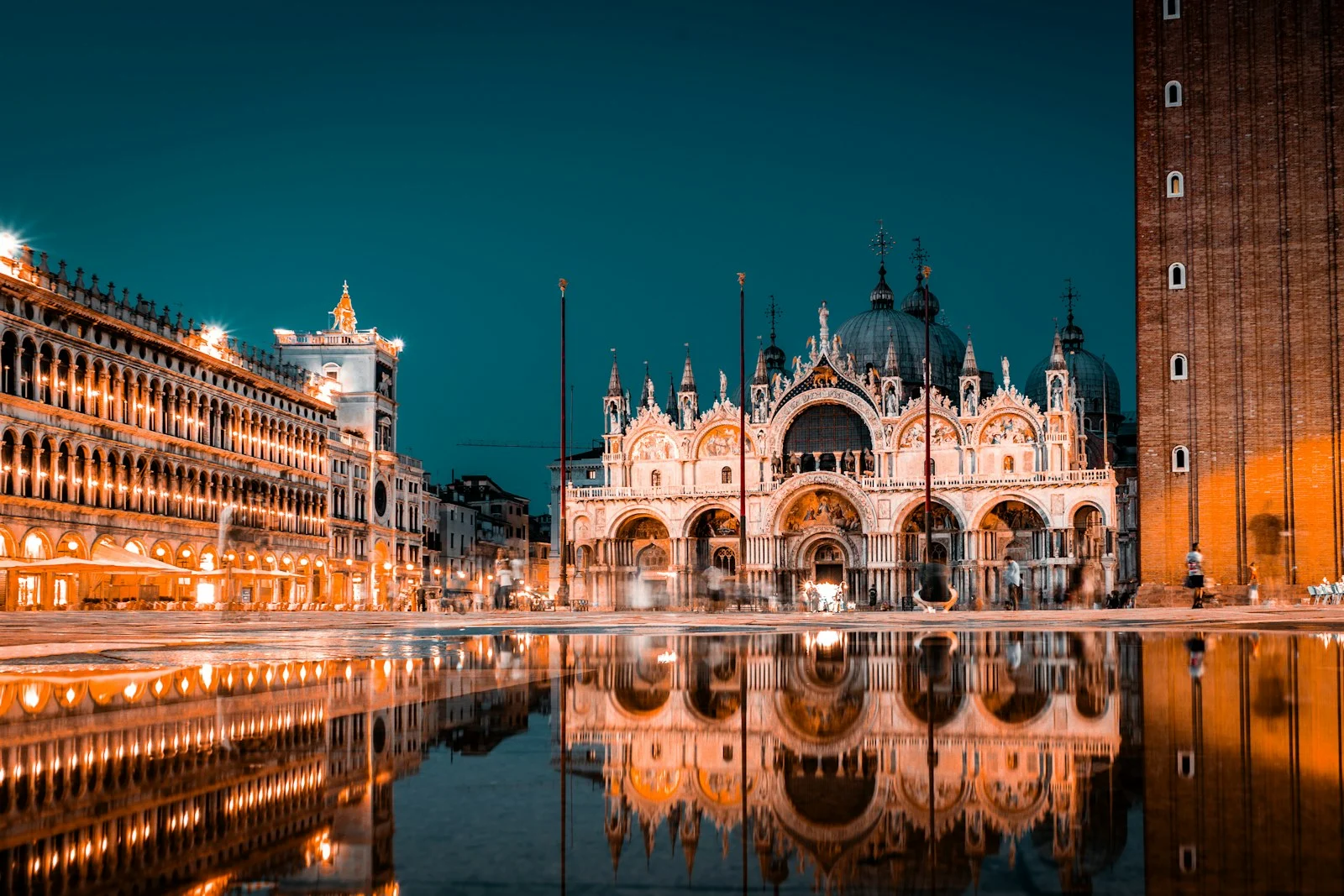
- The basilica. Since 2022 the narthex has been shielded by a glass wall that keeps the water out. If water does get inside, the regulation says the Procuratoria opens an alternative route watched by staff.
- Walkways. Raised wooden walkways on trestles go up along the main routes across the square. They can get crowded, so hold your child’s hand and do not try to overtake.
- Forecast. The city’s tide centre (Centro Maree) publishes a forecast several days ahead. If high water is due during your slot, bring wellies or pick a slot after the peak.
And a word on the entry fee: in 2026 it was charged to day-trippers only on selected days between April and July, so in November and December you do not need to pay it.
What else your basilica ticket gets you
Almost nobody writes about this, and it is the best-value part of the ticket. Since July 2025, any ticket that includes the basilica also opens around thirty Venetian churches and small museums for six months from the date of purchase. They include the basilica on the island of Torcello, the sacristy of the Salute with paintings by Titian and Tintoretto, Santa Maria dei Miracoli, the Madonna dell’Orto and San Sebastiano. Most of them used to charge for entry.
And one more, for children: the same ticket gets you free entry to the Home of The Human Safety Net in the Procuratie on the square itself, with an interactive exhibition, “A World of Potential”. It is a good way to sit out rain or high water a couple of minutes from the basilica.
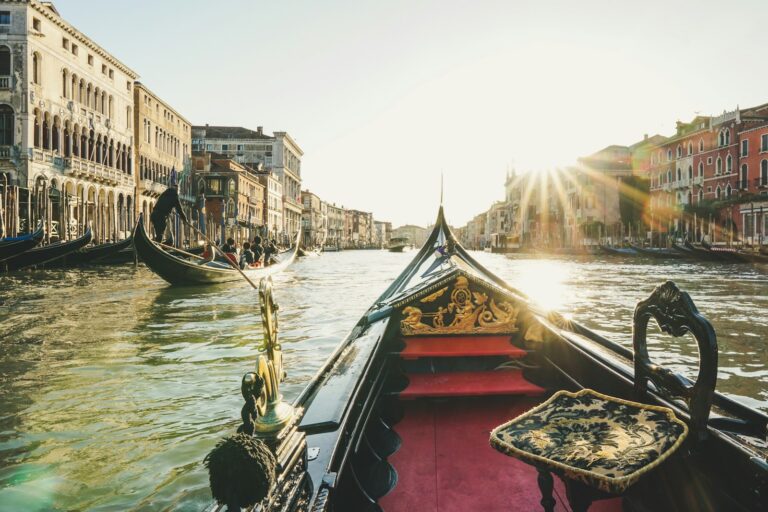
The basilica works well as the first stop of the day. How to tie it to the Rialto and the Grand Canal in one route is in our piece on what to see in Venice in one day. Just behind the square, in the Bacino Orseolo, is a gondola station — what a gondola costs and whether it is worth it. Everything about the square itself is on the St Mark’s Square page.
A children’s tour of Venice: a journey through the city’s riddles
A walking quest for the whole family: children solve puzzles and complete tasks, while the guide turns the walk into a game. The route takes in St Mark’s Square with the basilica and the bell tower, the Rialto Bridge, the Grand Canal and quiet courtyards. Along the way you will find out why Venice does not sink — handy the day before an acqua alta.
EUR 250 per group of up to 5 · 2.5 hours · ages 6+ · basilica and bell tower tickets bought separately
Our other routes around the city are on the Venice with children page.
Frequently asked questions
How much does it cost to enter St Mark's Basilica in Venice?
EUR 10 for an adult, EUR 5 for children aged 11 to 18, students under 26 and over-65s. Children under 10 go free, but they still need a ticket. The Pala d’Oro and the Museum with the Loggia of the Horses cost extra; the full ticket covering everything is EUR 30.
Can you get into St Mark's Basilica without a ticket and without queuing?
There is no longer a free tourist entrance with a queue: since 1 July 2025 the basilica only admits visitors with a named ticket for a specific half-hour slot. A ticket from the official website is your “skip the line”: at the door all that is left is the ticket scan and a metal detector.
What time does St Mark's Basilica open on Sunday?
On Sundays and major church feasts visitors are admitted to the basilica from 14:00, with last entry at 16:45. In the morning, from 9:30, only the Museum and the Loggia of the Horses are open, with a separate EUR 14 ticket for that time. On weekdays the basilica is open from 9:30 to 17:15, last entry 16:45.
Can you take a backpack into St Mark's Basilica?
A small one, yes: the rules bar backpacks and bags larger than 40 × 30 × 20 cm and wheeled suitcases in all cases. The free left-luggage room at the Ateneo San Basso mentioned in older guidebooks has been closed since 2023, so anything bigger has to go to a paid luggage store.
How long can you stay inside St Mark's Basilica?
The rules allow no more than 20 minutes in the basilica itself and no more than 10 minutes at the Pala d’Oro, following the roped-off route without stops that hold up the flow. Sitting down inside is not allowed.
How much does it cost to go up the St Mark's bell tower?
EUR 15 for adults, EUR 7.50 for children aged 11 to 18, free under 10. It is a separate ticket with its own time slot and is not part of the basilica’s full ticket. The only way up is by lift, about 40 seconds to the platform at 60 metres.
Does St Mark's Basilica flood in winter?
The square floods once the tide reaches 75–80 cm, while the MOSE barriers are raised only for forecasts of around 110 cm, so in November and December there can be water in the square. Since 2022 the basilica’s narthex has been shielded by a glass wall; if water does get inside, staff guide visitors along an alternative route.