Contents 12
- Which pushchair survives the sampietrini
- The main sights at a glance
- The Colosseum: a lift, but no cloakroom
- The Forum and the Palatine: stone, and a way round it
- The Vatican: museums and basilica yes, dome no
- The Pantheon and Navona: smooth inside, bumpy outside
- Where not to try
- The metro: four stations with no lifts
- Buses and trams: the rules say fold it
- Taxis and car seats
- Where to change a baby
- How to plan a day with a pushchair
Which pushchair survives the sampietrini
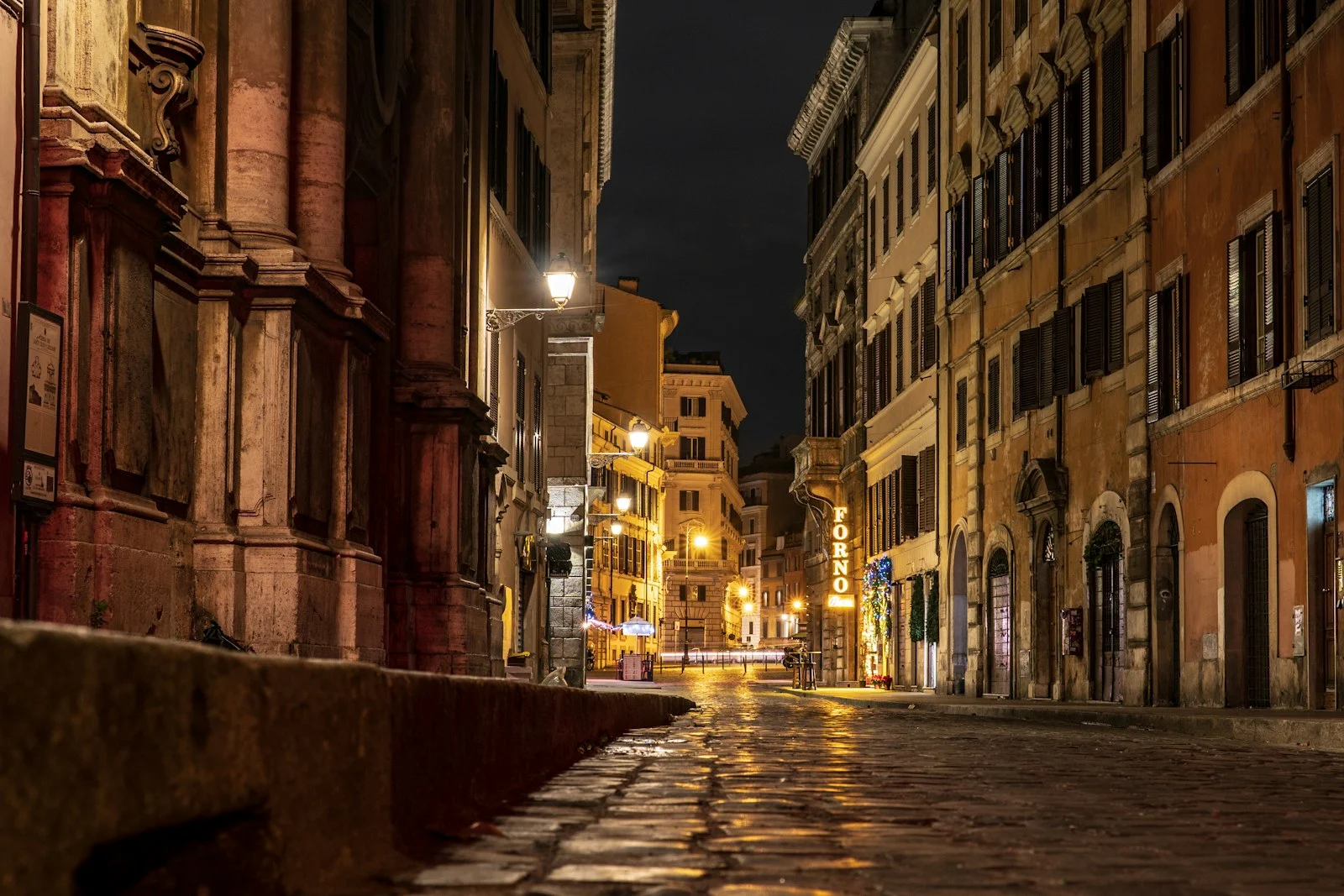
Sampietrini are the black basalt cubes that pave nearly all of the historic centre. They are laid on a bed of sand without mortar, with gaps between the stones, and over time some sink while others stick up. For a pushchair that means miles of constant juddering: small hard wheels catch in the gaps, the child sleeps badly, and whoever is pushing has aching wrists by evening.
What matters in a pushchair for Rome:
- Larger, softer wheels — rubber or air-filled. Little plastic “shopping centre” wheels are the first to give up on cobbles.
- Lockable front swivel wheels. On uneven stone, locked wheels hold their line instead of veering into every gap.
- One-hand fold and low weight. On a bus, on an escalator and at a staircase with no lift you will be folding it with the child in your other arm.
- A backrest that reclines almost flat and a big hood. In Rome the daytime nap happens on the move and in the sun.
Carrycot or buggy. A carrycot is heavy and folds in two stages, and no bus will wait while you do it. If your child is old enough for a seat unit, take a light buggy. If not yet, a sling or soft carrier is easier in the centre, and the carrycot is best kept for flat neighbourhoods and parks.
You will want a sling or carrier anyway. The pushchair is for naps and bags; the carrier is for the stretches where you end up carrying it: the Palatine, staircases, Trastevere’s streets in the evening, an old building with no lift. On those buildings, where a “third floor” can easily turn out to be five flights, see our guide on where to stay in Rome with children; with a pushchair we recommend Prati, with its wide, even pavements.
The main sights at a glance
| Place | With a pushchair | Worth knowing |
|---|---|---|
| Colosseum | yes | lift to the upper level, no cloakroom |
| Roman Forum and Palatine | partly | ancient paving and slopes; a bypass route with a lift |
| Vatican Museums | yes | dedicated lifts, free cloakroom, changing rooms |
| St Peter’s Basilica | yes | ramps and lifts, no left luggage |
| The dome | no | lift to the terrace only, then 320 steps |
| Pantheon | yes | ramp at the side of the portico |
| Piazza Navona | yes | pedestrianised, but cobbled |
| Spanish Steps | no | reach the top the long way, via the Pincio |
| Catacombs | no | steps underground, uneven floor |
The Colosseum: a lift, but no cloakroom
The visitor rules of the Colosseum Archaeological Park do not mention pushchairs as either banned or allowed, and people do go in with them. Two other lines in the same rules matter more. First, the park has no cloakroom or left-luggage service. Second, hand luggage may be no larger than 30 × 40 × 15 cm, and bigger backpacks are turned away. So the pushchair stays with you for the whole visit, and a bulky changing bag is better split between the pushchair basket and a small backpack. There is airport-style security at the entrance.
Inside, a step-free route is marked around the first level, and since June 2023 a glass panoramic lift has run inside arch XXVII. It takes you up to the gallery between the second and third levels, replacing about a hundred steep steps — with a pushchair it is the only sensible way up. The lift was built for all visitors, not only for people with disabilities. Which ticket to buy so you are not queuing with a child is covered in our guide to Colosseum tickets.
The Forum and the Palatine: stone, and a way round it
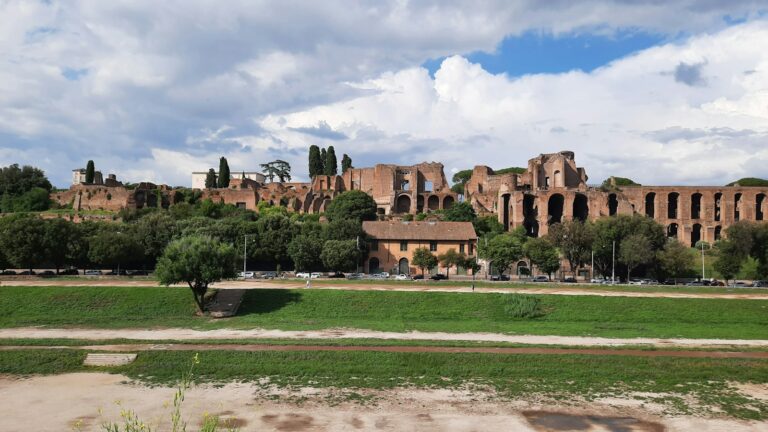
The Roman Forum is the bumpiest part of the day. The Via Sacra is paved with ancient basalt slabs that nobody has levelled for two thousand years: gaps, steps, potholes. The Palatine is a hill with dirt and gravel paths and short, steep climbs.
There is a way round, though. In 2015 an accessible route about one and a half kilometres long opened in the Forum: paths of compacted lime and pozzolana run alongside the Via Sacra to the House of the Vestals, the Temple of Antoninus and Faustina, the Basilica of Maxentius and the Curia. The easiest way in is from Via dei Fori Imperiali, through the Largo della Salara Vecchia entrance, where a lift takes you six and a half metres down to the level of the Forum. Another lift platform stands by the Arch of Titus, where the path leads on to the Palatine. Lifts in the park are repaired from time to time, so ask the custodians at the entrance whether the one you need is working.
For the Palatine itself we would carry the child in a carrier and push the pushchair empty or carry it folded: the slopes are short but the stone is uneven. The bag rules and the lack of a cloakroom are the same as at the Colosseum — it is all one park.
The Vatican: museums and basilica yes, dome no
The Vatican Museums say it plainly on their website: families with children and pushchairs are welcome. Custodians will show you the easiest route and the dedicated lifts. The cloakroom is free; suitcases, rucksacks and any bags the staff consider too large must be left there — the pushchair does not have to be. Along the route there are baby-changing rooms and a separate nursing room, and some of the cafés have high chairs. The Sistine Chapel demands complete silence, so the ideal plan is to reach it while the baby is asleep. How to book a ticket for the time you want is in our guide to Vatican Museums tickets.
St Peter’s Basilica is free, and you go in through the police security check in the right-hand colonnade of the square. According to its official website, the basilica is accessible by ramps and lifts. There is no left-luggage service, so it is best not to bring large bags. Children are welcome, and in the visitor reception area (Area accoglienza) there is a room with a changing table where you can also feed. Where the security check is, how to avoid arriving during Mass and what the dress code is are covered in our piece on St Peter’s and the dome.
The dome — do not try. The lift only goes to the terrace on the roof, and after that there are 320 steps: the passages narrow, the walls lean inwards, and at the top there is a spiral staircase. The official rules allow only small personal bags on the climb and state plainly that there is no left-luggage service. You cannot take a pushchair up, and there is nowhere to leave it below. With a baby in a carrier it is technically allowed, but the basilica itself warns that the climb is hard for small children, and we would not go. The workable option is to split up: one adult climbs while the other waits with the child in the basilica or the square.
The Pantheon and Navona: smooth inside, bumpy outside
From Piazza della Rotonda the portico has steps, but since 2023, when entry became ticketed, visitors have been let in at the left-hand corner of the façade, on the Via della Minerva side, and that is also where the ramp for pushchairs and wheelchairs is. Inside is a single round hall with a level marble floor and not one step.
Piazza Navona, five minutes’ walk away, is a pedestrianised square where you can let a child out of the pushchair without watching for cars. It is cobbled too, but flat and wide. What to look for at its three fountains is in our piece on Piazza Navona. The hard part is the way between them: narrow lanes, often with no pavement at all, with taxis squeezing past. Stick to the pedestrian alleys and take your time.
Where not to try
- The Spanish Steps. More than a hundred and thirty steps with no ramp, and Spagna metro station at the bottom is one of the four central stations without lifts. You can reach the top, by the church of Trinità dei Monti, the long way round: gentle ramps climb from Piazza del Popolo up the Pincio hill, and from there a level avenue past Villa Medici leads to the top of the steps. For the bottom, start from Flaminio station, which has lifts, and walk along the flat Via del Babuino — less than a kilometre. And remember that sitting on the steps is banned: we explained why in our piece on the Spanish Steps.
- Trastevere in the evening. By day you can get round it with a pushchair, but by dinner time the narrow cobbled streets fill with restaurant tables, crowds and cars in the side lanes. In the evening take the carrier. Where to walk and when to head home is in our piece on Trastevere in the evening.
- The catacombs. Visits are guided only, steps lead underground, the floor is uneven, and the catacombs themselves warn of barriers that cannot be overcome. Tour conditions say pushchairs do not go down. With a baby in a carrier it is technically possible, but ask yourself whether a one-year-old needs half an hour in the cool and the dark. Which catacombs to choose with a school-age child is in a separate guide.
- The dome of St Peter’s — see above: neither with a pushchair nor with a baby.
The metro: four stations with no lifts
According to the operator, ATAC, every metro station is accessible to passengers with reduced mobility except four on line A: Spagna, Barberini, Repubblica and Vittorio Emanuele. They have no lifts or stair lifts to the platforms, and in May 2026 the Roman press confirmed that nothing had changed. Annoyingly, these are exactly the stations for the Spanish Steps, the Trevi Fountain and the area around Termini.
The other stations do have lifts, but they are regularly out of service for repairs. ATAC keeps a “Metro station accessibility” page in the real-time section of its website listing lifts and escalators that are not working — check it in the morning before you set off.
ATAC’s rules for pushchairs on the metro are:
- the pushchair travels free; use the wider ticket gates;
- on stairs and escalators the pushchair is folded, and the child is carried or held by the hand;
- use the lift wherever there is one;
- in the carriage, position the pushchair so it is not in the way, hold on to it and put the brake on.
Children under ten travel free with an adult who has a ticket. Which tickets adults need and which stations a visitor will use is in our guide to the Rome metro.
Buses and trams: the rules say fold it
Here Rome is stricter than many people expect. ATAC’s rules say that pushchairs travel free on buses and trams if they are being used to carry a child and are folded to take up as little space as possible. How strictly this is applied depends on the driver and on how full the bus is, but plan your journey around the rule: child in your arms or in the carrier, pushchair folded. This is where a one-hand fold pays for itself — and where a heavy carrycot loses.
Taxis and car seats
In Italy a car seat is not compulsory in a taxi. Article 172 of the Highway Code allows children up to 150 cm tall to travel in taxis and in pre-booked cars with a driver without a child seat, provided they sit in the back and are accompanied by a passenger aged at least 16. That is why taxi drivers do not carry seats, and an ordinary taxi will not guarantee one.
If a car seat matters to you, there are two options: bring your own folding car seat or booster, or book a private transfer with a seat in advance and ask for it to be confirmed in writing. Taxis take pushchairs in the boot without fuss — just fold it before the car pulls up.
Where to change a baby
There are two places where we could confirm official changing tables: along the Vatican Museums route, with baby-changing rooms and a nursing room, and in St Peter’s Basilica, in the visitor reception area. The Colosseum park has toilets in several places, but we found no official information about changing tables, so do not count on them. We know of no public changing facilities at the Pantheon, Piazza Navona or the Spanish Steps either.
What works: a folding travel changing mat in the pushchair basket, and a day built so that the longest stop is the Vatican. And if your accommodation is not far from the centre, the simplest plan is to build in an hour back home in the middle of the day: a nap, lunch and a nappy change with no searching.
How to plan a day with a pushchair
- In the morning, check ATAC’s lift page and decide which station to use.
- One big sight with lifts — the Colosseum or the Vatican — for the first half of the day.
- After lunch, flat and pedestrianised places: the Pantheon, Navona, the avenues of the Pincio.
- In the evening, swap the pushchair for the carrier if you are heading to Trastevere or the Spanish Steps.
We run quest-style tours of Rome for children, starting from age four. See all our Rome routes here.
Frequently asked questions
Can you take a pushchair into the Colosseum?
Yes. There is an accessible route around the first level, and since 2023 a panoramic lift has taken visitors up to the gallery between the second and third levels instead of about a hundred steps. The park has no cloakroom, so the pushchair stays with you for the whole visit, and bags must be no bigger than 30 × 40 × 15 cm.
Are pushchairs allowed in the Vatican Museums?
They are: the museums state officially that families with pushchairs are welcome. Custodians will show you the easiest route and the dedicated lifts, the cloakroom is free, and along the route there are baby-changing rooms and a nursing room.
Can you climb St Peter's dome with a pushchair?
No. The lift only goes as far as the terrace, and after that there are 320 steps through narrow, sloping passages. Only small bags are allowed on the climb and there is no left-luggage service, so there is nowhere to leave a pushchair at the bottom either.
Can you use the Rome metro with a pushchair?
Yes, free of charge. Under ATAC’s rules the pushchair is folded on stairs and escalators, and the child is carried or held by the hand. Spagna, Barberini, Repubblica and Vittorio Emanuele on line A have no lifts to the platforms at all.
Do you have to fold a pushchair on a Rome bus?
Under ATAC’s rules, yes: pushchairs travel free on buses and trams if they are folded to take up as little space as possible. How strictly this is applied depends on the driver and how crowded the bus is, but plan on the rule.
Do you need a car seat in a Rome taxi?
Not by law: a child up to 150 cm tall may travel in a taxi without a car seat if they sit in the back and are accompanied by a passenger aged 16 or over. That is why an ordinary taxi does not guarantee a seat; if you want one, bring your own or book a transfer with a seat in advance.
What kind of pushchair should I take to Rome?
A light buggy that folds with one hand, with large, soft wheels and lockable front swivels. You will be folding it on buses, on escalators and at stairs with no lift. Bring a sling or a soft carrier for the places a pushchair cannot go.