Contents 6
Five stories to tell before the trip
Better not to tell it all at once: one story an evening, each ending with a promise — “We’ll find this in Rome.” Here is what to say and what to show later.
1. The she-wolf and the twins. Legend says Rome was founded by Romulus on 21 April 753 BC; the Romans themselves worked out the date centuries later. The twins Romulus and Remus were set adrift on the Tiber in a basket, the basket washed ashore, and a she-wolf fed the boys. They grew up, quarrelled, Romulus was left alone and named the city after himself. Rome still celebrates its birthday: in 2026 the city turned 2,779, and on those days people from historical societies walk through the centre in armour and togas.
A detail for a young detective: the famous bronze she-wolf in the Capitoline Museums is not as ancient as it looks. The twins beneath her were added in the 15th century, and many scholars now think the wolf herself is medieval. A bronze copy stands on a column beside the Palazzo Senatorio on the Capitoline square, and you can walk up to it for free at any time.
2. Where ordinary Romans lived. Most Romans lived not in palaces but in insulae — apartment blocks several storeys high. Shops and workshops at street level, flats above, and the higher the floor, the more cramped and cheaper. The remains of one such 2nd-century block can be seen from the street at the foot of the Capitoline, beside the steps of Santa Maria in Aracoeli. This is the Insula dell’Ara Coeli: it had at least five storeys and housed about 400 people — a big modern stairwell’s worth. It has been closed inside since May 2024 for works, but from above you can see the old street level and the arches where people traded.
A question for your child that Ostia will answer: where did the people in such a block eat and go to the toilet? Often out in the street — in snack bars called thermopolia and in public toilets with a couple of dozen seats and no partitions.
3. The baths. Not just a bathhouse but a pool, gym, park and club in one. You went from room to room: warm, hot, cold. The floors were heated from below by hot air from furnaces. A Roman could spend half a day at the baths, meeting friends the way we meet at a shopping centre. Ostia shows it best: in the Baths of Neptune, a terrace on the upper floor looks down on a mosaic covering the whole floor — Neptune with his trident driving four sea horses, surrounded by dolphins and tritons blowing on shells.
4. Chariot racing. Gladiators were not Rome’s main entertainment. Chariots were, in the Circus Maximus — a track 600 metres long and 140 wide. Ancient writers put the crowd at 150,000 to 250,000. Drivers raced for four teams — Reds, Whites, Greens and Blues — and fans followed them the way people follow football clubs today. Have your child pick a team in advance: on the field of the Circus Maximus they will have someone to run for.
If your child asks about gladiators, tell the truth rather than the film version: fights more often ended in a win than in death, and gladiators almost never fought lions. We take the myths apart in gladiators: what is true and what the films made up.
5. The legionaries. A legion had about five thousand soldiers. They lived eight to a leather tent, and these tent-mates ate together, marched together and pitched camp together. According to Vegetius’s military manual, at the ordinary pace a legion covered 20 Roman miles — nearly 30 kilometres — in five hours, and every evening the soldiers dug a ditch and built a rampart themselves. All of this is carved on Trajan’s Column: a band of relief about 190 metres long winds round it 23 times, with 155 scenes and more than two and a half thousand figures, Trajan himself appearing 58 times. The column stands by the Imperial Fora and can be seen for free from the street; bring binoculars, as the lower bands are easy to make out.
And the gods, one line each. Jupiter is the chief god, with thunderbolts; Rome’s main temple on the Capitoline was dedicated to him, Juno and Minerva. Mars is the god of war and, by legend, the father of Romulus and Remus. Vesta is the goddess of the hearth: girls aged six to ten were chosen as Vestal Virgins for thirty years, and they made sure the fire in her round temple in the Forum never went out. Children like hearing that a Vestal who let the fire go out was punished severely. And the Pantheon is a temple to all the gods at once, with an opening in the dome almost nine metres across: when it rains, the water falls straight onto the floor and drains away through holes in the marble. What to see inside and how to get in without queuing is in the Pantheon in Rome: entry and what is inside.
Where to start once you are there
The first hour in Rome decides whether the child stays interested. So do not start somewhere that means queuing and listening. A good first outing is free and takes forty minutes: the Capitoline square with the she-wolf on her column, then the view over the Forum from the terraces on either side of the Palazzo Senatorio — from above, the child sees the whole “town” at once — and the Insula dell’Ara Coeli below by the steps. The she-wolf story and the apartment-block story immediately get an address.
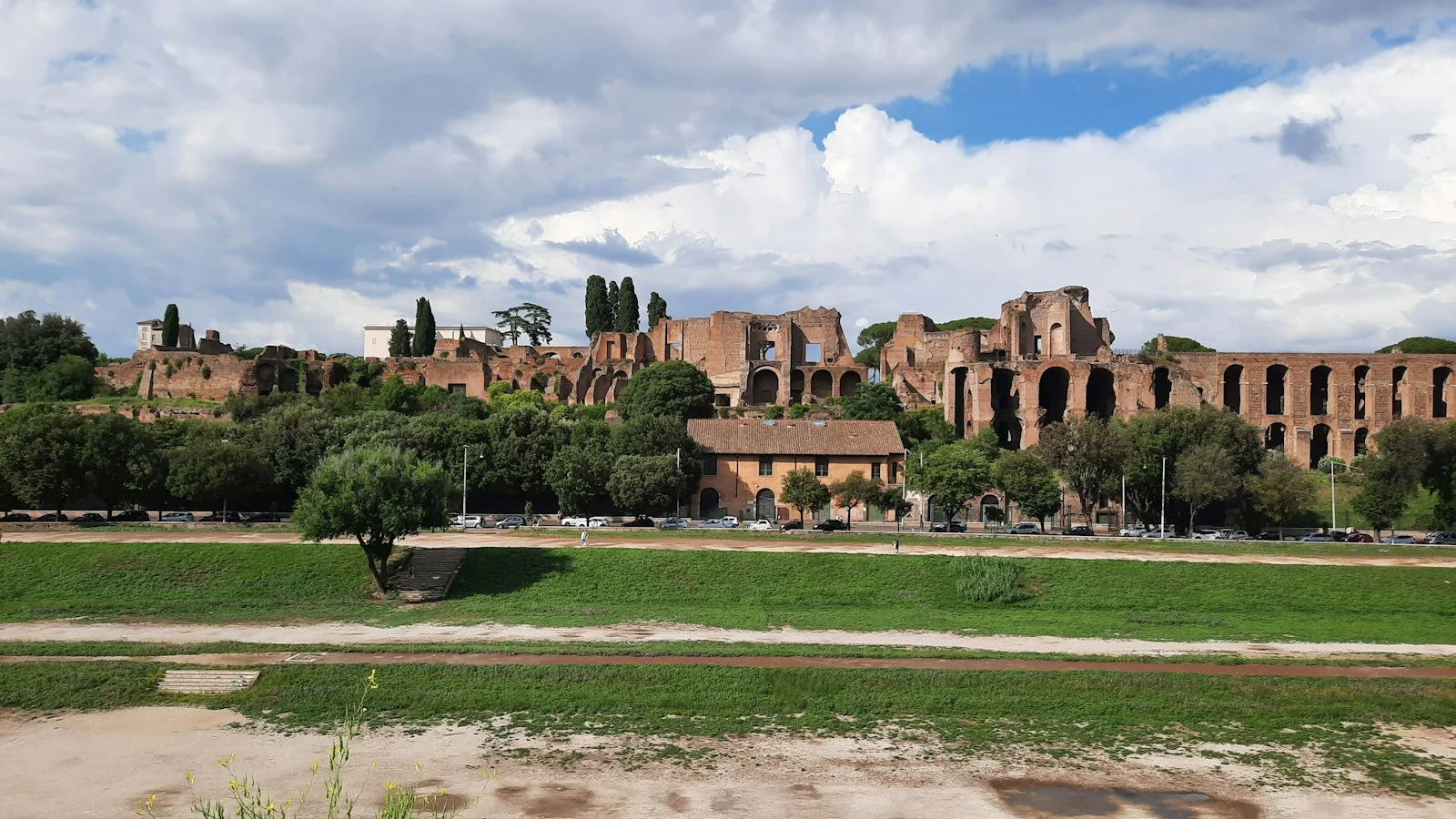
Next, somewhere to move. The Circus Maximus is now an open grassy field, free to enter, with the Circo Massimo metro station next to it. You can race down the straight where the chariots once ran, and count how many child-sized steps there are in 600 metres. At the curved end of the circus there is a paid archaeological area with galleries and a medieval tower.
Put the Colosseum and the Forum with the Palatine on the morning of another day, when the child already knows what they are looking for. They share one ticket and under-18s go free, but a child still needs a named ticket with an entry time. How to buy it and which ticket you need for the underground is in Colosseum tickets: how to buy and what is included, and what to see on the Forum and the Palatine, and in what order, is in the Roman Forum and the Palatine. How to fit all of this into a day a child can manage is in Rome in one day with a child.
Quest “Ancient Rome: the life of ordinary Romans”
Three hours about how ordinary people lived, not emperors. The route takes in the Circus Maximus, the Imperial Fora and the Capitoline, with the Colosseum from the outside. Children measure ancient buildings in paces, hold a real Roman coin, haggle as if at a Roman market and learn how to wrap a toga properly.
EUR 250 per group of up to 5 · 3 hours · ages 7+
Which site suits which age
A child feels “I was there” where they can do something themselves: run, sit, find, count. So the same place gives a four-year-old and a twelve-year-old completely different things.
| Site | What comes alive | Best for | Entry |
|---|---|---|---|
| Circus Maximus | chariot races: a field you can run on | 4+ | field free; Circo Maximo Experience EUR 12, family EUR 22 |
| Pantheon | the temple of all the gods and the hole in the roof | 4+ | EUR 7, free under 18 |
| Capitoline: she-wolf and insula | Rome’s founding and ordinary people’s homes | 5+ | free, from the street |
| Colosseum | entrance numbers, the arena, the underground | 6–7+ | joint ticket with the Forum, free under 18 |
| Ostia Antica | a whole town: toilet, snack bar, baths, theatre | 6+ | EUR 18, free under 18 |
| Forum | game boards on the steps, the Temple of Vesta | 8+ | joint ticket with the Colosseum |
| Palatine, Trajan’s Column | huts from Romulus’s time, legionaries in stone | 10+ | Palatine on the same ticket; column free |
The Circus Maximus in headsets. If an empty field leaves your child cold, the Circo Maximo Experience runs on site: 40 minutes in augmented and virtual reality headsets, eight stops, a chariot race and a life-size Arch of Titus. The soundtrack comes in eight languages, English among them. Tickets are EUR 12, reduced EUR 10 for young people up to 26, a family ticket EUR 22 for two adults and children under 18, and under-6s go free. Children under 14 may wear the headsets with parental consent. From 1 October to 23 December it is open 10:00–16:00, last entry 14:50, closed on Mondays; booking ahead online or on 060608 is recommended.
The Palatine is for older children. For little ones it is mostly foundations, but a ten-year-old has things to look for. In the south-west corner of the hill, holes in the rock mark where the posts of Iron Age huts once stood: the wooden walls rotted long ago, only the holes remain, and they are called the “Hut of Romulus”. Augustus built his own house right next to it — deliberately beside the “founder’s home”. For a child who already knows the legend, that beats any palace.
Ostia Antica: a town, not stones
If after the Forum your child says “it’s all just ruins”, take them to Ostia. This was Rome’s sea port, and what survives here is not single monuments but streets with houses, shops, baths and a theatre. It is usually less crowded than the Forum, and there is enough space to wander for half a day.
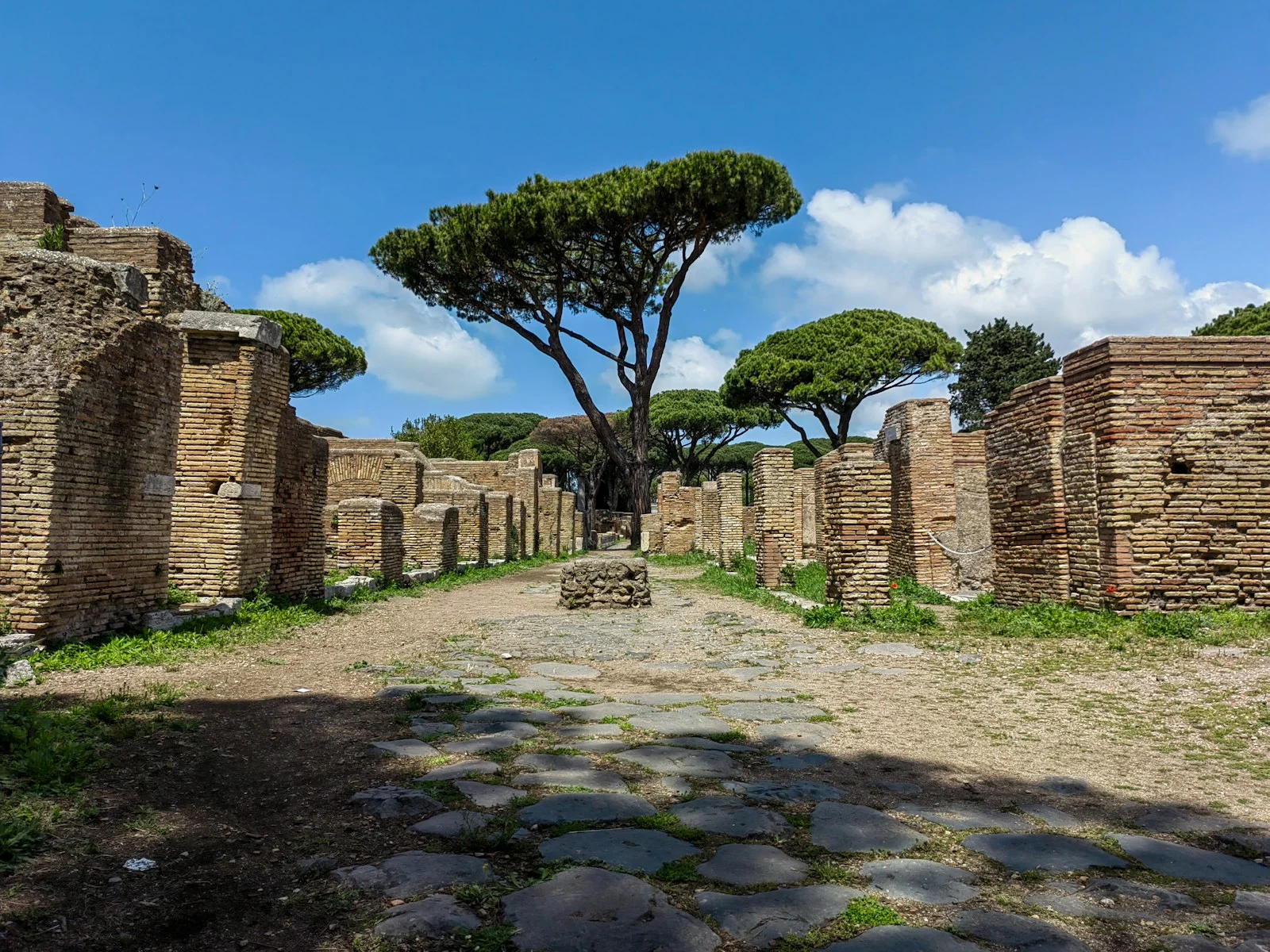
Getting there. Metro line B to Piramide, then walk to the neighbouring Porta San Paolo station and take the Roma–Lido train to the Ostia Antica stop — about 25 minutes. An ordinary Metrebus ticket at EUR 1.50, the same as for the metro, is valid. From the station to the entrance is a few minutes’ walk over a footbridge.
Tickets and hours. Entry is EUR 18, free for under-18s. Open Tuesday to Sunday, closed on Mondays. From 25 October to the end of February the hours are 8:30–16:30, in March until 17:15, and from April to September until 19:00; the ticket office closes an hour earlier. The ticket is valid for 8 days and gives one entry to each site in the park.
What to show your child.
- The public toilet by the Forum Baths — twenty marble seats along three walls, with no partitions at all. The doors here revolved: the marble thresholds still have the holes for the pivots. There is no better answer to “how did ordinary Romans live?”
- The thermopolium on Via di Diana — a 3rd-century street snack bar with a marble counter and a painting of food on the wall that is thought of as a sort of menu.
- The Baths of Neptune — that mosaic of Neptune and the sea horses, seen from the upper-floor terrace.
- The Square of the Corporations — behind the theatre, a row of 61 small offices of merchants and shippers, each with a black-and-white mosaic sign on the floor: ships, lighthouses, fish. The game is to find the elephant: its mosaic was laid by merchants from Sabratha in today’s Libya, who traded in ivory and wild animals.
- The theatre next to it — a semicircle of steps from the 1st century BC, rebuilt in the 2nd century AD. You can sit on the steps like the audience two thousand years ago.
What to read and watch before the trip
We only name things we have checked are real and available. The ages are our own estimate.
- “The Eagle of the Ninth”, Rosemary Sutcliff. The classic novel about a young Roman centurion searching for a lost legion in Britain. For about ten and up — the best possible preparation for Trajan’s Column.
- “Asterix: The Mansions of the Gods”, the 2014 animated film. Caesar builds a block of Roman flats next to the Gauls’ village — a handy picture of what an insula was. It is a comedy, not a textbook, so afterwards it is worth saying what was made up.
- “SPQR: A History of Ancient Rome”, Mary Beard. For parents and teenagers from about 14: how a small town became an empire, without the textbook gloss.
- For younger children, any well-illustrated encyclopedia of daily Roman life — homes, food, clothes, school — works better than a timeline of emperors.
Games to play on site
A child with a mission walks twice as far through the ruins without complaining. These games need nothing but sharp eyes.
- SPQR hunt. The four letters for “the Senate and People of Rome” appear on manhole covers, fountains, lamp posts and litter bins all over modern Rome. Whoever finds the most in a day gets to be consul.
- Find your Colosseum entrance. A Roman ticket was a pottery shard with the number of the arch you went in by. On the surviving stretch of the outer wall, Roman numerals are still visible above the arches, from XXIII to LIIII. Write a number on a slip of paper, say XXXVIII, and let your child find their arch. And let them notice how the Romans wrote 54: not LIV, but LIIII.
- A two-thousand-year-old board game. More than eighty game boards are scratched into the steps and paving of the Basilica Julia in the Forum, left by bored Romans waiting for court or for friends. Look for a circle divided into eight, or a grid of squares. Do not play on the marble itself — take a photo and play it on paper in the evening.
- Chariot race. On the field of the Circus Maximus, race from one end to the other “for your team”. Or count how many of your child’s steps fit into 600 metres.
- Find the elephant. In the Square of the Corporations at Ostia, hunt for the elephant among dozens of mosaic signs, then a ship and a lighthouse.
- Legionaries on the column. With binoculars at Trajan’s Column, look on the lower bands for soldiers building a camp, crossing a river on a bridge of boats or carrying their packs.
Family quest “Journey through time”
If you would rather a guide ran the game for you: children get maps, riddles and creative tasks, and the route runs from the Colosseum (outside) through the Roman Forum, Trajan’s Column and the Imperial Fora to the Pantheon and Piazza Navona. The pace is adjusted to the children’s age, and if they are far apart in age, they get different roles.
EUR 250 per group of up to 5 · 3 hours · ages 6+
Frequently asked questions
At what age does ancient Rome become interesting to a child?
From about four or five, through places where they can run and touch: the Circus Maximus, the Pantheon with its hole in the dome, the Mouth of Truth. The Colosseum and the Forum usually click from around seven, when a child can hold a story in their head. The Palatine and Trajan’s Column are more for ten and up.
What should I tell my child about ancient Rome before the trip?
Five short stories of ten minutes each: the she-wolf and the twins, the apartment block where ordinary Romans lived, the baths, chariot racing and the legionaries. Give each one a detail the child can spot on site. Dates and the names of emperors can wait.
Where in Rome can you see how ordinary Romans lived?
For free, the Insula dell’Ara Coeli at the foot of the Capitoline: the remains of a 2nd-century block at least five storeys high where about 400 people lived, visible from the street. As a whole town, at Ostia Antica: a 20-seat public toilet, a street snack bar with a marble counter, baths and a theatre.
How do you get to Ostia Antica and how much is entry?
Metro line B to Piramide, then from the Porta San Paolo station the Roma–Lido train to the Ostia Antica stop, about 25 minutes on an ordinary Metrebus ticket at EUR 1.50. Entry is EUR 18, free for under-18s. Open Tuesday to Sunday; from 25 October to the end of February the hours are 8:30–16:30, and the ticket office closes an hour earlier.
Is the Circo Maximo Experience worth it with a child?
If your child is over six and likes gadgets, yes. It is 40 minutes in augmented-reality headsets on the field of the Circus Maximus, with an English soundtrack among the eight languages. Tickets are EUR 12, a family ticket EUR 22 for two adults and children under 18, and under-6s go free. Closed on Mondays.
What books about ancient Rome are good for children?
For English-speaking readers, Rosemary Sutcliff’s “The Eagle of the Ninth” remains the classic novel about a Roman soldier in Britain, for roughly ten and up. For a parent or a teenager, Mary Beard’s “SPQR” explains how a small town became an empire. For younger children, any well-illustrated encyclopedia of daily Roman life works better than a timeline of emperors.
Where can you see the Capitoline Wolf in Rome for free?
A bronze copy stands on a column beside the Palazzo Senatorio on the Capitoline square, and you can walk up to it at any time. The original is in the Capitoline Museums. The twins were only added in the 15th century.