Contents 10
- Why the square is this shape
- The stadium underground: the situation in 2026
- The Fountain of the Four Rivers: what to show your child
- The Bernini and Borromini legend — and why it is a myth
- The Fountain of the Moor and the Fountain of Neptune
- Sant’Agnese in Agone
- Artists and caricaturists: how to agree a price
- The Christmas fair: the Befana from 1 December to 6 January
- Where to eat nearby without tourist traps
- When to go
Why the square is this shape
Navona is long and narrow with a rounded northern end because it sits exactly on the arena of the Stadium of Domitian. The emperor dedicated it in AD 86; the stands held about 30,000 spectators, and according to Rome’s official tourism portal it measured about 275 by 106 metres. This was a venue for Greek-style running and wrestling, not chariot racing, so unlike the Circus Maximus it had no central dividing wall and no obelisk.
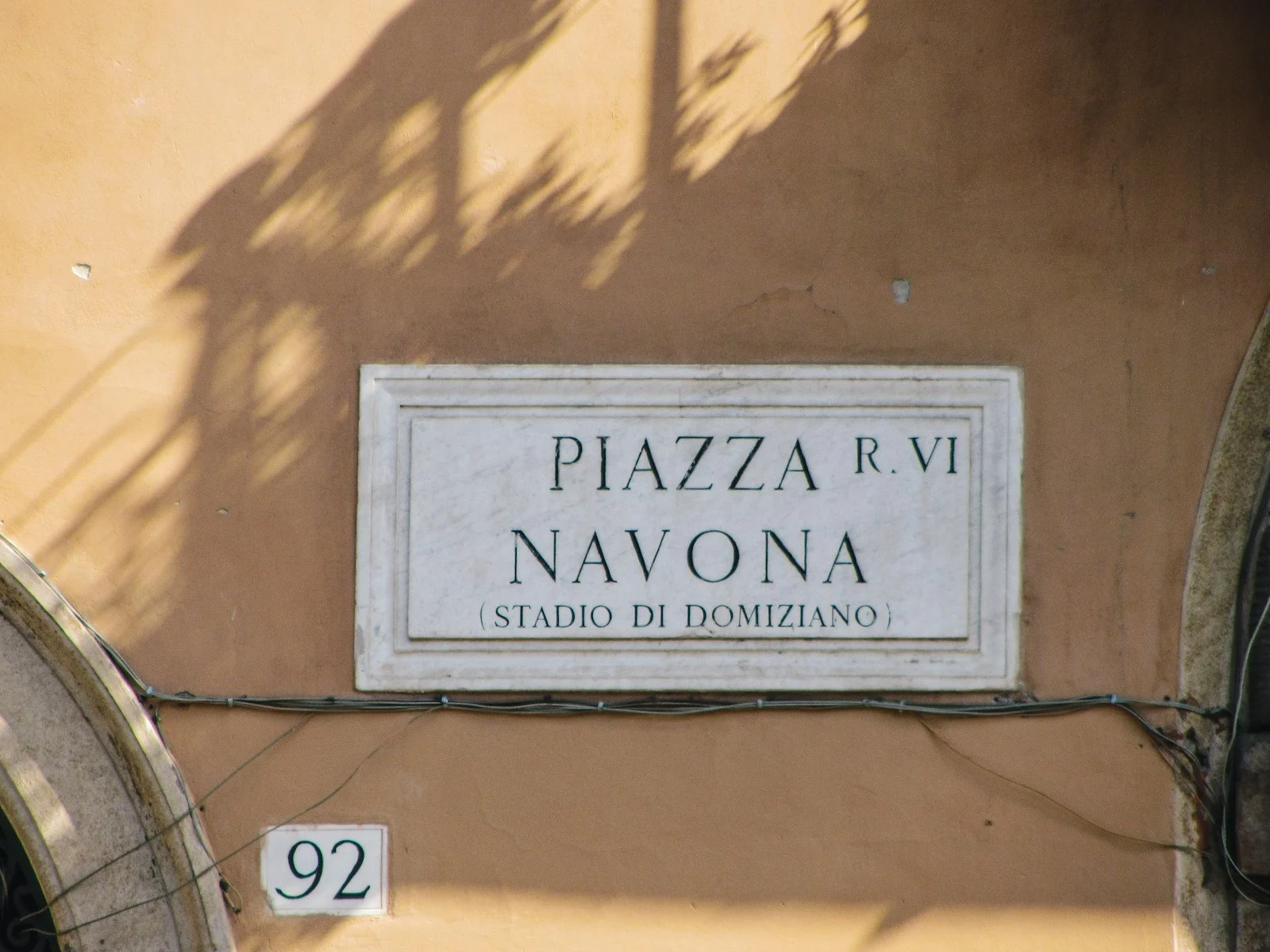
Over time the stands were stripped for stone, but houses grew up on their foundations. So the façades around the square still stand where the spectators once sat, and the square traces the arena. Even the name comes from here: the place of the games was called in agone, which in everyday speech became “n’agone” and then Navona.
Put it to your child like this: “We are standing on the stadium’s field, and the houses are the stands — only made of stone and with windows.” Walk to the rounded northern end: that is the bend of the old running track.
The stadium underground: the situation in 2026
Since 2014 an archaeological site, Stadio di Domiziano, operated beneath the square: the remains of the northern entrance and arches, about 4.5 metres down, entered from Via di Tor Sanguigna 3. It suited children well: a short underground route, an audio guide, everything in one space. As of 6 October 2026 it is closed. Rome’s official tourism portal, turismoroma.it, says the site is closed for restoration; the same notice appeared on the stadium’s own website in spring 2026, and that website no longer loads at all. Nobody is giving a reopening date.
Before the closure an adult ticket cost EUR 9, children paid less and the youngest went free — according to ticket resellers, since there is no official price list available now. If a website is selling tickets, check the status on turismoroma.it before you buy.
What you can do for free: leave the northern end of the square for little Piazza di Tor Sanguigna and look down over the railings. Below street level you can see the arches and walls of the stadium’s northern entrance — the very gap between ancient Rome and today’s city. Two minutes, and your child sees with their own eyes how much the city has “grown”. If you want to start from the basics — who the Romans were and why everything old ended up underground — we have an article on ancient Rome for children: where to begin.
And one more link to the stadium, two minutes away: just beyond the southern end of the square stands Pasquino, a battered fragment of ancient sculpture traditionally thought to have decorated the stadium. For centuries Romans stuck anonymous verses about popes and officials on it, which is where the word “pasquinade” comes from. Notes still appear on the plinth today.
The Fountain of the Four Rivers: what to show your child
The central fountain was designed by Gian Lorenzo Bernini for Pope Innocent X of the Pamphili family, whose palace stands on the square. It was unveiled on 12 June 1651. In the middle is a travertine rock topped by an Egyptian-looking obelisk 16.54 metres high. The obelisk is actually Roman: it was made under the same Domitian, and his name is carved among the hieroglyphs. A neat touch: Domitian’s obelisk stands in Domitian’s stadium. At the very top is a bronze dove with an olive branch, the Pamphili family emblem.
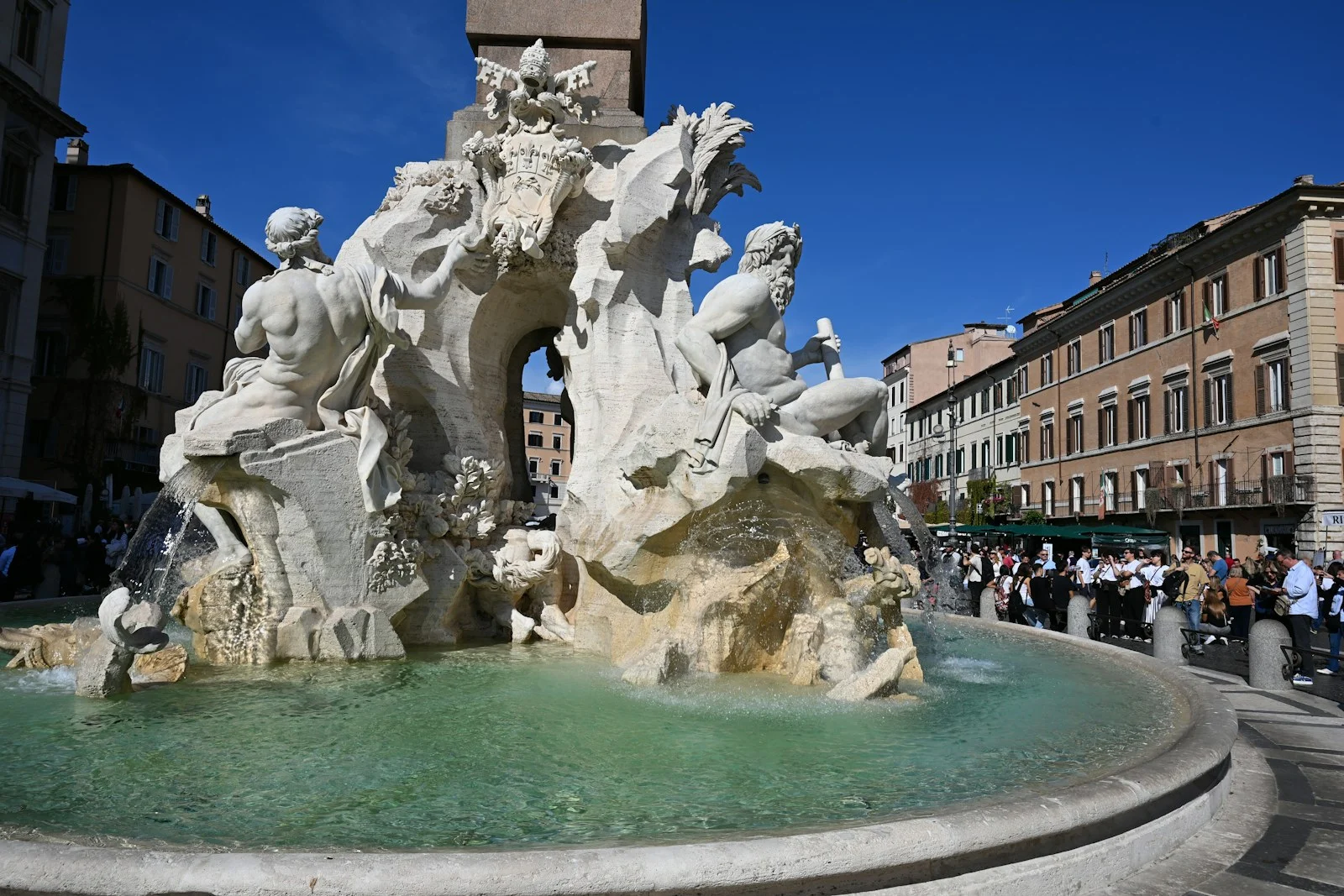
Around the rock sit four giants — the rivers of the four parts of the world known at the time. The fun part is identifying each from its clue:
| River | Continent | How to spot it |
|---|---|---|
| Nile | Africa | head covered with cloth, a lion and a palm tree nearby |
| Ganges | Asia | holds a long oar, a serpent nearby |
| Danube | Europe | reaches towards the Pamphili coat of arms, a horse nearby |
| Río de la Plata | the Americas | raised arm, coins, an armadillo nearby |
The Nile’s head is covered because in the 17th century nobody knew where its source was. The Ganges with its oar is a river you could sail a long way. The coins by the Río de la Plata hint at the silver the river is named after. The armadillo came out rather odd: it is often said that Bernini never saw one and worked from descriptions — whether or not that is true, comparing it with a photo of a real armadillo makes children laugh either way.
The Bernini and Borromini legend — and why it is a myth
You will almost certainly hear this story in the square: Bernini and Borromini, the two great architects of Roman Baroque, could not stand each other. So the Nile covers its face to avoid seeing Borromini’s “ugly” church opposite, and the Río de la Plata throws up an arm as if the façade were about to collapse.
The rivalry was real, but the story about the statues does not fit the dates. The fountain was unveiled in June 1651. Work on Sant’Agnese in Agone began in 1652, first to a design by the Rainaldi architects, and Borromini only took it over in 1653. When Bernini set up his giants, there was nothing for them to look at. The Nile is covered for a much simpler reason — its unknown source. It makes a good lesson for an older child: a great story, checked against the dates.
The square once had another summer attraction: from the mid-17th century, on August weekends, the fountain drains were blocked, the low-lying square flooded, and carriages drove through the water. Pope Pius IX abolished the “lake of Navona” in 1866.
The Fountain of the Moor and the Fountain of Neptune
Navona has three fountains, and the two at the ends are older than the one in the middle. The basins of both were made by the architect Giacomo della Porta in the 1570s, when water from the ancient Aqua Virgo aqueduct was brought back into the centre.
- The Fountain of the Moor is the southern one. Bernini added the central figure to the old basin: a powerful sea-man standing on a shell and gripping a dolphin between his legs, with water spouting from its mouth. It was carved to Bernini’s design by the sculptor Giovanni Antonio Mari. The tritons around the edge are copies from 1874; the originals were moved to the Villa Borghese park.
- The Fountain of Neptune is the northern one. Its basin stood without statues for nearly three hundred years, and only in 1878, after a competition held by the city, did it gain Neptune wrestling an octopus (by the sculptor Antonio Della Bitta) and the nereids, cherubs and sea horses (by Gregorio Zappalà). The octopus is usually the children’s favourite.
A quick game across all three fountains: find the dolphin, the octopus, the armadillo and the dove. Whoever finds all four picks the gelato. Do not dip your feet in or climb on the rims — paddling in Rome’s fountains gets you fined. For a drink, use the street drinking fountains; there is an article on the nasoni.
Time Travel: a family quest tour of Rome
Children get maps, riddles and creative tasks, and the route runs from the Colosseum and the Roman Forum past Trajan’s Column and the Pantheon to Piazza Navona — to uncover the secrets of Rome’s fountains. There is an optional gelato stop along the way.
EUR 250 per group of up to 5 · 3 hours · ages 6+
Sant’Agnese in Agone
The church with the concave façade and dome opposite the Fountain of the Four Rivers is dedicated to St Agnes, who according to tradition was executed right here, by the arches of the stadium, in the early 4th century. Building began in 1652; Borromini ran the works from 1653 to 1657, when he was removed. Inside are the painted dome, the tomb of Pope Innocent X and relics of St Agnes, including her skull. Beneath the church is a chamber venerated as the place of her martyrdom.
The church’s official website lists no entry fee. It is open Tuesday to Friday from 9:00 to 13:00 and 15:00 to 19:00, and on Saturday and Sunday from 9:00 to 13:00 and 15:00 to 20:00; it is closed on Mondays. Visitors do not walk around during services, and it is best to cover shoulders and knees. Ten minutes is plenty with a child: go in, look up into the dome and come back out to the square.
Artists and caricaturists: how to agree a price
Portrait painters and caricaturists in Piazza Navona are a long tradition. They work under umbrellas along the square with samples on display, and if your child wants a caricature, it is a nice souvenir drawn in front of you. There are no verifiable figures for prices: there is no shared price list, and it varies from artist to artist. So agree everything in advance:
- Look at the samples of several artists. Styles differ: some do near-photographic portraits, others a funny caricature with a huge head.
- Ask the price before your child sits down. Check what it includes: colour or black and white, the paper size, one child per sheet or two.
- Ask how long it will take. Sitting still is hard for a small child — be honest with the artist and choose a quick sketch.
- Agree on a tube or folder. Otherwise the sheet will be crumpled by the time you reach the hotel.
- Pay once you have seen the finished work, and carry cash — not everyone takes cards.
Living statues and musicians in the square expect a coin if you photograph them or stop to listen. Sellers of light-up toys and squishy balls walk the square constantly — it is easier to tell your child beforehand whether you will buy anything than to decide it by the fountain.
The square, the fountains and the church are all free, which makes Navona a good breather in an expensive day. For more places in Rome where you pay nothing, see our round-up of ten free places in Rome.
The Christmas fair: the Befana from 1 December to 6 January
Navona’s big winter event is the Befana festival, named after the kindly witch who brings children presents on the night before 6 January — and coal (usually made of sugar) for the naughty ones. Rome runs it through a tender: in 2025 the city selected stallholders for three seasons at once, from 2025/2026 to 2027/2028. Under its terms the festival runs from 1 December each year to 6 January of the next, so this season from 1 December 2026 to 6 January 2027.
What it usually includes, according to the city’s official announcements for previous seasons:
- wooden stalls with Christmas decorations, nativity scenes, toys, children’s books and sweets — the city sets out the permitted goods in the tender;
- an old carousel with horses and a puppet theatre;
- free workshops and activities for children in the city’s marquees;
- on the morning of 6 January, the Befana’s “descent” into the square with the help of the fire brigade, the festival’s finale.
In recent seasons the city has put the emphasis on the children’s programme: part of the square goes to free activities, and trading pitches are awarded by tender with a fixed list of goods. Rome usually publishes the exact schedule for the season on comune.roma.it closer to the start of December. If you are in Rome at the end of November, the festival has not started yet — setting up usually happens just before it opens.
Where to eat nearby without tourist traps
Tables right on Navona mean paying for the view. Coffee at a table in Italy always costs more than at the bar, and on the main square the difference is especially noticeable. If you want to sit and look at the fountain, do — just know what you are paying for. If you simply need to feed your child, walk two or three streets away.
- Signs of a trap: a tout at the door, a menu with photos of dishes in ten languages, a fixed-price “tourist menu”, no prices on the menu outside.
- Where to look: west of the square, Via del Governo Vecchio and Via dei Coronari; south, the Campo de’ Fiori area with its morning market. There are more takeaway pizzerias there and places selling pizza by the slice, by weight — easier with children than waiting for an order at a table.
- Check the bill: in Rome a coperto, a cover charge for the table, is banned by Lazio regional law; if it appears, ask for it to be removed.
Specific places, children’s menus and where to find high chairs are in our article on where to eat with children in central Rome.
When to go
- In the morning before ten. The square is almost empty, you can look at the fountains without a crowd, and the artists are just setting up. The best time for the “find the animals” game.
- In the evening. Lights, musicians, more artists and living statues — but also more people. For older children this is the most atmospheric time.
- Not at midday in summer. The square is open, there is almost no shade and the paving heats up.
- In December, go on a weekday afternoon if you want the carousel without a queue; weekend evenings and 6 January are the busiest.
Navona is five minutes’ walk from the Pantheon, so the two pair well: the Pantheon in the morning while the queue is shorter, then Navona and lunch in the side streets. How entry to the Pantheon works is in the Pantheon in Rome: entry and what is inside, and how to fit the whole centre into a day without wearing your child out is in Rome in one day with a child. If your route runs via Piazza del Popolo, the Spanish Steps and the Trevi Fountain, Navona makes a fitting finale — that is how our quest “The Formula of Italy” is built. Everything about the square itself is on the Piazza Navona page.
Frequently asked questions
Why is Piazza Navona such a long, narrow shape?
The square sits directly on the arena of the Stadium of Domitian, dedicated in AD 86. The surrounding buildings stand on the foundations of the ancient stands, so the square follows their outline: a long rectangle with a rounded northern end. Even the name comes from the Latin in agone, “the place of the games”.
Which rivers are on the Fountain of the Four Rivers?
The Nile (Africa), the Ganges (Asia), the Danube (Europe) and the Río de la Plata (the Americas). The Nile’s head is covered because its source was unknown at the time; the Río de la Plata has an armadillo, the Danube a horse, the Ganges an oar and a serpent, and the Nile a lion and a palm tree.
Did Bernini really turn a statue away from Borromini's church?
No, it is a legend. The fountain was unveiled on 12 June 1651, while work on Sant’Agnese in Agone only began in 1652 and Borromini took charge in 1653. Bernini could not have mocked a façade that did not yet exist.
Can you visit the underground of Piazza Navona, the Stadium of Domitian?
As of 6 October 2026, no: Rome’s official tourism portal says the archaeological area is closed for restoration, and the stadium’s own website is offline. There is no reopening date. For free, you can see part of the stadium’s northern entrance through the railings in Piazza di Tor Sanguigna, just beyond the northern end of Navona.
When is the Christmas market in Piazza Navona in 2026?
Under the terms of Rome’s three-year tender, the Befana festival runs from 1 December to 6 January, so for the 2026/2027 season from 1 December 2026 to 6 January 2027. The city publishes the programme closer to December; the finale is on 6 January, when the Befana “descends” into the square in the morning.
How much does a portrait or caricature cost in Piazza Navona?
There is no set price list: it depends on the artist, the technique, the size and how many faces are on the sheet. Ask the price before your child sits down and check what it covers — colour or black and white, one child or two, a tube to carry it in.
Do you pay to enter Sant'Agnese in Agone?
The church’s website lists no entry fee. It is open Tuesday to Friday from 9:00 to 13:00 and from 15:00 to 19:00, and at weekends until 20:00; it is closed on Mondays.