
Rome does have a metro, it is small, and that is what makes it convenient: three lines, and almost everything you came for stands next to one of the stations. A single ticket costs 1.50 EUR, and children under ten travel free.
Three lines — and the whole of tourist Rome
Line A is orange, B is blue (with a B1 branch), C is green. There are only three interchanges and nowhere to get confused. We drew the diagram below ourselves: only the stations you would actually go underground for.
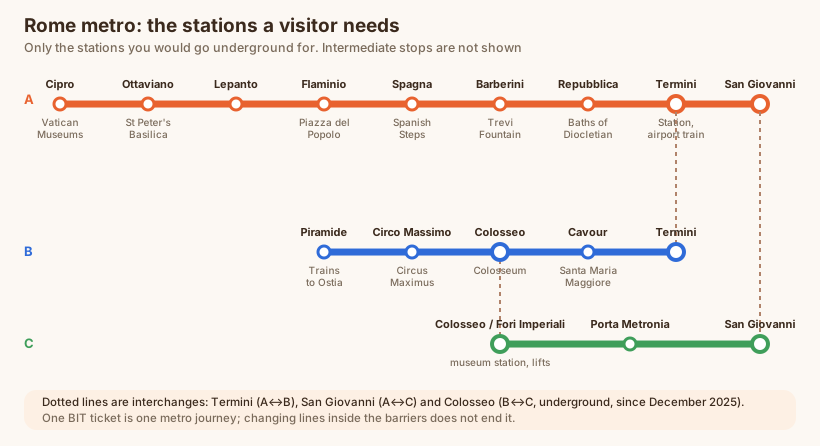
The Rome metro is small by capital-city standards: 73 stations on three lines. The reason is well known — there is archaeology under the city, and every new station turns into an excavation. But what exists works simply.
Which ticket to buy
One ticket covers everything: metro, buses, trams and city trains. It is called Metrebus, and at a kiosk you simply ask for a «BIT».
| Ticket | Price | Valid for |
|---|---|---|
| BIT, single | 1.50 EUR | 100 minutes |
| MULTIBIT for 2, 3, 5 or 10 journeys | 3.00 — 15.00 EUR | 100 minutes each |
| ROMA 24H | 8.50 EUR | one day |
| ROMA 48H | 15.00 EUR | two days |
| ROMA 72H | 22.00 EUR | three days |
| CIS, weekly | 29.00 EUR | 7 days |
The main rule of the BIT. The hundred minutes are about surface transport: within them you can change between buses and trams as often as you like. But it lets you into the metro once. Changing from line to line does not count as a journey as long as you have not passed back through the barriers; at San Giovanni you do have to pass through, and that is permitted by a separate clause of the rules.
Do the sums rather than buying a day ticket out of habit. A day ticket pays off from the sixth journey in a day. With children you will not travel that much: a child tires of interchanges faster than of walking in the street, and a real day in the centre is two or three journeys. Multi-day passes are worth buying only if you are staying a long way from the centre.
The MULTIBIT gives no discount: ten journeys cost exactly ten singles. Its only point is not having to queue at the machine every time.
You need not buy a ticket at all: the barriers have red readers where you tap a bank card or a phone, and the same 1.50 EUR is charged. Travellers report a daily cap on the card after which journeys are free, but ATAC does not confirm this officially — so it is not something to count on.

Children, pushchairs and one rule nobody writes about
Children under ten travel free — on the metro, buses and trams, if they are with an adult who has a ticket. No separate child ticket is needed, and the rules set no limit on how many children per adult.
Two caveats people trip over.
- On Trenitalia trains it is free only under four — including the airport express from Fiumicino. The ticket has the same name, the rule is different.
- A pushchair travels free only if it is folded. That is the literal wording of the operator's rules, not an inspector's spite. An unfolded pushchair is not allowed in the carriage by the rules, and at rush hour you will be reminded of it.
Hence the practical conclusion: the Rome metro is transport for a family with a child who already walks. With a pram that will not fold it is easier to walk or to take a bus, where folding is not required.
Hours and what to do after closing
The metro runs from 5:30 to 23:30, and on Fridays and Saturdays until 1:30 in the morning. The last train leaves the terminus, not your station, so allow a margin if you have to change.
After closing, night buses follow the same routes: nMA along line A, nMB and nMB1 along line B, nMC along C. The ticket is the same. This really is worth knowing in advance: working it out at midnight with a child in your arms outside a closed station is far worse.
Lifts: why there is no list of stations here
The commonest question from a family with a pushchair is where the lifts are in the Rome metro. The honest answer: a list of stations with lifts can be compiled, but it will be of no use. Lifts break and are repaired constantly, and a station where everything worked yesterday meets you with stairs today.
So the operator keeps a different and far more useful page — «Accessibility of metro stations». It lists what is out of service right now. Open it the day before you plan to travel.
As an example, here is what was closed on the day we wrote this article, 13 September 2026:
- Spagna — the lift and the inclined lift between Vicolo del Bottino and Trinità dei Monti were out. That is precisely the climb to the Spanish Steps people go there with a pushchair for.
- Termini on line A — the lift towards Laurentina, though there was an accessible way round through the line B platforms.
- Lepanto, Cornelia, Re di Roma, Subaugusta on line A and Ponte Mammolo on line B.
In a week this list will be a different one — which is the whole point.
And something few people know: assistance for passengers with reduced mobility can be booked in advance, and the stations offering it include ones a visitor needs — Ottaviano and Flaminio on line A, Colosseo and Circo Massimo on line B.
Two stations now serve the Colosseum
In December 2025 the station Colosseo / Fori Imperiali opened on line C. It is linked underground to the old Colosseo station on line B, so you can change without coming up to the street.
For a family this matters more than it sounds. The new station has four underground levels and is more than thirty metres deep, and its lifts run from the concourse down to the platforms. The station itself is built as a museum: what was found during the excavations is displayed right in the passageways, and it is the only stop in Rome where a child is interested before even reaching the surface.
From 18 September 2026 work is under way at the station: the lifts are being extended to the museum level so that pushchairs can reach it. While the work lasts, line C trains sometimes run only as far as Porta Metronia — check the «Tempo reale» section on the operator's site before you travel.
If you are heading for the Colosseum, it is worth sorting out the entry tickets in advance too: we have put together a guide to buying Colosseum tickets and what they include.

What else to know before your first descent
- The ticket must be validated. In the metro the barriers do it; on a bus it is the yellow or red validator by the door. An unvalidated ticket counts as no ticket, and the fine is collected on the spot.
- Line A is packed at rush hour. With a pushchair or a small child, between 8 and 9:30 and from 18 to 19:30, it is better not to try: it is not so much dangerous as pointless — you simply will not fit.
- Pickpockets work where it is crowded. Line A, the stretch between Termini and Ottaviano, and bus 64 are the places any Roman will warn you about. Nothing exotic: backpack in front of you, phone not in a back pocket.
- There may be no air conditioning. The older line A trains heat up in summer, and in July fifteen minutes underground is harder going than the same fifteen minutes walking in the shade.
We have nothing to offer on the subject of the metro — we run children's tours and quests, not travel passes. If you are planning Rome with children, have a look at all our Rome routes or our guide to where to go in Rome with children. And if the Trevi Fountain is on your list, note that since February the descent to the basin has been paid, and it costs 2 EUR.


