Contents 8
The ticket: the dome is only in the Brunelleschi Pass
There is no ticket for the dome on its own: since March 2022 the Opera has sold only combined passes. The dome is in one of them, and the other official way up is a guided tour run by the Opera. Tickets are sold at tickets.duomo.firenze.it and at the ticket office at Piazza San Giovanni 7. Florence Cathedral itself is free and needs no booking.
| Ticket | Includes | Adult | Ages 7–14 | Ages 0–6 |
|---|---|---|---|---|
| Brunelleschi Pass | dome, bell tower, museum, Baptistery, Santa Reparata | EUR 30 | EUR 12 | free |
| Giotto Pass | everything except the dome | EUR 20 | EUR 7 | free |
| Ghiberti Pass | museum, Baptistery, Santa Reparata | EUR 15 | EUR 5 | free |
| Opera guided tour of the dome (Italian and English) | dome climb with a guide | EUR 50 | EUR 30 | free |
How the Brunelleschi Pass works. When you buy, you choose a date and a time slot for the dome, and the pass is valid for three calendar days from that date. Only the dome has a fixed time: the bell tower, museum, Baptistery and Santa Reparata can be visited on any of the three days during opening hours. The slot cannot be changed or cancelled, and there are no refunds. You are asked to arrive no more than 5 minutes early, and you may be no more than 5 minutes late.
The pass is named, children’s included. Before paying you enter the first and last name of everyone going, free under-7s included, and Opera staff check them against ID at the dome entrance. Bring your children’s passports. One order is capped at 10 passes.
How fast the slots go. We opened the official ticket site on 6 October 2026. There was not a single dome slot left up to and including 21 October. On Thursday 22 October only the last entry, at 6.45 pm, remained, and the weekend of 24–25 October was sold out entirely. For Tuesday 27 October, three weeks away, the whole morning had gone; 1.30 pm and the evening from 5.15 pm were still free. The lesson for high season: book three to four weeks ahead, and earlier still for morning slots. It may be easier in low season, but do not count on it. The ticket office on the square will not save you: the Opera states plainly that it has no extra places and that online availability is final. Nor is there any “skip the line” for the dome — the time slot is what saves you the queue, and the Opera says third-party sellers promising skip-the-line entry are not authorised by it.
What the official rules say about children
- Under 18 — only with an adult. This applies to both the dome and the bell tower.
- Under 12 — hand held. The Italian version of the Opera’s rules states that children under 12 must be accompanied on the terraces by an adult aged 18 or over and held by the hand.
- No age ban. Tickets for ages 0 to 6 are free, but the child still needs a place in the same slot — book it together with your own. Private tours that include the climb often set their own “7 and over” limit; that is the operator’s rule, not the Opera’s.
- No pushchair, no rucksack. Pushchairs are not allowed on the terraces, and the narrow stairs settle the question anyway. Rucksacks, medium and large bags, parcels and suitcases must be left before the climb at the free luggage storage at Piazza Duomo 38/r (daily 7.30 am to 8.15 pm) — you will not be let in with them. There is a metal detector at the entrance.
- No eating or drinking inside. The Opera’s rules forbid it inside the monuments, so give your child a drink and visit the toilet before you go in.
- Footwear. Heels are advised against because of the steep, narrow passages, and climbing barefoot is forbidden.
How the climb goes
The entrance to the dome is the Porta della Mandorla, the cathedral’s north door on the Via dei Servi side. The Opera recommends allowing about 45 minutes for the dome; the climb itself takes most people twenty to twenty-five minutes.
- The lower section. Stone stairs inside the cathedral walls up to the base of the dome. The steps are ordinary, but it is dim, and overtaking or letting people past is awkward.
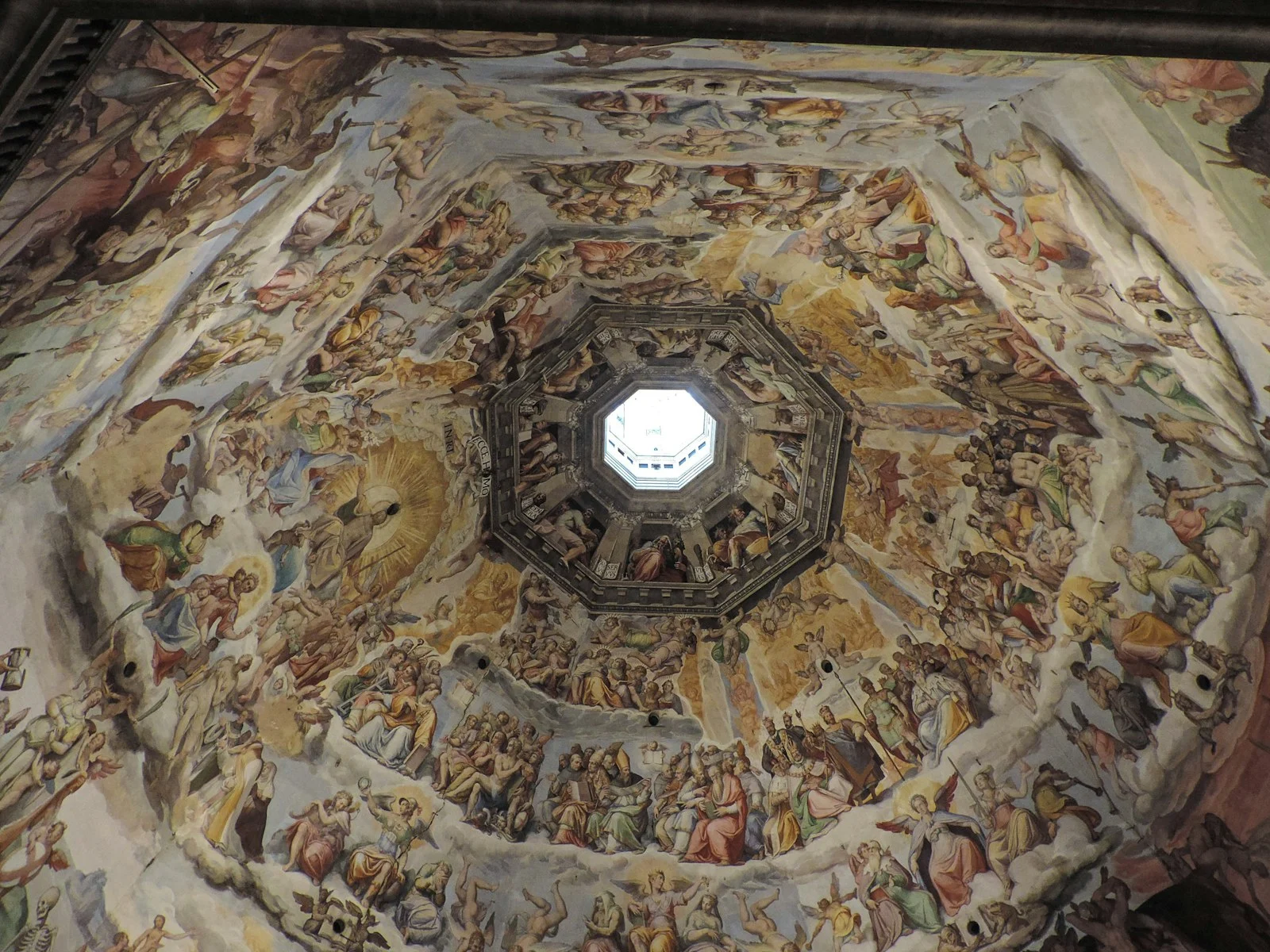
- The gallery round the drum. About halfway you come out onto a narrow balcony inside the dome, at the lower edge of the frescoes. Giorgio Vasari and Federico Zuccari’s Last Judgement, painted in 1572–1579, is a couple of metres away: from the cathedral floor the figures look tiny, but here the devils and sinners are life-size. The walkway is less than a metre wide and is separated from the drop into the cathedral by a transparent barrier taller than an adult. You go up along one half of the ring and come down along the other.
- Between the two domes. Then the stairs go into the gap between the inner and outer shells — working passages once used by the builders. In places the ceiling is low and adults have to stoop, and the walls curve with the vault. On some stretches the up and down flows share one passage, and one group waits against the wall while the other goes by.
- The final stretch is the steepest: high steps following the curve of the vault right under the lantern. This, visitors say, is where people who dislike tight spaces give up.
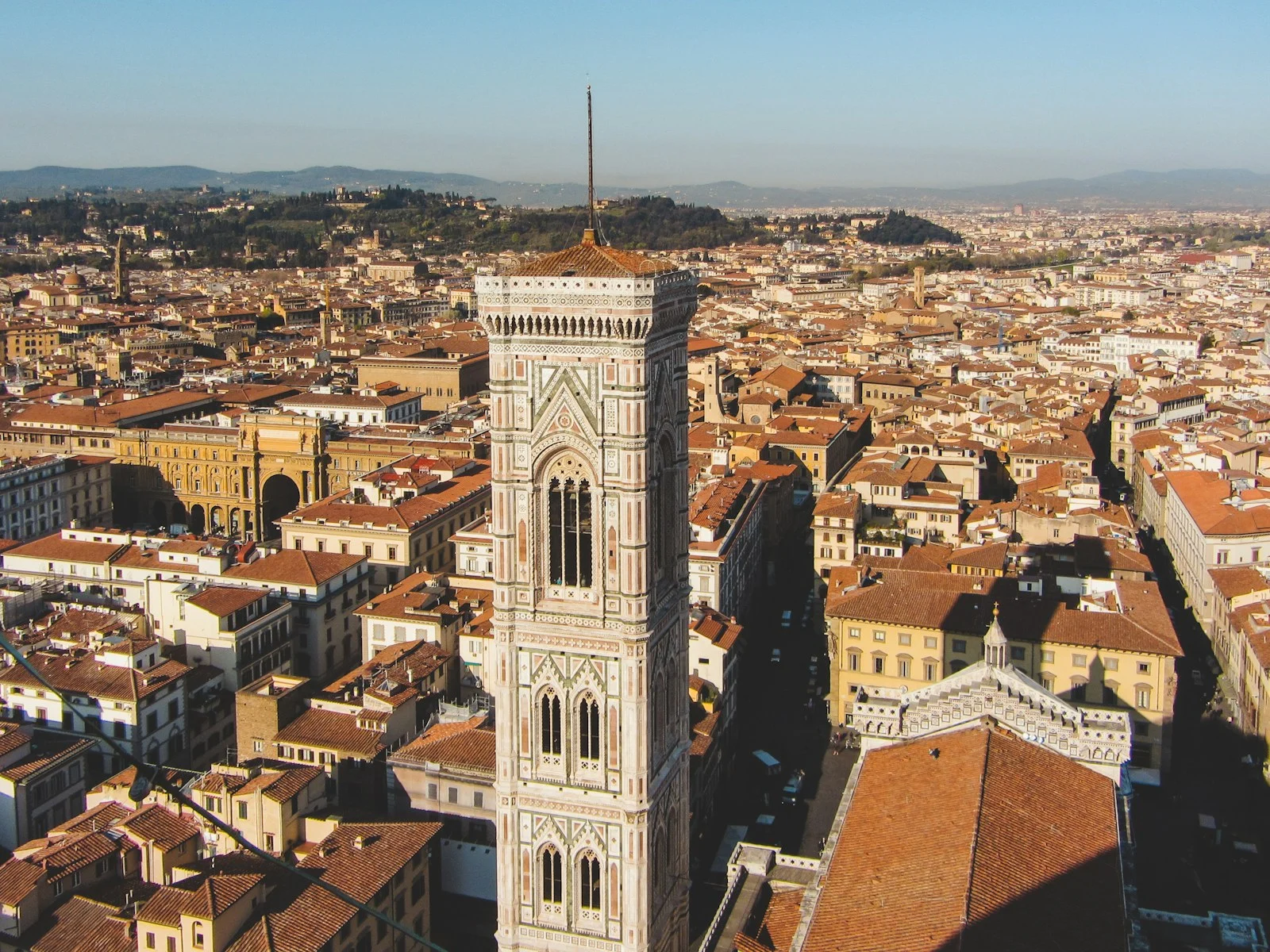
- The terrace at the foot of the lantern. A full circle of the city, Giotto’s Bell Tower from above and the Tuscan hills beyond the rooftops.
Coming down is on foot too — there is no lift on the way down either. After 463 steps, legs tire going down as much as going up: let your child stand on the terrace for a couple of minutes before starting back.
If your child runs out of steam halfway
There is no official exit point on the route, and the Opera says nothing about how to turn back. So it is best to decide in advance, section by section:
- Below the gallery the steps are ordinary; you can stand against the wall, rest and let people pass.
- The gallery is the last convenient place to change your mind. The way down also runs along it, so this is the easiest place to join the downward flow. If your child is whimpering on the gallery with the tight passages still ahead, turn round: you have seen the frescoes, and that is half the experience.
- Above the gallery turning back against the flow in a narrow passage is hard, and it is usually simpler to carry on calmly to the terrace and come down along the route. We would not carry a child in our arms on the upper section: the steps are steep and there is little room.
What helps them make it: a challenge to count the steps up to 463, finding the three-faced devil swallowing sinners on the gallery, and spotting from the top the bell tower they can climb tomorrow. And a fallback plan: if your child refuses at the door, one adult climbs the dome and the other takes the child to the museum or the bell tower — the Brunelleschi Pass gets you into those without booking on all three days.
Who should not climb
The Opera explicitly advises against climbing the dome and the bell tower for people with heart or respiratory conditions, vertigo or claustrophobia, and for pregnant women. For children we would add two signs: they are scared of small lifts or of the dark — or they are already tired by the third floor of an ordinary building. In hot weather, visitors report that it is stuffy between the shells, and in summer that can be harder than the climb itself.
Dress code. A detail most people miss: the Opera’s dress code applies only in the cathedral and the Baptistery, not on the dome or the bell tower. So shorts and a vest are fine for the climb. But if you want to go into the cathedral the same day (free, Monday to Saturday 10.15 am to 3.45 pm) or the Baptistery, shoulders and knees must be covered, and no flip-flops. It is easier to dress for everything.
Giotto’s Bell Tower: 414 steps and places to rest
The bell tower stands next to the cathedral and is almost as high: its top terrace is about 85 metres up, and people who have climbed both say the dome’s terrace is only about ten metres higher. The staircase, though, is a different matter.
| Dome | Giotto’s Bell Tower | |
|---|---|---|
| Steps | 463 | 414 |
| Lift | no | no |
| Where to rest | mainly on the gallery | three loggias in the upper half |
| Tight spots | passages between the shells, low in places | a staircase inside the tower, no low passages |
| View from the top | the city and the bell tower | the city and the dome itself |
| Ticket | Brunelleschi Pass, EUR 30 / 12 | Giotto Pass, EUR 20 / 7, or the Brunelleschi Pass |
| Time slot | compulsory | compulsory with the Giotto Pass, not needed with the Brunelleschi Pass |
| Recommended time | about 45 minutes | about 45 minutes |
On the way up the bell tower you pass the “Apostolica”, the largest of its bells, cast in 1401 and weighing 1,268 kg — a good stop with a reason for a child. Two caveats: the top terrace is enclosed by safety netting, and the bell tower is currently under restoration — the terrace is open, but the Opera warns that the view may be partly obscured.
Our view: with children aged five to eight, start with the bell tower. Bear in mind that the Brunelleschi Pass’s validity runs from the dome date, so “bell tower today, dome tomorrow” does not work on one pass. But on the dome day you can visit the other sites on the pass before your booked time: take an afternoon dome slot and climb the bell tower in the morning. If it went easily, you all do the dome; if it was hard, one adult goes up while the rest head calmly to the museum.
When to go
- Dome hours. Monday to Friday from 8.15 am, last slot 6.45 pm; Saturday, last slot 4.30 pm; Sundays and public holidays 12.45 pm to 4.30 pm. Slots start every 45 minutes. Closed on Easter Sunday, 25 December and 1 January, and there are occasional maintenance closures, which the Opera announces in advance in the ticket site’s FAQ.
- The first slot, 8.15 am, is the best with a child: it is cooler and there are fewer people on the stairs. But it sells out first.
- Winter evenings. From late November to January the sun sets in Florence at around five, so slots from 5.15 pm are in the dark: city lights instead of hills. Some children find that even better.
- Sunday is awkward: the dome opens only at 12.45 pm, and the cathedral is closed to visitors.
The pass’s three days are easy to split. If you have one day in Florence, put the dome in the morning and build the rest around it — how, we explain in what to see in Florence in one day. If you are coming from Rome just for the day, pick a slot no earlier than midday so the train does not leave you racing the clock — the journey itself is covered in how to get from Rome to Florence. With two or three days, a relaxed combination works well: “David” at the Accademia Gallery in the morning — it is about ten minutes’ walk from there to the cathedral — the dome in the afternoon, and the Uffizi the next day on the cheaper 4 pm entry.
How to explain to a child why the dome does not fall down
Start with the problem Brunelleschi had to solve. The cathedral was built, but above it was an eight-sided hole 45.5 metres across on the inside. Arches and vaults were then built on centring — wooden supports that hold the bricks until the mortar sets. But there were no timbers long and strong enough to carry a vault that size. The dome was built between 1420 and 1436, and Brunelleschi raised it without centring. It is still the largest brick-and-stone dome in the world. Three things your child will see with their own eyes on the climb:
- Herringbone brickwork. The bricks are laid in courses, and at regular intervals one brick is set on its edge. These upright bricks run in a spiral, like the pattern on a fir tree, and clamp each new course. Each course holds itself up as a closed ring and does not slide inwards while the mortar dries. In the passages between the shells you can see this brickwork up close.
- Two domes instead of one. The inner one is thick and carries the load; the outer one is lighter and keeps the rain off. They are tied together by 24 vertical ribs and 10 horizontal rings — like the frame of an umbrella. The stairs you are climbing run right between them.
- A weight on top. The 21-metre marble lantern presses down on the top of the dome and stops the vault from spreading outwards — just as Brunelleschi planned. He never saw it finished: he died in 1446. The golden ball on the lantern was put up by Verrocchio in 1471; the present one is an early 17th-century replacement.
If your child already knows why the Leaning Tower of Pisa does not fall, compare the two: the tower is held up by careful work with the ground beneath it, the dome by the way every brick was laid. For those who will not be climbing, the Opera runs a VR story of the build told by Brunelleschi himself, on Via degli Alfani — according to the Opera it is suitable for children aged 8 and over.
A tour-and-game for children in Florence
Three hours around the centre with Pinocchio: palace riddles, animals hidden in the architecture, Florence Cathedral from outside, Piazza della Signoria, the Ponte Vecchio and the bronze boar at the Mercato Nuovo. The quest does not climb the dome — it fits neatly in the morning, with a dome slot in the afternoon, so your child reaches the top already knowing what they are looking at.
EUR 250 per group of up to 5 · 3 hours · ages 6+ · we do not climb the dome, Opera tickets not included
Our other children’s routes around the city: all our tours in Florence.
Frequently asked questions
From what age can children climb Brunelleschi's Dome?
There is no official minimum age. The rule of the Opera di Santa Maria del Fiore is that under-18s must be with an adult, and children under 12 must have their hand held on the terraces. In our view the climb suits a child of about seven or eight who is confident on stairs and does not mind tight spaces.
How much does it cost to climb Brunelleschi's Dome?
The dome is only included in the Brunelleschi Pass: EUR 30 for adults, EUR 12 for children aged 7 to 14, free up to and including age 6. The other official option is the Opera’s guided tour of the dome: EUR 50, or EUR 30 for ages 7 to 14.
Do I need to book a time for the dome?
Yes. A dome time slot is compulsory and is chosen when you buy; it cannot be changed or cancelled. You may be at most 5 minutes late. In October 2026 the slots for the next two weeks were sold out, and the ticket office on the square has no extra places.
Is there a lift up Brunelleschi's Dome?
No. It is 463 steps up and back down on foot between the dome’s shells. The Opera recommends allowing about 45 minutes for the visit.
Which is better with a child, the dome or Giotto's Bell Tower?
With children of five to eight we would start with the bell tower: 414 steps, an ordinary staircase inside the tower, three loggias in the upper half where you can stop, and the dome itself in view from the top. The bell tower is included in the Brunelleschi Pass with no time slot needed.
Is there a dress code for climbing the dome?
No. The Opera applies its dress code only to the cathedral and the Baptistery, where bare shoulders, shorts above the knee and flip-flops are not allowed. Shorts are fine for the dome and the bell tower, but you may not climb barefoot, and heels are advised against.
Can I climb the dome with a rucksack or a pushchair?
No. Rucksacks and medium or large bags must be left before entry at the free luggage storage at Piazza Duomo 38/r, or you will be turned away. A pushchair cannot go up: the stairs are narrow, and pushchairs are not allowed on the terraces.