
Since 2 February 2026 it costs 2 EUR to come down to the basin of the Trevi Fountain. Looking at the fountain from the square is still free — and that is the first thing people confuse: you pay not for the view but for the descent to the water.
What exactly became paid
The square in front of the Trevi is built like a small amphitheatre. At the top, where the streets come in, stands the crowd with its phones. A few steps lead down, and there is the rim of the basin, the water a metre away and the very spot where coins are thrown. You only pay for the lower part.
- Free — the whole square above the steps. The fountain is visible in full from there, and the photograph works.
- 2 EUR per person — the descent to the basin.
The city explains the charge not by money but by crowding. In 2025 about nine million people passed by the fountain: thirty thousand a day on average, up to seventy thousand at peak. The square, meanwhile, is the size of a small courtyard.
The scheme runs until 31 December 2027, so it is not a one-season experiment.

When the charge applies and when entry is free
The charge does not run around the clock, and that is the most useful thing to know in advance.
| Day | Ticketed entry | When it is free |
|---|---|---|
| Tuesday — Thursday, Saturday, Sunday | 9:00 — 22:00 | all other hours |
| Monday and Friday | 11:30 — 22:00 | all other hours |
The third column is not a loophole but the official rule: outside those hours the fountain remains freely accessible to everyone. The ticket desk is simply closed, and people go down to the basin without a ticket.
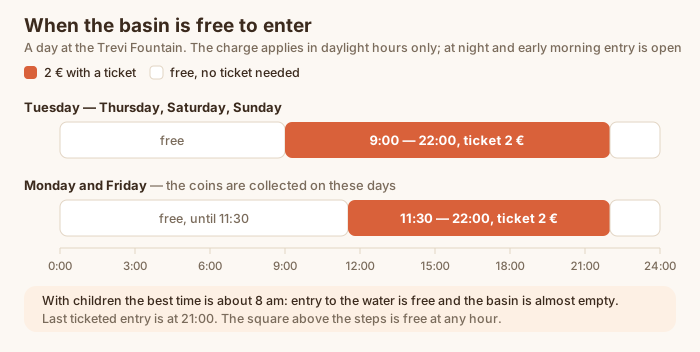
Monday and Friday open later than the other days, at 11:30. On those same days the coins are collected from the basin. Officially the two are not linked, but for you it means two and a half extra hours of free morning.
Children: free under six, full price after that
There is a single tariff at the fountain, and that is the main trap for families. Free entry applies to:
- children under 6;
- residents of Rome and the Metropolitan City, on production of an ID;
- people with disabilities and one companion;
- accredited guides.
A child from 6 to 18 pays the same 2 EUR as an adult. There is no child or school rate here at all.
A family of four with children of seven and ten will pay 8 EUR. The sum is small but unexpected: at the Colosseum and the Vatican Museums parents are used to free entry under eighteen and expect the same here. We covered in detail how to buy Colosseum tickets and why a child still needs one there — at zero price, admittedly.
Where to buy a ticket
- Online — fontanaditrevi.roma.it, the only official site.
- In advance in the city — municipal museums, tourist information points and partner desks. They take cash as well.
- On the spot — the desk at the entrance to the descent, card only. Cash is not accepted there.
The ticket is sold open: with no date or time. There is no slot to book as at the Colosseum — buy once and come on any day of your trip. The other side of that: the ticket cannot be refunded or exchanged.
There is no time limit at the basin. You can stand as long as you like, and with a child that matters more than it sounds: nobody hurries you along.
Are there fewer people
There are figures for the first three weeks. Between 2 and 22 February 2026, 167,791 people came down to the basin, of whom 158,352 held a paid ticket. The city collected 316,704 EUR.
Divide that and you get about 8,400 people a day against thirty thousand on average in 2025. Different areas were counted — the whole square before, only the descent now — but the order of the difference is clear: it has become several times freer by the water.
For a family with a child that, rather than the two euros, is the real news. In July it used to be almost impossible to reach the rim with a five-year-old in your arms: a dense crowd, selfie sticks and no chance of calmly throwing a coin. Now you can.

The coin: how to throw it and where the money goes
The ritual is simple: stand with your back to the fountain and throw the coin with your right hand over your left shoulder. One coin means you will return to Rome, two that you will find love, three a wedding.
The coins have nothing to do with the new charge; they are different money. The 2 EUR from tickets goes to the city for the upkeep of the monument and order on the square. The coins are lifted from the basin on Mondays and Fridays and passed to Caritas of Rome: food aid for families, canteens, shelters. The order of magnitude is about three thousand euros a day and a million and a half a year.
Children like this part best, and it also answers the awkward question of why anyone throws money into water. The coin your child throws will be somebody's dinner within a week.
What to show a child at the fountain
The Trevi is a rare Roman sight that needs no explaining: people simply like it. But ten minutes of delight run out, and after that you need hooks. What works is not dates but this.
- The water is eighteen centuries older than the fountain. It arrives along the Aqua Virgo aqueduct, built in 19 BC. Twenty-one kilometres, and it still works.
- Why «the virgin's water». By legend a girl showed the spring to Roman soldiers. That scene is carved on the fountain itself — you can find it with your eyes. A ready-made task: who spots the girl on the wall first.
- Why «Trevi». From the Latin trivium — a junction of three roads.
- The size. Twenty-six metres high — a nine-storey building — and forty-nine wide. The largest fountain in Rome.
- It is not a fountain but a facade. The Trevi is built against the wall of a real palace: instead of a grand entrance the building has water.
- The lovers' spouts to the right of the basin. Legend says a couple who drink from them will live in harmony into old age.
The fountain took thirty years to build, from 1732 to 1762. Nicola Salvi began it and Giuseppe Pannini finished it: Salvi did not live to see it open.
Tour and quest «The Formula of Italy»
Three hours through the baroque centre, where the Trevi is one stop rather than the only one. Children hunt for clues on Piazza Navona, at the Spanish Steps and on Piazza del Popolo, and work out why the city needs so many fountains and why the statues point in different directions.
250 EUR for a group of up to 5 · each further person +20 EUR · 3 hours · from age 6 · the 2 EUR charge for the descent to the basin is paid separately, buy the tickets in advance for the whole family
For older children there is a version of their own: «The Secrets of Rome» — the same district, but a serious conversation, from eleven.
Getting there and when to come
The nearest metro is Barberini, line A, about seven minutes' walk. The square is small and hemmed in by buildings: you cannot see the fountain until you come out right on to it. With children that is a convenient moment — ask them to close their eyes at the last corner.
The best time with a child is around eight in the morning. Access to the basin is free then, there is almost nobody by the water, and the light is soft. The second free window, after ten at night, is usually too late for a family, though the floodlit fountain is worth it if the child is holding up.

Before setting out you can see what is happening on the square right now: there is a live webcam at the fountain, free to watch. It shows at once whether to go now or wait an hour.
And if Rome is only just beginning for you, see our guide to where to go in Rome with children, and all our Rome routes.


