Contents 8
If you have one day and one museum in Florence, the Accademia is easier with a child than the Uffizi: one great statue and a short route. How it fits into the day is covered in our piece on what to see in Florence in one day, and the other big museum in our guide to Uffizi tickets.
Tickets
| Ticket | Price | What you get |
|---|---|---|
| Accademia Gallery | EUR 20 + EUR 4 booking | Entry at your chosen time |
| Under 18 | free | With proof of age; under-12s only with an adult |
| EU citizens aged 18–25 | EUR 2 | With passport or ID |
| Accademia + Bargello, 48 hours | EUR 26 + EUR 4 booking | Two museums instead of EUR 20 + EUR 12 separately |
| First Sunday of the month | free for everyone | No booking, one shared queue |
On 1 February 2026 the full ticket went up from EUR 16 to EUR 20, so figures in older guidebooks no longer hold. There is one official seller, B-Ticket, linked from the museum’s own site.
Tickets are issued in your name. You may be asked for a passport at the door so the name can be checked, and the free children’s ticket is only given against proof of age. Bring passports for the whole family, children included.
How to avoid the queue
- Book a time. That is your queue-skip — no need to pay resellers extra for “skip the line”.
- Avoid Tuesdays. The museum is shut on Mondays, and by its own figures Tuesdays and weekends are the peak days. Wednesdays and Thursdays are the calmest.
- First slot or lunchtime. Doors open at 8:15, and the museum says its quietest window is 1pm to 2.30pm.
- Skip the free Sunday with a family. Children are free anyway, and on that day booking is switched off and everyone queues together.
The Accademia is open Tuesday to Sunday, 8:15am to 6:50pm, last entry 6:10pm. It is closed on Mondays, 1 January and 25 December.
The rules people get turned away for
- Bags no bigger than 40 × 30 × 18 cm. There is no cloakroom at all, so there is nowhere to leave a large rucksack.
- Water: one bottle up to 500 ml. Food only if sealed and kept in your bag; a baby’s bottle is allowed.
- Photos are fine without flash or tripod. Selfie sticks are not let in.
- Drawing is allowed in pencil — bring your child a sketchbook.
- The toilets come only at the end of the route, on the lower floor. There is a baby-changing table. Go before you enter.
- Audio guide: EUR 6, against a deposited ID. The children’s version comes in Italian, English, French, German and Spanish.
What is inside and in what order
The route is short and leads you along: the Hall of the Colossus, the Gallery of the Prisoners, then David in his tribune. The rest is optional.
- The Hall of the Colossus. By the entrance stands Giambologna’s full-size clay model for the Rape of the Sabine Women. The marble version is in the Loggia dei Lanzi on Piazza della Signoria: if you pass it later, let your child recognise it.
- The Gipsoteca. A hall of hundreds of 19th-century plaster models. The dark dots on them are the marks of nails used as reference points to copy each model into marble.
- The musical instruments on the ground floor are the underrated room. There is a Stradivari viola from 1690, the oldest surviving upright piano (1739) and a psaltery made entirely of marble. You can hear the instruments at multimedia stations.
With a child we would skip the paintings upstairs.
The Prisoners: figures climbing out of the stone
The four unfinished statues in the corridor before David usually interest children more than David himself. Michelangelo made them for the tomb of Pope Julius II; the project was cut back and the figures stayed in his workshop. Until 1909 they stood in a grotto in the Boboli Gardens.
The Young Prisoner’s body is already out of the block, but the head is barely roughed out. Atlas still has his head entirely inside the stone. The surface is scored with grooves from a toothed chisel. Ask your child: is he climbing out of the stone or stuck in it? — and they will work out for themselves how a sculptor works.
David himself: why the block was called spoiled
With its base the statue is 5.17 m tall and weighs 5,560 kg. That is taller than three adults standing on each other’s shoulders.
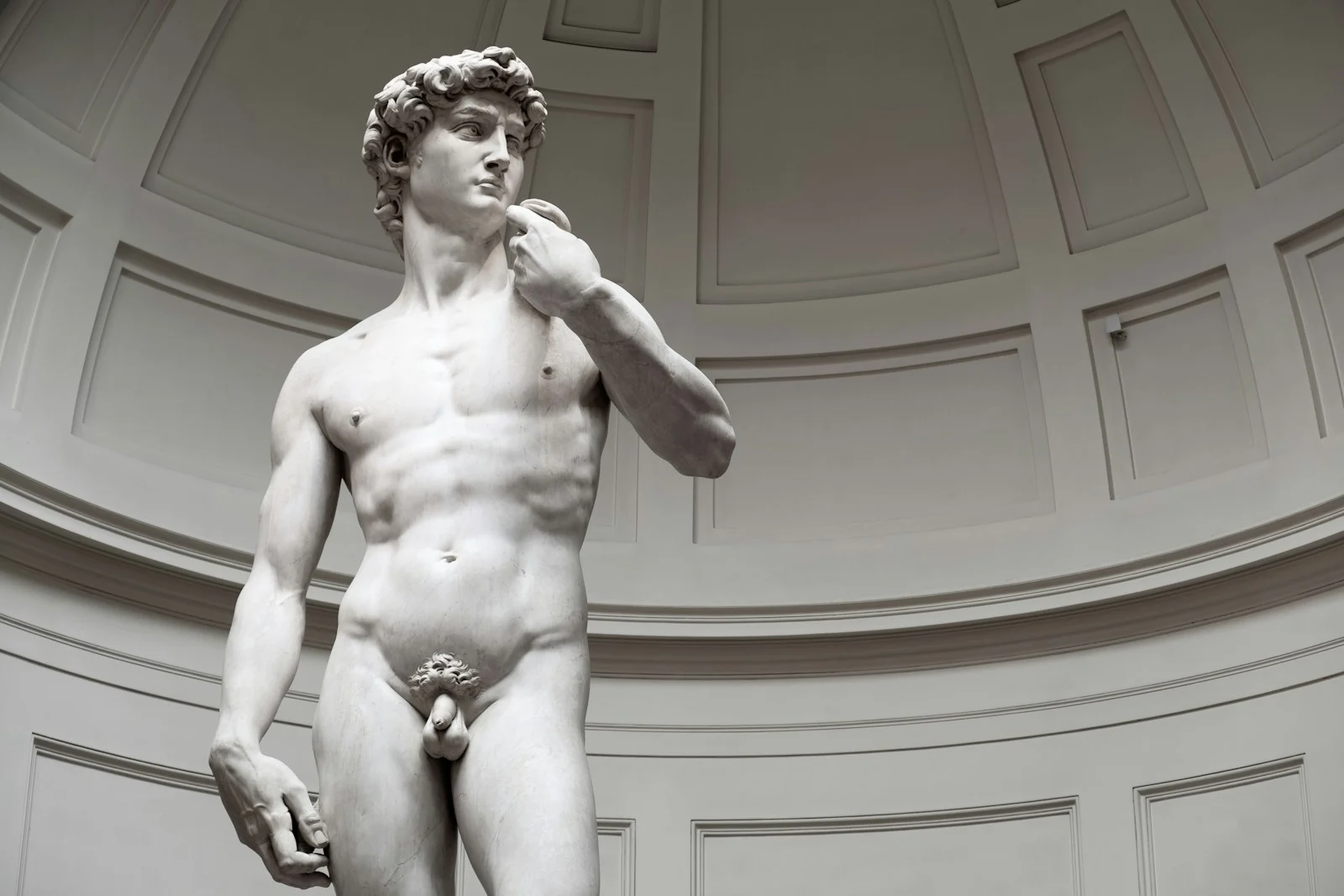
The block of Carrara marble was first worked in the 1460s by Agostino di Duccio, then by Antonio Rossellino. Both gave up, and the narrow, already-hacked stone lay in the cathedral yard for around twenty-five years. Florentines nicknamed it the Giant. Michelangelo, aged 26, got the commission on 16 August 1501 and fitted his figure into what was left.
The statue was meant for a buttress of the cathedral, high off the ground. But in 1504 a committee that included Leonardo da Vinci and Botticelli decided to put it by the entrance to Palazzo Vecchio. At the time, parts of David were gilded: the garland on his head, the tree stump behind his leg and the sling.
The statue stood outdoors for three and a half centuries, and in 1527 its left arm was smashed during a riot. In August 1873 David was taken to the Accademia — and waited nine years in a wooden crate while a tribune was built for him.
Why the statue is protected from vibration. In 2014 Italy’s National Research Council and the University of Florence found micro-cracks in the left ankle and in the stump that takes part of the weight. Five and a half tonnes of marble stand on slender legs, with crowds passing every day. Running in the museum is banned by the rules — one rule that is easy to explain to a child.
What to look for on David with a child
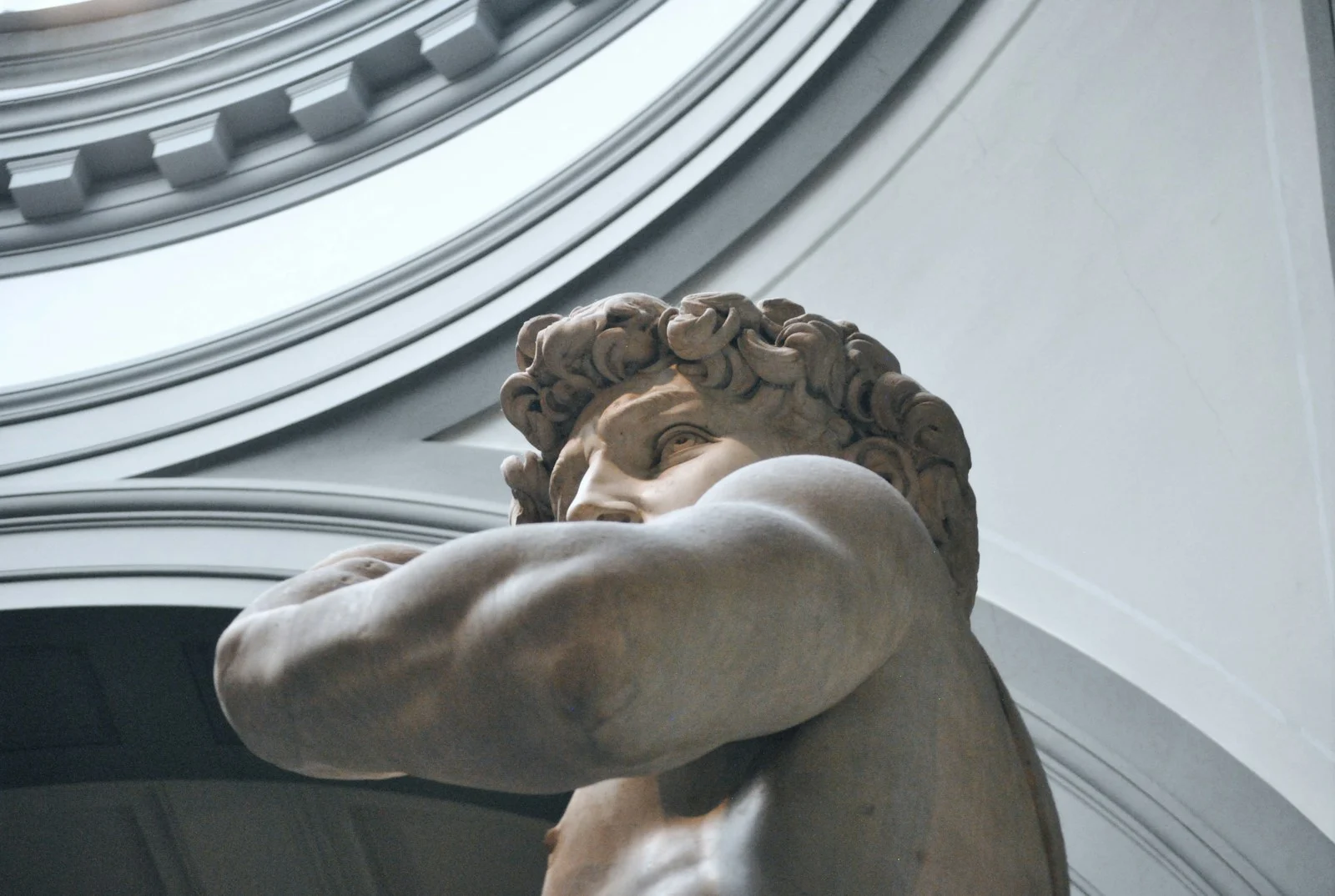
- Proportions. The head and right hand are noticeably larger than they should be. Ask why. One explanation: the statue was meant to stand high on the cathedral, and from below a big head and hands read better.
- Where the sling is. You can hardly see it: the strap runs over his left shoulder and down his back. Walk round behind and find it.
- Where the stone is. It is in his lowered right hand. Let your child spot it — from the front it is easy to miss.
- Where he is looking. Brows drawn, eyes to the left. This is David before the fight, not after the victory: Goliath has only just appeared.
- Veins. You can see veins on the right hand. Ask how stone can be made to look warm.
The three Davids of Florence
- The original — the Accademia Gallery. Marble under the tribune’s light; you can get fairly close and walk all the way round.
- The copy in Piazza della Signoria. Luigi Arrighetti’s marble copy has stood since 1910 exactly where the original stood until 1873. Free, at any hour.
- The bronze on Piazzale Michelangelo. Cast by Clemente Papi in 1866 and put up on the terrace in 1875. Dark green, on a tall plinth above the city.
If you show your child all three, ask at the copies how they differ from the original — let them look for themselves, using the questions above. And the Bargello has Donatello’s bronze David — after the victory, with Goliath’s head at his feet. The 48-hour Accademia + Bargello ticket is made for exactly that comparison.
A tour-and-game for children in Florence
Three hours on foot round the centre with Pinocchio: riddles of old palaces, animals hidden in the architecture and the story of gelato. The route takes in the cathedral of Santa Maria del Fiore, Piazza della Signoria with its David, the Ponte Vecchio and the market with the bronze boar. The Accademia is not on the route — we would fit it in the morning, before the quest.
EUR 250 per group of up to 5 · 3 hours · ages 6+
Frequently asked questions
How much is a ticket to the Accademia Gallery in Florence?
A full ticket is EUR 20, and booking an entry time adds EUR 4. Under-18s go in free; EU citizens aged 18 to 25 pay EUR 2.
Where is the original David in Florence?
The original has stood in the Accademia Gallery on Via Ricasoli since 1873. The marble statue in Piazza della Signoria is a 1910 copy, and the bronze on Piazzale Michelangelo is a 19th-century cast.
How long do you need at the Accademia Gallery?
With a child an hour is enough: David, the Prisoners and the musical instruments. The museum itself suggests around an hour and a half if you also take in the paintings upstairs.
Can you take photos of David?
Yes, for personal use and without flash. Tripods and selfie sticks are not allowed in.
Can I bring a backpack into the Accademia Gallery?
Only a small one, up to 40 × 30 × 18 cm. There is no cloakroom, and large rucksacks and suitcases are turned away.
When is the Accademia Gallery free?
On the first Sunday of every month. Booking is switched off on those days and everyone waits in the same queue, so with children we would avoid it.
Do I need to book the Accademia Gallery in advance?
Yes: the museum itself warns that the wait without a booking can be long. Booking costs EUR 4 and gets you in at a set time.