Contents 7
What is free: the courtyards and their stories
You do not have to “buy” the whole castle. The courtyards are public space — Milanese walk through them to get to the park — and there are enough stories here for the first hour. Go in through the main gate under the tall tower on the Piazza Castello side.
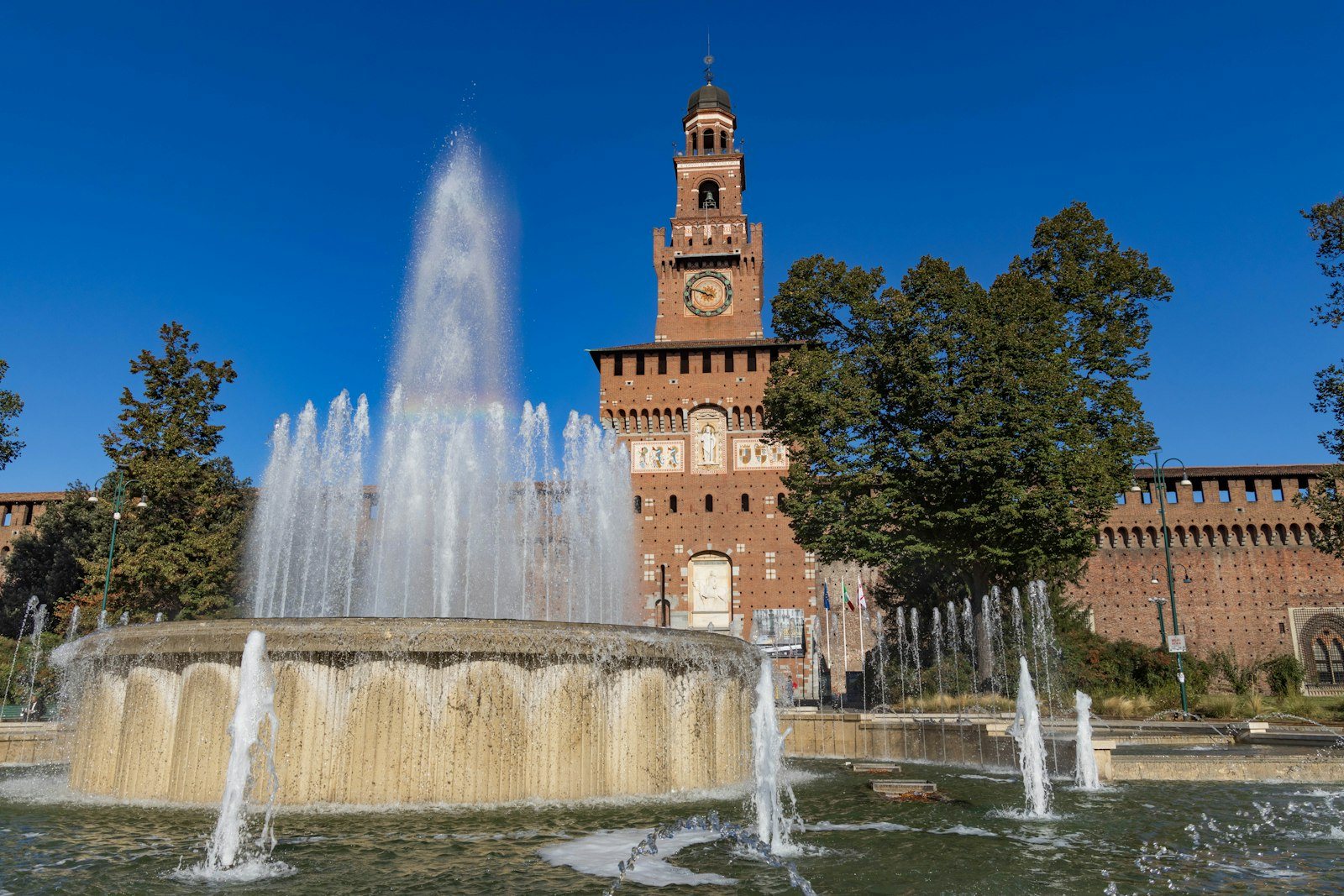
- The Filarete Tower. It was designed in 1452, and in June 1521, after it had been turned into a gunpowder store, it collapsed. The one you see today was rebuilt from old drawings and opened in 1905. Children usually enjoy the question: “Do you think this tower is 570 years old, or 120?”
- The Cortile delle Armi is the huge first courtyard. Along one wall lie Roman stone sarcophagi from the 3rd–4th centuries and fragments of statues, brought here from demolished buildings around Milan. Towards the next courtyard you can see the old medieval moat, known as the “dead moat”.
- The Corte Ducale is the courtyard where the dukes lived. Under the arcade at its entrance is the “elephant portico”: you can still make out a painted elephant on the wall, and on the wall next to it the paw prints of another large animal, probably a lion. Finding both is a good task for a child. There was also a staircase here with low steps, so that Duke Galeazzo Maria Sforza could ride up to his rooms on horseback.
- The Rocchetta is a “fortress within the fortress”, with blank, windowless walls on the outside. After Duke Galeazzo Maria was stabbed by conspirators on 26 December 1476, his widow, Bona of Savoy, moved in here and added a tall tower so she could watch the whole castle. It is a story worth telling your child before you go up on the walls.
The moat around the castle is dry, but from the bridges you can see how deep it was. On the park side there was once another wall, the Ghirlanda, with its own moat fed by water from a navigli canal. What survives of it are underground passages — more on those below.
For a four- or five-year-old this may be enough: half an hour running round the courtyards, the bridge, the moat and the tower, then the park. With an older child the courtyards are a warm-up for the museums.
Museum tickets: free for children, EUR 10 for adults
There are nine museums inside the castle, all on one ticket. On 10 May 2026 the City of Milan doubled the price from EUR 5 to EUR 10, so you will be seeing the old figure in guidebooks and reviews for a while yet.
- Full ticket — EUR 10. Valid all day for all the museums, including the Ancient Egypt Gallery, with one entry into each section.
- Reduced — EUR 5: for visitors aged 65 and over, university students, and EU citizens aged 18 to 25.
- Free — children and teenagers up to 17, and a disabled visitor plus one companion.
- First Sunday of the month — free for everyone, but these tickets are not issued online, only at the desk. Expect a queue.
- Second Tuesday of the month — free for anyone up to 25.
The free Tuesdays after 14:00 that many websites still mention are the old rules and no longer apply.
One small but important point: your child needs a ticket too, just a EUR 0 one. Online it is the “omaggio” option; at the desk they will issue it with yours. Age can be checked, so bring your child’s ID or a copy on your phone. The online shop sells up to nine tickets per order.
Opening hours: the museums are open Tuesday to Sunday, 10:00 to 17:30, and closed on Mondays. The ticket office closes at 16:30, which is also the last entry to each section. The museums are also closed on 25 December, 1 January and 1 May.
A family trick: the ticket is valid all day, with one entry into each section. So you can see the mummies and the armoury in the morning, go out to the park for lunch, and come back for the musical instruments in the afternoon. Just do not try to enter the same section twice.
If you are also planning the Natural History Museum with its dinosaurs (another civic museum, also EUR 10 since May 2026), look at the annual Milano Museo Card for EUR 15. It is issued in your name, gives free entry to all the civic museums, and pays for itself by the second museum. For short stays there is also the Tourist Museum Card at EUR 20 for three consecutive days.
What to see inside with a child
No child will manage all nine museums in one go, and most adults will not either. Pick two or three by interest. Here is what usually works with children, starting with the safest bet.
The Ancient Egypt Gallery (Galleria Antico Egitto). The surest choice: sarcophagi, amulets, figures of gods with animal heads, little ushabti statuettes meant to do their owner’s work in the afterlife, and real mummies. There is also a statue of Pharaoh Amenemhat III, almost four thousand years old. Note that the castle’s audio guide does not cover this gallery.
The Armoury (Armeria, room XIV in the Museum of Ancient Art). European swords, daggers and firearms from the late 14th to the 19th century — the “knights” part that wins many children over to the castle. A tip: before you go in, ask your child how a fighting sword differs from a ceremonial one, and let them find an example.
The Museum of Musical Instruments. Around 900 instruments from all over the world: a huge double virginal, early violins, oboes. Teenagers are often most taken with the last room — the equipment of Milan’s RAI electronic music studio, which ran from 1955 to 1983. These are cabinets full of knobs and cables that made “music from machines” long before computers.
Michelangelo’s Rondanini Pietà. The master’s last sculpture: he worked on it for the final ten years of his life and never finished it. It stands in the former Spanish Hospital, where in the 16th century sick soldiers were treated, plague victims among them. Small children will be bored here, but a ten-year-old can see what a genius’s unfinished work looks like: one arm polished smooth, the figure beside it barely roughed out of the stone. Walk all the way round — it is displayed so you can see it from every side.
Leonardo da Vinci’s Sala delle Asse is the room where Leonardo painted the ceiling as a bower of sixteen mulberry trees with intertwined branches and ropes. As of October 2026, according to the castle’s official website and ticket shop, the room is closed for restoration. If your child is set on Leonardo, look at the digital exhibitions about the room on the castle’s website beforehand, and go to Santa Maria delle Grazie for the real thing: we have a separate guide to getting in to see The Last Supper.
To keep your child from just trailing after you, use the castle’s free materials. The official website offers the Kit EduCastello: colouring pages, a cut-out paper castle, puzzles, Leonardo riddles, a memory game and board games, all led by a character called Ludovico, a descendant of Duke Ludovico il Moro. There is also a printed children’s guide, available at the castle Infopoint or to download from the website. The materials are in Italian, but the games and pictures work without the language. Print a few pages at home — for a seven-year-old it beats any audio guide.
For adults there is an audio guide in six languages, English included, for hire at the bookshop by the museum entrance for EUR 5. And every Saturday at 11:00 there is a walk-in guided tour of the museums in English, meeting at the Infopoint at 10:45; the price, around EUR 20, includes the museum ticket.
Walking the walls: the Merlate Panoramiche
Yes, you can walk the castle walls, and since 2024 you can do it without a tour. The route is called the Merlate Panoramiche: a section of the old sentry walk between the battlements. From up here you can see how the defences worked, and beyond the walls the rooftops and skyscrapers of Milan.
- Length and weather. About 300 metres, all of it under a roof, so you can go in the rain. Eight points along the way have panels in Italian and English.
- Getting up. You climb the grand staircase in the Rocchetta courtyard — more than 100 steps. There is a separate lift for pushchairs and anyone who finds stairs difficult.
- Hours. Tuesday to Sunday from 10:00, last entry 17:00. Visitors go up in groups of up to 25 every 15–20 minutes with a member of staff, without a guide.
- Tickets. EUR 10, or EUR 5 reduced, not included in the museum ticket. Free for children up to 5, but those tickets are issued only at the desk in the castle Infopoint, not online. According to press reports, the EUR 5 reduced ticket applies to everyone under 18 and over 65; the official page does not list the reduced categories for the walls, so check at the desk.
An honest word about small children. The rules forbid carrying a child on your shoulders or leaning over the parapet, and the castle itself warns that in places the parapet is high and short children will struggle to see the view. For a three- to five-year-old this is a walk down a “corridor with walls” rather than a viewpoint. From about seven, once a child can reach the gaps between the battlements, it becomes the real “I’m a knight on the walls”.
Besides the self-guided walk, Ad Artem, the company that runs tours at the castle, offers guided tours of the walls and of the Ghirlanda underground passage. That is a brick corridor with a vaulted ceiling 2.80 metres high and loopholes looking onto the moat, through which soldiers could slip out of the fortress unseen. There are also game formats — “Merlate in gioco: Leonardo’s riddle” on the walls and a murder mystery in the tunnels, an hour each. Age limits are strict: 8 and over for the walls tour, 10 and over for the tunnels, where they suggest bringing one torch for every two people. Schedules change month by month; in autumn 2026 tours ran mainly at weekends, with evening specials at Halloween. Judging by the descriptions, the tours and games are in Italian, so they suit teenagers with at least some of the language.
What it costs a family of four
Two adults and children aged eight and twelve, on an ordinary day.
| What | Adults | Children aged 8 and 12 | Total |
|---|---|---|---|
| Castle courtyards | EUR 0 | EUR 0 | EUR 0 |
| Castle museums, ordinary day | 2 × EUR 10 | EUR 0 | EUR 20 |
| Museums, first Sunday of the month | EUR 0 | EUR 0 | EUR 0 |
| Walls (Merlate Panoramiche) | 2 × EUR 10 | 2 × EUR 5* | EUR 30 |
| Museums + walls | EUR 50 |
If you can only do one and your children are under seven, choose the museums: Egypt and the armoury cost EUR 20 for two adults, and the children go free. If they are eight or older and have already seen mummies elsewhere, the walls give you something no museum can.
Planning your visit
The metro is easiest. The nearest station is Cairoli (red line M1), which brings you out right by the Filarete Tower. Lanza (green M2) and Cadorna FN (M1 and M2) also work — Cadorna is where the Malpensa Express from the airport arrives. From the cathedral square it is about a kilometre along Via Dante, a straight, car-free pedestrian street.
A handy order for half a day:
- 10:00 — straight to the ticket desk before the groups arrive. Start with the Ancient Egypt Gallery while your child is fresh.
- 11:00 — the armoury and one more museum of your choice: musical instruments or the Pietà.
- 12:00 — the walls, if you have a ticket. Last entry is 17:00, so they can move to the afternoon.
- 12:30–13:00 — the courtyards on your way out to the park: the elephant, the moat, the Rocchetta.
- Then — Parco Sempione, lunch and the playgrounds.
A rough guide by age:
- 4–6: the courtyards, the moat, the bridges and the Egypt gallery. With a pushchair you can go up on the walls by lift, but much of the view will be hidden behind the parapet.
- 7–10: mummies, the armoury, the walls, and the colouring pages and puzzles from the EduCastello kit. From eight, consider the guided walls tour.
- 11–14: all of the above plus the Pietà, the electronic music room and, if your child understands Italian, the Ghirlanda tunnels from age 10.
If you only have a day in Milan, the castle fits between the cathedral and The Last Supper. How to link them into one route is in our guide to what to see in Milan in one day. The history of the fortress itself, from the Visconti to the present day, is on our Sforza Castle page.
After the castle: Parco Sempione
The castle’s back gate opens straight into Parco Sempione, the best-known park in central Milan, with lawns, a pond and trees where children can finally run without being told “shh, it’s a museum”. There are playgrounds in the park — the main reason to end the day here.
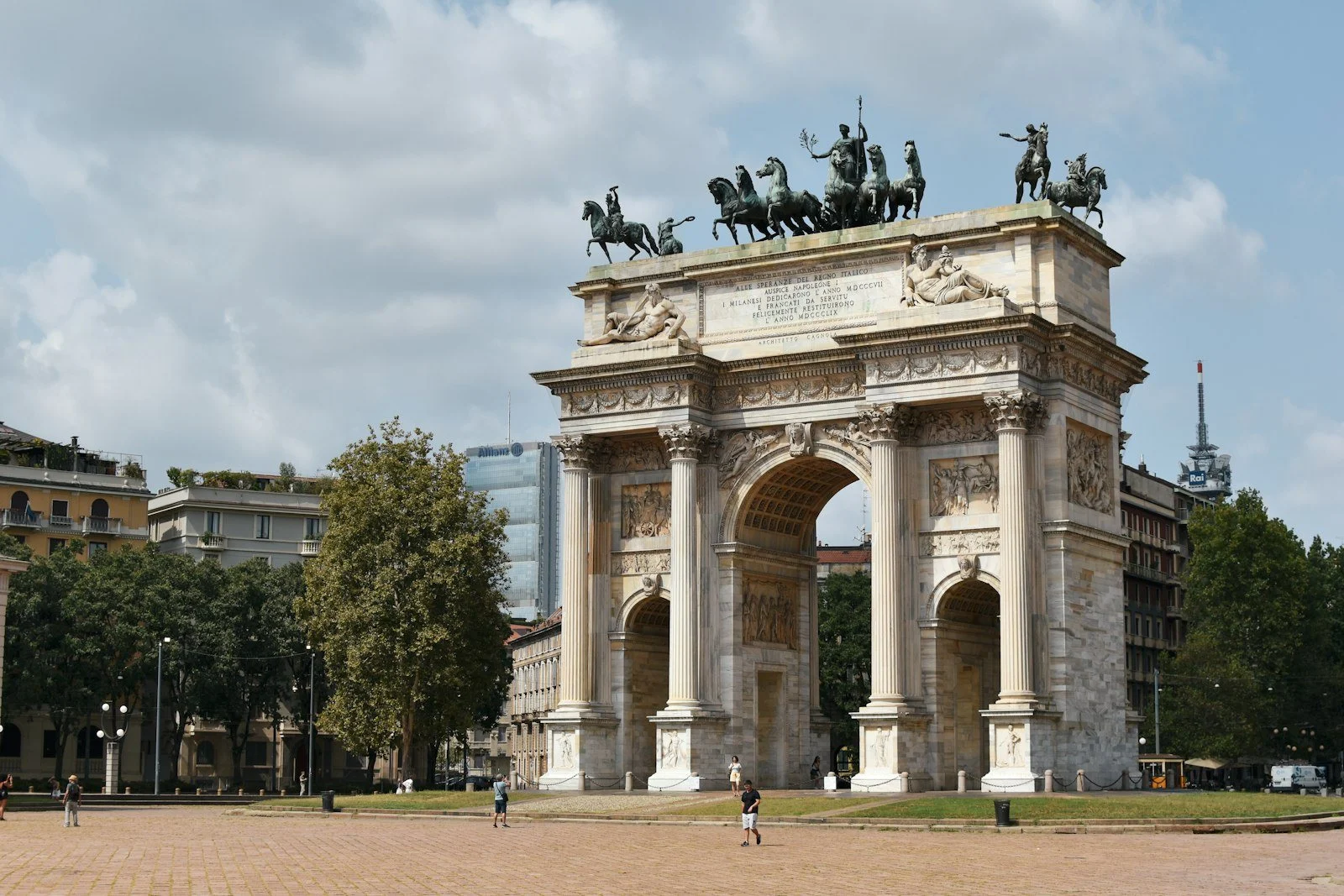
- The Arco della Pace stands at the far end of the park, directly opposite the castle, across the full length of the lawns. Walking there makes a good goal: on top of the arch is a bronze chariot drawn by six horses, easy to see from below.
- The Civic Aquarium (Acquario Civico) is a small aquarium in an Art Nouveau building on the edge of the park, right by the castle. Separate ticket.
- The Torre Branca is a steel observation tower in the park near the Triennale, with a lift to the top. Hours vary with the season, so check before you go.
If energy is low after the museums, just head for the nearest playground and rest there. That is enough to make a day at the castle one your child remembers fondly.
“Milan for Kids” sightseeing tour
A playful walk around the historic centre: children hunt for secret signs on the walls, solve riddles and observation challenges, while adults learn things no guidebook mentions. The route takes in Milan Cathedral, the Galleria Vittorio Emanuele II and Sforza Castle, with stories of Leonardo, knights and the plots its walls remember. The castle museums are not mentioned in the tour description: if you want the mummies and the armoury, leave time for them afterwards — children get in free anyway.
EUR 260 per group of up to 5 · 3 hours · ages 6+
Our other routes and workshops in the city are on the page tours in Milan.
Frequently asked questions
How much does it cost to enter Sforza Castle in Milan?
The courtyards are free for everyone. A single ticket for all the castle museums, including the Ancient Egypt Gallery, has cost EUR 10 since 10 May 2026, or EUR 5 reduced. Children and teenagers up to 17 go free, but they still need a EUR 0 “omaggio” ticket from the desk or online.
Can you visit Sforza Castle for free?
Yes. The courtyards, the square in front of the castle and the way through to the park are open free of charge every day from 7:00 to 19:30. The museums are free for everyone on the first Sunday of the month, and for anyone up to 25 on the second Tuesday. The free Tuesday afternoons mentioned in older guidebooks no longer exist.
Do children go free into the Sforza Castle museums?
Yes, everyone up to 17. The battlement walk (Merlate Panoramiche) is a different matter: it is free only up to the age of 5; for older children, according to press reports, a reduced EUR 5 ticket applies.
Can you walk on the walls of Sforza Castle?
Yes. The Merlate Panoramiche is a self-guided walk of about 300 metres along the covered sentry walk, Tuesday to Sunday, last entry 17:00. Tickets are EUR 10, or EUR 5 reduced, and are not included in the museum ticket. There is a lift for pushchairs.
How long do you need at Sforza Castle with a child?
The courtyards take 30–40 minutes. Courtyards plus two or three museums take 2–2.5 hours. Add the walls and a stroll in Parco Sempione and it is half a day. Nobody does all nine museums in one go with a child, and there is no need to.
Is Leonardo's Sala delle Asse open?
Not as of October 2026: the castle’s official website and ticket shop say the room is closed for restoration. For now the ceiling can only be seen in the digital exhibitions on the castle’s website.
Is Sforza Castle open on Mondays?
The courtyards are open every day, Mondays included. The museums, the ticket office and the battlement walk are closed on Mondays. The museums are also closed on 25 December, 1 January and 1 May.